

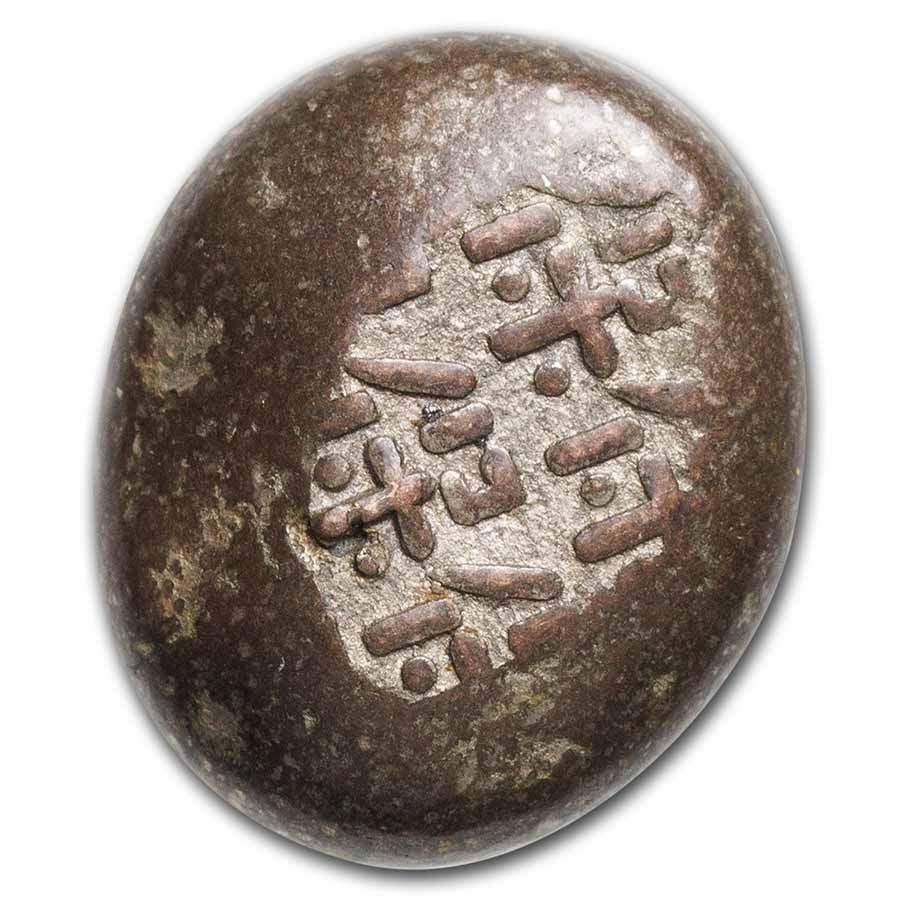
Japan Billon Mameitagin "Bean Money" (Small)
Japan Billon Mameitagin "Bean Money" (Small)
In the landscape of historical currency, few pieces capture the imagination quite like the Japanese Mameitagin, commonly referred to as bean money. Circulated from the seventeenth century through the middle of the nineteenth century, these unusual silver alloy pieces depart entirely from the traditional flat, circular shape of Western coinage, offering instead a tactile, organic form reminiscent of small beans. Because these pieces were valued by weight rather than a fixed denomination, their physical characteristics vary significantly. Individual specimens typically weigh between 2 and 5 grams, containing approximately 0.0300 troy ounces of silver. The silver purity and overall weight fluctuated over the decades of production, reflecting the shifting economic conditions of the era. The surface of a Mameitagin coin tells a story of official validation. The obverse side is stamped with specific treasury marks and era identifiers, which authorized the piece for commerce. In contrast, the reverse side remains a rough, unadorned blank, showcasing the raw, cast nature of the metal. These small, irregular objects provide a fascinating window into the monetary systems of pre-1800 Japan.
Fair market value
Member valueSee live fair market value on all 26,000+ coins with a free account.Sign up freeLog in
Prices shown are estimated fair market values based on live spot prices and typical dealer ask premiums. They are provided for informational purposes only and are not an offer to buy or sell. The price a dealer will pay for an item (bid) is typically 10–20% below the values shown, depending on the item, its condition, and current market conditions.
Specifications
| Country | Japan |
|---|---|
| Grade | Genuine |
| Metal | Silver |
| Weight | 0.0300 troy oz |
| Thickness | N/A mm |

Coins you visited
Quick access to coins you've looked at recently.
Coins you saved
Quick access to coins you saved.