
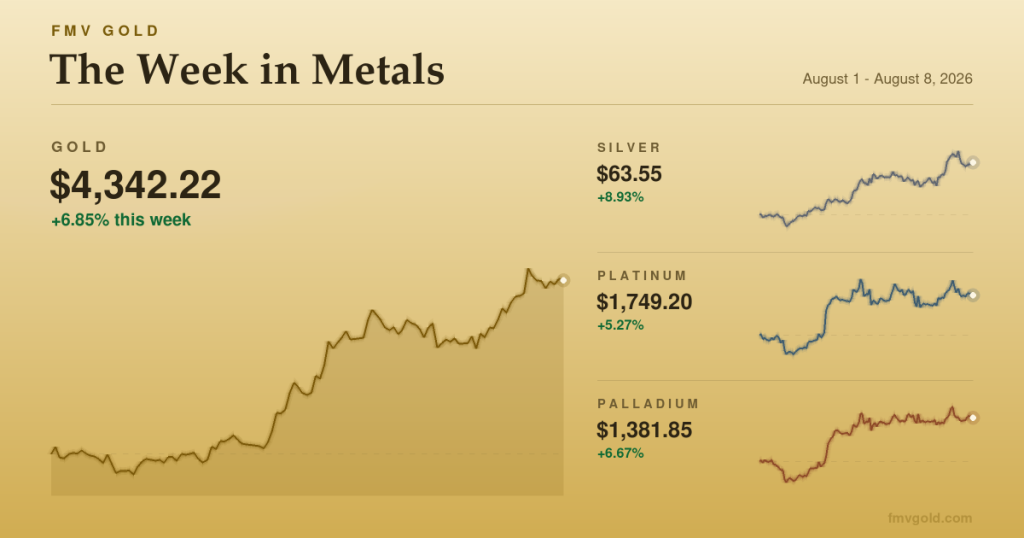
Monday looked like more of the same. Gold slid to $4,026 an ounce in early New York trading, silver dipped under $57, and the story that had run all summer, oil-driven inflation keeping the Federal Reserve in a tightening mood, appeared fully intact. Then the Strait of Hormuz started to open, crude started to fall, and on Friday morning the Labor Department handed traders a jobs report nobody had penciled in. Gold closed the week at $4,342.22 an ounce, its largest weekly gain anywhere in our one-year archive. Silver did better than that.
The week in numbers
- Gold: up about 6.5% on the week, with a high of $4,370.79 Friday midday and a low of $4,026.40 Monday afternoon.
- Silver: up about 8.5%, running from a Monday low of $56.63 to a Friday high of $64.96.
- Platinum: up about 5.0%, high of $1,783.41 on Wednesday, low of $1,613.69 on Monday.
- Palladium: up about 6.5%, high of $1,406.10 Friday, low of $1,246.81 Monday.
The stories that moved the market
The week began where the last one ended, with rates winning. Every metal on our board printed its weekly low within a half hour of each other on Monday afternoon, gold at $4,026 and silver at $56.63, as traders held to the view that a closed shipping lane and expensive crude would keep the Fed leaning hawkish. Two weeks earlier the central bank had left its target range at 3.50% to 3.75% amid three dissents in favor of a quarter-point increase, and Chair Kevin Warsh had described the decision as a rigorous review rather than a pause. Futures markets went into August pricing roughly 61% odds of a hike in September.
Tuesday cracked that consensus, and Wednesday broke it. Reports emerged that Washington and Tehran were close to an agreement reopening the Strait of Hormuz, with Treasury Secretary Scott Bessent suggesting a deal could land within the day. West Texas Intermediate slid toward a three-week low near $74 a barrel. What followed was less a safe-haven bid than a disinflation trade: cheaper energy meant a cooler inflation path, a cooler inflation path meant fewer rate increases, and metals that pay no interest do their best work when the rate case against them weakens. Silver gained roughly 3.5% Wednesday to a monthly high, and platinum put on close to 6% in a single Tuesday session.
By Thursday gold had cleared $4,300 for the first time since mid-June and then spent the day going sideways, trading between roughly $4,225 and $4,304 as negotiators worked toward a partial reopening rather than a full one. That patience lasted until 8:30 Friday morning.
The July employment report showed the American economy shedding 23,000 jobs against a forecast for a gain of about 80,000. The unemployment rate actually edged down to 4.1%, but labor-force participation slipped to 61.4%, a five-year low, and downward revisions to prior months pulled the trailing twelve-month average down to roughly 34,000 jobs a month. Odds on a September increase fell to about 44%, from that 61% reading of ten days earlier. Gold ran to $4,370.79 by midday and gave back only a portion of it. Silver touched $64.96, its best level in six weeks, before easing into the close. In the space of five sessions the market had gone from expecting the Fed’s next move to be up, to something closer to a coin flip.
What it means for American gold
For anyone holding plain one-ounce bullion, the week moved the metal floor a long way. The metal value of a one-ounce gold piece rose by roughly $264 over the five sessions, and a one-ounce silver piece added just under $5. That figure is the melt value, the worth of the metal itself, and nothing more. It is the floor beneath a coin, not its price.
The distinction matters most for the coins that make up a typical American holding. A Gold Eagle or a Silver Eagle in ordinary bullion condition tracks that floor closely. A proof or graded example, a Saint-Gaudens Double Eagle, or a pre-1933 piece with real collector interest behind it moves on a slower and largely separate clock, one set by grade, scarcity, and how many other people want that particular issue this month. A 6.5% week in spot does not translate into a 6.5% week for a graded coin, in either direction. Our methodology page explains how we compute the metal floor from the spot archive, and the live charts show the full trace of the week described above.
Silver’s leadership gives the Morgan dollar its moment of relevance. The series exists because of the Bland-Allison Act of 1878, which obliged the Treasury to buy silver each month and strike it into dollars. Every Morgan carries 0.7734 troy ounces of silver, so a week like this one lifts the floor under each of them by a bit under $4 in metal terms. What sits above that floor, as always, is a question for the catalog rather than the ticker.
Where this leaves the market
Perspective is worth keeping. Gold’s record high in our archive is $5,414.49, set on January 28 of this year, which leaves Friday’s close roughly 20% below the peak even after the best week in twelve months. Year to date, gold is up about 0.6%, a remarkable round trip for a metal that gained a third and then gave it all back. Silver is down about 11% on the year, platinum about 18%, palladium about 15%. Both major metals also remain under their 200-day averages, gold by roughly 3% against a $4,495 average and silver by nearly 11% against $71. The gold-silver ratio narrowed from just under 70 at the week’s open to about 68 by Friday’s close, a modest shift that reflects silver doing the heavier lifting.
Read together, those numbers describe a market that has repaired some damage without changing its trend. One strong week off a deep drawdown is a rebound. Whether it becomes something more depends on data that has not been released yet.
The week ahead
- Wednesday, August 12, 8:30 a.m. ET: July Consumer Price Index. The first inflation reading to capture any relief from the drop in crude, and the single most important number on the calendar for September rate expectations.
- September 15 and 16: the next scheduled Federal Reserve meeting. Nothing between now and then carries more weight for metals than how those odds drift.
- Ongoing: whether the Hormuz reopening moves from partial agreement to actual tanker traffic. The market has priced a good deal of that already.
Sources
- Gold, silver rally as weak payrolls cut Fed hike pressure (Kitco, August 7)
- Gold, silver prices surge as US economy sheds 23,000 jobs (Mining.com, August 7)
- Silver surges as Hormuz reopening hopes sink oil (USAGOLD, August 5)
- Gold prices surge as Hormuz inches closer to reopening (Yahoo Finance, August 6)
- Kevin Warsh says Fed will deliver price stability after July hold (Chase, July 29)
- U.S. CPI release dates, 2026 schedule
Price figures are from FMV Gold’s own minute-by-minute spot archive (UTC trading days).