
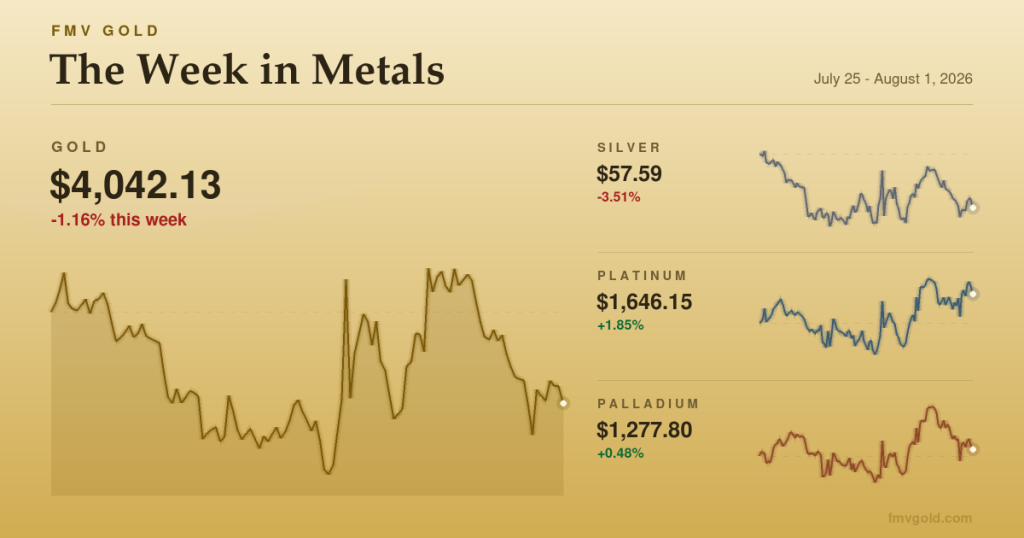
Gold spent Wednesday morning testing a number its holders have watched all summer, and for a few minutes it lost. The metal traded down to $3,999.35 ahead of the Federal Reserve’s statement, then spent the next two sessions climbing back out. By Friday evening the week’s ledger read almost blank for gold, off about a quarter of a percent, an odd result for five sessions that carried a three-way split at the Fed, a suspected currency intervention out of Tokyo, and a pause in American airstrikes over Iran. The metals that actually moved were the industrial pair, with platinum and palladium finishing well clear of the field.
The week in numbers
- Gold: down 0.26 percent. High of $4,116.53 on Thursday, low of $3,999.35 on Wednesday.
- Silver: down 0.91 percent. High of $60.01 in Monday’s opening hours, low of $56.76 on Tuesday.
- Platinum: up 3.41 percent. High of $1,664.67 on Thursday, low of $1,580.37 on Wednesday.
- Palladium: up 2.54 percent. High of $1,320.42 early Friday, low of $1,243.84 on Wednesday.
The stories that moved the market
The week opened with the previous week’s oil bid still in the tape. Silver printed its high of $60.01 in the first hours of Monday trading and never saw that level again. From there the complex leaked. Durable goods orders came and went on Monday without much argument, and by Tuesday’s close gold had given up better than a percent to finish near $4,025 while silver slid to $56.76, its low for the week. The mood was defensive for a specific reason: futures markets had spent the back half of July pricing a real chance that the Fed’s next move would be a hike rather than a cut, with odds on a September increase running above 80 percent a week earlier, according to CME FedWatch data cited by Reuters.
Wednesday was the hinge. The Federal Open Market Committee left the target range at 3.50 to 3.75 percent, noting that inflation “remains elevated relative to the Committee’s 2 percent goal” partly on supply shocks in energy, while job growth had kept pace with the workforce. What made the decision unusual was the vote. Three officials, Beth Hammack, Neel Kashkari and Lorie Logan, dissented in favor of a quarter-point increase. A hold with that much hawkish company inside the room is not the same as a comfortable hold, and gold’s slip under $4,000 came in the hours before the statement rather than after it. Once the language was digested, the metal closed the day up better than 1.5 percent.
Thursday delivered the shock. The dollar suffered its steepest one-day fall against the yen since late 2022, dropping roughly 3 percent from above 163 to an intraday 157.80, a move currency strategists widely attributed to intervention by Japan’s Ministry of Finance (the ministry, following its usual practice, declined to comment). Second-quarter GDP landed at 1.5 percent annualized against expectations closer to 2.1 percent, which handed Tokyo a convenient moment to act. A dollar falling that fast is ordinarily a gift to metals, and gold took it as far as $4,116.53, its high for the week. The bigger beneficiaries were platinum, up better than 2 percent on the day, and palladium, up 3.5 percent.
Friday gave much of it back. The dollar index recovered its footing and climbed back above 100, and news that the United States had paused airstrikes in Iran overnight drained some of the war premium that had supported bullion since early July. Gold fell about 1.5 percent on the session and silver about 2.6 percent, though gold still closed out July with a small monthly gain, its first since February. The platinum group metals held most of their ground, helped along by the continuing trade action against Russian palladium supply that has been repricing that market since the winter.
What it means for American gold
For holders of American bullion, this was a week of standing still. The metal value of a one-ounce American Gold Eagle, which carries a full troy ounce of gold behind its $50 face value, moved roughly $11 lower across the five sessions. A one-ounce American Silver Eagle saw its metal value slip by about 53 cents. Those are floor figures, not what anything trades for, and after a week this quiet the floor is essentially where it started.
Historic American gold moved less in absolute terms, simply because there is less metal in it. A Saint-Gaudens Double Eagle holds 0.9675 troy ounces, so its melt floor tracked gold’s small decline at slightly under the full-ounce figure. The same logic applies to Morgan dollars and Peace dollars at 0.7734 troy ounces of silver apiece. Augustus Saint-Gaudens designed his Double Eagle at the request of Theodore Roosevelt, and the coin was struck from 1907 until 1933, which is a reminder that the pieces in most American collections have sat through a great many weeks noisier than this one.
Worth keeping separate: melt is the metal floor and nothing more. Proof, graded, commemorative and pre-1933 material trades above that floor on collector demand, and those premiums move on a slower clock, responding to grading populations and auction results rather than to a Thursday move in the yen. A flat week in spot tells you very little about them, which is why our valuation method treats the two layers separately.
Where this leaves the market
Step back and the summer’s damage is still the dominant fact. Gold’s close of $4,042.13 sits about 25.3 percent below the record $5,414.49 set on January 28, and about 12.1 percent under its 200-day average near $4,600. On the year gold is down roughly 6.4 percent. Silver’s position is harsher: its $57.59 close is some 50.6 percent below the January record of $116.61 and about 23.5 percent under a 200-day average near $75, leaving it down close to 19.6 percent in 2026. Platinum and palladium remain down more than 20 percent apiece year to date despite this week’s gains.
The gold-silver ratio finished at 70.2 ounces of silver to one of gold, versus 69.7 a week earlier and roughly 60 at the start of the year. That drift tells the story of the past seven months as plainly as any chart on our market pages: silver gave back its winter outperformance and then some, and a week like this one keeps nudging the ratio wider rather than fixing it.
The week ahead
- Monday, August 3: ISM Manufacturing PMI.
- Wednesday, August 5: ADP private payrolls and ISM Services PMI.
- Thursday, August 6: weekly initial jobless claims.
- Friday, August 7: the July employment report, covering nonfarm payrolls, the unemployment rate and average hourly earnings. With three Fed officials already voting to hike, this is the number that matters.
Sources
- Federal Reserve issues FOMC statement, July 29, 2026
- Gold slips as US dollar regains footing; heads for first monthly gain in five (Kitco/Reuters)
- Dollar drops most since 2022 as Japan strikes yen market after Fed’s three-way split
- Gold prices today, July 31, 2026: US paused airstrikes overnight
- Duties on Russia’s palladium may support price for longer (Miningmx)
- Economic calendar for August 3 to 9, 2026
Price figures are from FMV Gold’s own minute-by-minute spot archive (UTC trading days).