

A $250 gold coin and a bag containing $1,000 in dollar coins sound like straightforward purchases.
Until you discover that $250 is not the gold coin’s selling price, and the thousand-dollar bag costs $1,350.
Welcome to the distinction between legal-tender denominations and collector retail prices.
The United States Mint has scheduled both 2026 President Donald J. Trump products for November 19 at noon Eastern. As of November 18, neither release has occurred.
Whatever a collector thinks of the subject, the purchasing decision should begin with specifications rather than politics.
The Gold Proof: Metal, Art and a Price Still Unknown
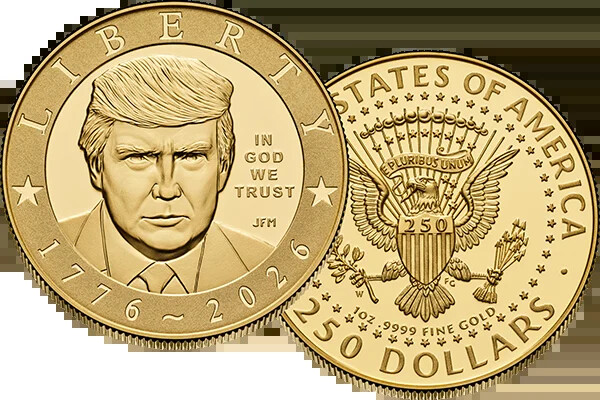
The 2026-W Semiquincentennial President Donald J. Trump 24K Gold Proof Coin contains one troy ounce of .9999 fine gold.
It is a West Point proof with a $250 face value.
That denomination is not its retail price. The Mint had not published the selling price as of November 18.
The obverse portrait was created by Joseph Menna, based on a White House photograph by Daniel Torok. The reverse features the Presidential Seal.
The Mint lists a 75,000-coin mintage limit, a 75,000 product limit and a household order limit of four.
Those limits describe authorized quantities and purchasing restrictions, not completed production or actual sales.
Collectors can evaluate the portrait, relief and proof finish as examples of American Mint craftsmanship without treating the issue as an investment forecast.
The Dollar Bag: More Face Value, No Gold
The companion product is a bag of 1,000 Philadelphia-produced $1 coins.
Its listed price is $1,350, compared with a combined face value of $1,000.
That gives us transparent arithmetic:
($1,350 – $1,000) / $1,000 = 0.35, or 35%.
The bag costs 35% above face value before additional fees.
That is a collector-product markup over denomination, not a precious-metal premium.
These are base-metal dollars containing no gold. They have a circulating finish but have not previously circulated.
The Mint limits purchases to two bags per order for weight-handling purposes and identifies an additional handling fee at checkout. Its listing shows no household limit.
Which Product Actually Fits?
The gold proof offers a defined quantity of fine gold, specialized finishing and a commemorative design.
The dollar bag offers a large quantity of circulating-quality coins at a price above their spendable value.
Those are fundamentally different propositions.
Someone seeking gold exposure must examine the gold proof’s eventual retail price against its metal value. Someone building a dollar-coin collection should ask whether 1,000 examples justify the packaging and price.
Neither the $250 denomination nor the $1,000 combined face value tells buyers what they could recover through resale.
The Mint’s official program comparison helps establish the basic product distinction.
The lesson is bigger than this release: face value, metal content, retail price and collector appeal are four separate numbers, or considerations.
A careful buyer never lets one stand in for another.
Image: U.S. Mint render of the Trump $250 gold proof, not a photograph and not the base-metal dollar.