
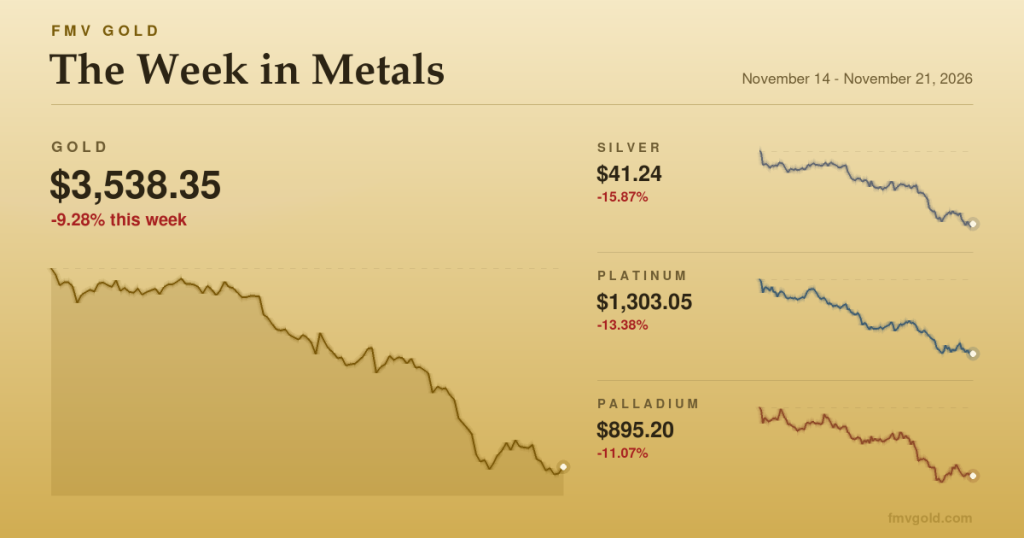
The week opened Sunday evening with gold a hair above $3,900 and a market that seemed to think the worst of November was behind it. It wasn’t. By Friday’s close, spot gold had given up almost 9% to settle near $3,538, its lowest finish in more than a year, and silver had done something worse, shedding better than 15% to end around $41. Nothing collapsed on any single afternoon. The damage came the slow way, one Fed comment and one data release at a time, with Wednesday and Thursday doing most of the work.
The week in numbers
- Gold: down 8.9% on the week, from $3,884.15 to $3,538.35. High $3,900.38 at the Sunday evening reopen (Nov. 15); low $3,503.80 on Friday, Nov. 20.
- Silver: down 15.4%, from $48.75 to $41.24. High $49.03 at the Sunday reopen (Nov. 15); low $40.81 on Friday, Nov. 20.
- Platinum: down 12.7%, from $1,492.60 to $1,303.05. High $1,504.99 early Monday, Nov. 16; low $1,294.41 on Friday, Nov. 20.
- Palladium: down 10.6%, from $1,001.55 to $895.20. High $1,008.01 at the Sunday reopen (Nov. 15); low $880.15 on Friday, Nov. 20.
Highs and lows are intraweek spot readings from FMV Gold’s minute archive, measured against the prior Friday’s close, for all four metals.
The stories that moved the market
Monday and Tuesday were the quiet setup. Governor Christopher Waller’s talk of a half-point rate increase in December was still ringing in traders’ ears as the week began, and the World Gold Council’s weekly note, pointedly titled “Waller the Dollar,” warned that a firmer dollar and rising real yields made a potential double whammy for gold. Gold drifted rather than broke. Silver dropped more than 3% on Monday amid softer Chinese factory and retail figures, then clawed a little back on Tuesday, even as New York Fed President John Williams said the central bank would likely need to raise rates again and St. Louis Fed President Alberto Musalem suggested several more hikes might be needed.
Wednesday is when the floor gave. Gold slipped through $3,800 in European trading, hit its lowest level since September 2025, and kept going into the evening as minutes from the Fed’s October meeting landed. Those minutes didn’t contain a shock so much as a confirmation: per Kitco’s reading, “the vast majority” of officials saw upside risks to inflation, with energy prices and tight refined-fuel supply among the worries. Gold finished the day down close to 3%, and silver slid toward $45.
Thursday added a twist that should, on paper, have helped. Initial jobless claims rose to 203,000, above forecasts, and the Philadelphia Fed’s manufacturing gauge fell to 6.3 from 20.9. Softer numbers usually ease rate fears. Instead, the major stock indexes fell about 2% on renewed selling in AI-related shares, the dollar stayed near a 19-month high, and metals went down with everything else, a pattern consistent with investors trimming whatever they could sell. Gold broke below $3,650 by the U.S. afternoon. Kitco also noted that tensions between the U.S. and Iran around the Strait of Hormuz did little to stir safe-haven buying.
Friday brought no single headline, just more of the same. Silver fell below $42 for the first time since September 2025, and futures pricing compiled by CME FedWatch put the odds of a quarter-point hike at the Dec. 8-9 meeting at roughly 99%, according to Trading Economics. Gold touched $3,503.80 in the U.S. afternoon before closing just above $3,538.
What it means for American gold
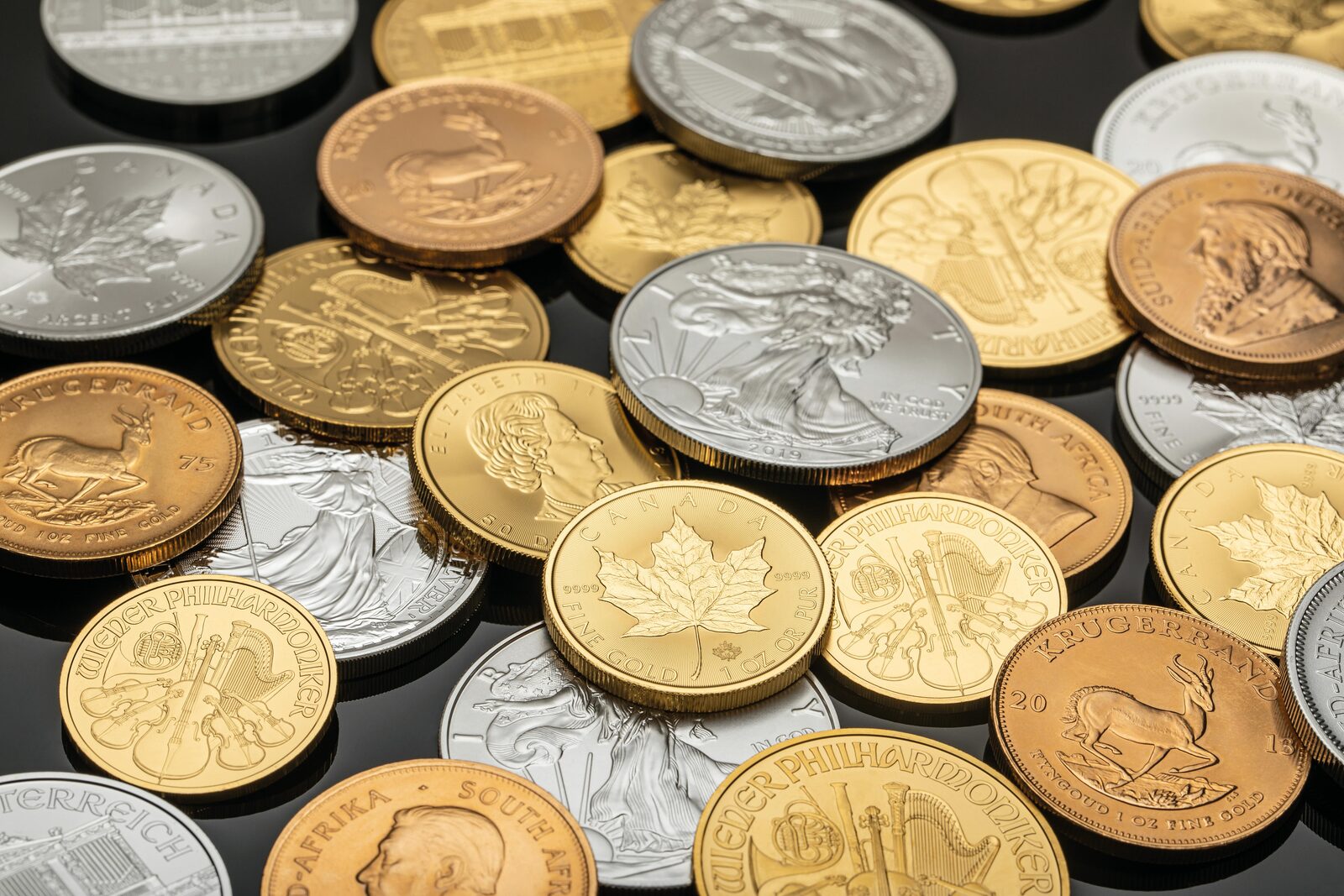
For anyone holding an American Gold Eagle, the arithmetic of the week is blunt: the metal inside a plain one-ounce bullion coin lost roughly $346 in melt value between the two Friday closes. That’s the floor dropping, and it is a real change in what the gold itself is worth. Holders of the American Silver Eagle saw the metal value of a one-ounce bullion coin fall by about $7.50, which in percentage terms was the harsher week by a wide margin.
The same direction applies, proportionally, to classic silver dollars like the Morgan and Peace dollars, each carrying 0.7734 troy ounce of silver, and to pre-1933 gold such as the Saint-Gaudens $20 Double Eagle with its 0.9675 troy ounce. The Saint-Gaudens design, for the record, came out of Theodore Roosevelt’s push to give American coinage a more artistic face, and it reached circulation in 1907. A design like that is a reminder that melt value is only the starting line. Proof, graded, commemorative and pre-1933 coins trade on collector demand that tends to move more slowly than spot, sometimes cushioning a week like this one and sometimes lagging it. That premium is a separate story from the metal, and one sharp week rarely settles it. Our valuation method explains how the two layers fit together.
Where this leaves the market
Gold’s record in FMV Gold’s daily archive is $5,414.49, set on Jan. 28, 2026. A week ago the metal sat about 28% below that mark; it now sits nearly 35% below. It is down about 18% for the year, measured from the Dec. 31 close of $4,318.18, and roughly 20% under its 200-day average of about $4,408, an average that itself slipped some $32 over the week as the higher prices of spring and summer roll out of the window.
Silver’s numbers are starker. Its archive record of $116.61, also from Jan. 28, now looks a long way off, with Friday’s close about 65% below it. Silver is down roughly 42% year to date and sits close to 39% beneath its 200-day average near $67. Both gold and silver closed the week at their lowest daily readings of the past 12 months.
Because silver fell almost twice as far as gold, the gold-silver ratio widened from about 79.7 to 85.8, meaning an ounce of gold now buys nearly 86 ounces of silver. That shift says the selling leaned hardest on the metals with the most industrial exposure, which also fits platinum’s near 13% drop. Our live charts carry the full history for anyone who wants to look further back.
The week ahead
- Tuesday, Nov. 24: Conference Board consumer confidence, 10:00 a.m. Eastern.
- Wednesday, Nov. 25: the second estimate of third-quarter GDP and the October personal income and outlays report, which carries the PCE inflation gauge the Fed watches most closely, both scheduled for 8:30 a.m. Eastern.
- Thursday, Nov. 26: Thanksgiving. U.S. stock markets are closed, and the Friday session that follows is customarily shortened, so expect thin trading in metals.
- Looking further out: the Federal Reserve’s next policy meeting runs Dec. 8-9.
Sources
- Kitco: Gold falls below $3,650, silver tumbles as Fed rate concerns pressure metals (Nov. 19)
- Kitco: Gold prices remain under pressure as Fed minutes show central bank committed to cooling inflation (Nov. 18)
- New Straits Times (Reuters): Gold drops 2pct to over one-year low as hawkish Fed signals boost dollar (Nov. 18)
- BullionVault: Gold and silver search for a floor on Fed rates (Nov. 18)
- USAGOLD: Gold slips to $3,842 as WGC flags a dollar-yield double whammy (Nov. 17)
- Trading Economics: Silver news stream (Nov. 13-20)
Price figures are from FMV Gold’s own minute-by-minute spot archive (UTC trading days).