
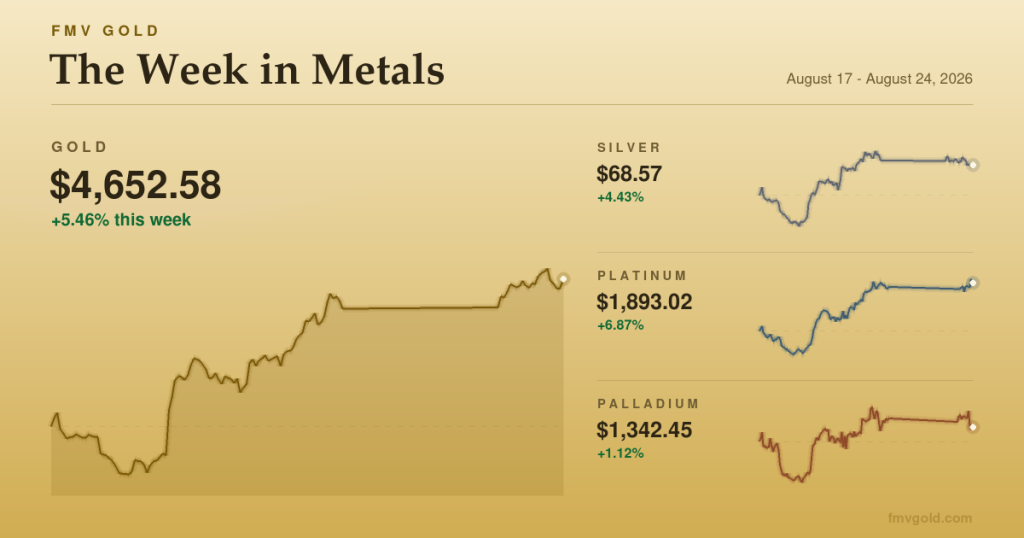
Tuesday looked like the beginning of a bad week for gold. The ten-year Treasury note was paying 4.72 percent, within reach of a one-year high, and investors worried about the Strait of Hormuz were buying government paper rather than metal. Then the Treasury Department spoke on Wednesday, and the arithmetic turned over. By Friday’s close gold had added better than five percent, silver had pushed past $69, and the federal debt had crossed $40 trillion for the first time.
The week in numbers
- Gold: up 5.2 percent, from $4,376.97 to $4,603.65. High close $4,603.65 on Friday, low close $4,334.31 on Tuesday.
- Silver: up 6.6 percent, from $64.70 to $68.98. High close $68.98 on Friday, low close $63.35 on Tuesday.
- Platinum: up 7.6 percent, from $1,749.00 to $1,882.00. High close $1,882.00 on Friday, low close $1,716.25 on Tuesday.
- Palladium: up 2.5 percent, from $1,318.20 to $1,351.05. High close $1,351.05 on Friday, low close $1,290.00 on Tuesday.
Figures are Friday-close to Friday-close on a closing basis.
The stories that moved the market
Monday passed without much argument. Gold drifted up to close near $4,417, silver held just under $66, and the market seemed content to wait for the Federal Open Market Committee minutes due midweek. That patience did not survive Tuesday. Long-end yields pressed higher, the ten-year touching 4.72 percent, and gold gave back the week’s small gain and more, closing at $4,334. The geopolitical news that week was not gentle, amid reports that a British vessel had been struck by an unidentified projectile in the Strait of Hormuz and that the sixty-day negotiating memorandum between Washington and Tehran had lapsed without renewal. In an ordinary week that combination lifts gold. Instead the safety bid went into Treasuries, yields on the short end fell, and the opportunity cost of holding an asset that pays no interest went up. Gold suffered for it.
Wednesday rewrote the week. The Treasury announced it would at least double the size of its liquidity-support buybacks of ten-year to thirty-year debt, a technical operation with a very untechnical message: the government intends to manage the cost of its own borrowing. Long-end yields fell, the dollar weakened, and gold posted what Kitco described as its largest single-day jump since early February, closing above $4,520. Silver ran with it, breaking $66 and then continuing. Ole Hansen of Saxo Bank noted that the move faded briefly on Thursday as long-end yields climbed back, which is what the tape shows: gold essentially flat on the day, holding its gains without extending them.
Friday brought the number that will outlast the week’s price action. Federal debt topped $40 trillion for the first time, and an interview with Treasury Secretary Scott Bessent did not settle investor nerves about fiscal sustainability. Gold closed at $4,603.65, a three-month high, with the dollar soft and the metal now trading above a technical level that chart-watchers had been circling for weeks. Silver finished at $68.98. Giovanni Staunovo at UBS put a twelve-month figure of $5,400 an ounce on the combination of rising global debt and a persistently weak dollar, which is one analyst’s view and worth reading as such.
Beneath the headlines, the physical market behaved the way it usually does in a rising tape. Retail premiums on coins and small bars stayed firm, and dip-buying below $4,500 kept absorbing supply rather than adding to it. That is a quieter signal than a five percent week, and often a more durable one.
What it means for American gold
For anyone holding American Gold Eagles, the week moved the metal floor beneath them by roughly $227 an ounce. That is the melt value of one troy ounce of gold, nothing more: the metal content of a single Eagle, priced at spot. A Silver Eagle carries one troy ounce of silver, and its floor rose about $4.28 on the week. Those two figures apply to plain bullion issues only.
Everything else in an American collection moved less mechanically. A Saint-Gaudens double eagle holds 0.9675 troy ounces of gold, so its metal floor rose by slightly less than an Eagle’s, and pre-1933 gold has never traded on melt alone. Morgan and Peace dollars carry 0.7734 troy ounces of silver apiece, and the same principle applies with more force, since condition and date drive those markets far more than spot does. Proof, graded, and commemorative pieces trade on collector demand, which moves on its own slower schedule and does not reprice because the ten-year yield fell on a Wednesday. A week like this one lifts the floor. It does not tell you what any particular coin is worth, and it is worth remembering that the Saint-Gaudens design entered circulation in 1907 at President Roosevelt’s insistence, when the question of what a gold coin should look like mattered more to Washington than what it should cost.
Where this leaves the market
Gold closed Friday about 15 percent below its record high of $5,414.49, set on January 28 of this year, and up 6.6 percent for 2026 so far. The technical development that mattered was the 200-day average: gold spent the week crossing it, finishing roughly 2 percent above a level near $4,515 that it had been trading beneath. Silver tells a different story, up 6.6 percent on the week yet still down 3.7 percent on the year and about 4 percent below its own 200-day average. The gold-silver ratio narrowed from 67.7 to 66.7 as silver outpaced gold, a modest move in silver’s favor after a long stretch of the reverse. Platinum, despite the best weekly gain of the four metals, remains down more than 12 percent year to date, and palladium down more than 17 percent. Monday’s session, which had traded by the time this edition was published, carried gold higher again to $4,649.59.
The week ahead
The Kansas City Fed’s Economic Policy Symposium runs from August 27 to 29 at Jackson Hole, with the announced theme “Financial Innovation: Implications for Payments and Policy.” Fed Chair Kevin Warsh is scheduled to deliver the keynote on Friday, August 28, at 10 a.m. Eastern, his first at the symposium as Chair. Given how squarely this week’s rally rested on the path of yields, that speech is the fixture most likely to set the tone for metals into month-end.
Sources
- Gold rallies to 3-month high as frail dollar, technicals support (Kitco News, August 21)
- Physical Gold Powers Toward $4,600 As U.S. Debt Tops $40 Trillion (USAGOLD, August 21)
- Gold falters as U.S. Treasury yields rise (Yahoo Finance, August 18)
- About the Jackson Hole Economic Policy Symposium (Federal Reserve Bank of Kansas City)
- Chair Warsh To Give Jackson Hole Keynote Speech Aug 28 At 10am ET (MNI Markets)
Our full price history is on the charts page, and the way we value coins is set out in how it works.
Price figures are from FMV Gold’s own minute-by-minute spot archive (UTC trading days).