
Two coins can feature the same president, come from the same U.S. Mint and still belong in completely different buying categories.
That is the situation collectors face with the 2026 President Donald J. Trump issues.
The special $1 Trump coin went on sale September 2. It has a gold-colored finish, but it is not a one-ounce gold bullion product. The Associated Press reported the September 2 release, while CoinNews lists the dollar coin’s composition as 88.5% copper, 6% zinc, 3.5% manganese and 2% nickel, the manganese-brass alloy used for golden dollars. For more on the dollar coin itself, see our earlier article, The Gold Donald Trump Coin With No Gold.
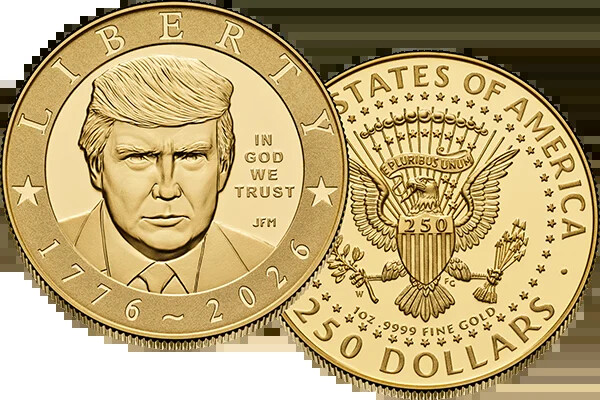
A second and substantially different product is scheduled for November 5, 2026: a President Donald J. Trump one-ounce 24-karat proof gold coin.
The November Coin Is the Precious-Metal Issue
The U.S. Mint identifies the forthcoming proof as one troy ounce of .9999 fine gold. Its design carries Trump’s portrait, the dates “1776-2026” and the Presidential Seal. The gold coin carries a $250 denomination. The Mint says it will be struck at West Point with an order limit of one per household; price and mintage limit had not been announced as of September 27. That figure is legal face value, not its retail issue price and not a statement of the gold’s market value.
As with other one-ounce U.S. Mint gold products, collectors should separate three numbers: the denomination stamped on the coin, the value of the contained gold and the price charged by the Mint or a later seller.
Those figures serve different purposes.
A U.S. Mint Product Still Requires Specification Reading
The advantage of an official Mint issue is that collectors can consult published product specifications rather than guess from appearance.
That becomes especially useful here because “gold-colored $1 coin” and “one-ounce 24-karat gold proof” sound similar in an advertisement but describe materially different objects.
The distinction is factual, not political.
Collector interest in a presidential subject may contribute to demand, but it does not add another fraction of an ounce to the planchet. Likewise, the $250 denomination should not be presented as the coin’s purchase price.
What to Check Before November 5
For the forthcoming gold proof, start with the known specification: one troy ounce of .9999 fine gold. Then evaluate the Mint’s announced retail price once it is published and decide how much additional premium you place on the proof finish, presidential theme and 250th-anniversary design.
For the $1 issue, buy it as a U.S. commemorative collectible if that is what interests you, not under the mistaken belief that its golden appearance represents one ounce of bullion.
At FMVGold.com, identify the metal first. The theme comes second.
Image: U.S. Mint.