
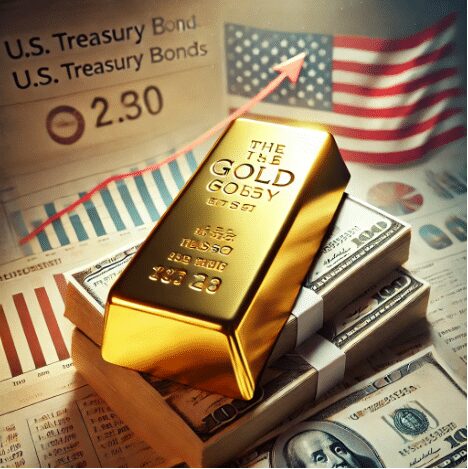
A non-yielding asset in a yield-driven world
Gold has no earnings, no coupon, and no dividend. That single fact is the key to its macro behavior. Because an ounce of gold sitting in a vault produces no income, its appeal rises and falls with the income an investor gives up by owning it instead of an interest-bearing alternative. Macroeconomics enters through three connected channels: real yields, inflation expectations, and the dollar.
Real yields: gold’s most reliable tether
The real yield is the interest rate on a bond after subtracting expected inflation — roughly, the inflation-adjusted return on holding safe government debt. It is the cleanest single measure of gold’s opportunity cost.
The textbook relationship is inverse. When real yields rise, safe bonds become more attractive relative to a metal that yields nothing, and gold tends to weaken. When real yields fall — especially when they turn negative, meaning cash and bonds are losing purchasing power — gold’s zero yield suddenly looks competitive, and the metal tends to strengthen. Many of gold’s strongest historical runs coincided with periods of deeply negative real yields.
The practical lesson: when assessing gold’s macro backdrop, the level and direction of real yields usually matters more than the nominal interest rate or the inflation rate taken alone.
Inflation expectations: the hedge, with caveats
Gold’s reputation as an “inflation hedge” is real but frequently oversimplified. Over multi-decade spans, gold has broadly preserved purchasing power, which is the core of the monetary case for holding it. Over shorter windows, the relationship is noisy.
The reason is that expected inflation, not realized inflation, drives prices, and it interacts with policy. If inflation rises but central banks raise interest rates faster, real yields increase and gold can fall even as prices climb — exactly the bind precious metals can face when an inflation shock simultaneously delays rate cuts. Conversely, if inflation rises and central banks tolerate it (letting real yields drift lower), gold tends to do well. So the useful question is not “is inflation high?” but “is inflation outrunning the policy response?”
The dollar: gold’s pricing denominator
Gold is quoted in U.S. dollars worldwide, which builds in a mechanical relationship. A stronger dollar raises gold’s price in other currencies, dampening overseas demand and typically weighing on the dollar price; a weaker dollar does the reverse. The dollar also reflects relative monetary policy and global risk appetite, so it often moves in the same direction as real yields, reinforcing the effect.
The correlation is real but not ironclad. There are episodes — acute crises, or periods of intense official-sector buying — when gold and the dollar rise together as both attract safe-haven flows. Treat the dollar as an important input, not a mechanical lever.
Where today’s regime departs from the textbook
Here the historical patterns require care. Through this cycle, gold has repeatedly set records and held a historically elevated price even during stretches of firm real yields and a resilient dollar — conditions that the simple model says should have capped it. Several structural forces help explain the divergence:
- Sustained central bank demand. Heavy, price-insensitive official-sector buying has added a persistent bid that the real-yield model does not capture.
- Geopolitical and fiscal premia. Elevated geopolitical tension and concerns about long-run government debt trajectories have supported a “monetary insurance” bid that is somewhat independent of the rate cycle.
- Diversification away from concentrated reserve holdings. Some official and private buyers have sought to reduce reliance on any single reserve currency, a slow structural shift rather than a cyclical trade.
The takeaway is not that the macro framework has stopped working — real yields, inflation expectations, and the dollar still explain most short-term swings, as a sharp rate-driven washout will quickly remind anyone. It is that a structural demand layer now sits underneath the cyclical signal, which can keep the price floor higher than the rate model alone would predict.
Three scenarios
Rather than forecasting, it is more useful to map how gold has tended to behave across distinct macro environments.
Rising-rate environment. When real yields are climbing and the dollar is firm — typically because growth or inflation is forcing tighter policy — gold faces its stiffest headwind. Historically it has struggled to make sustained progress here and is prone to sharp corrections. The structural demand layer can cushion the downside, but the cyclical wind is in its face.
Falling-rate environment. When real yields are declining — easing policy, slowing growth, or rising recession risk — gold has often performed well, sometimes strongly, particularly if rate cuts arrive alongside still-elevated inflation that pushes real yields negative. This is the classic tailwind regime.
Sideways / range-bound environment. When rates, inflation, and the dollar are broadly stable, gold’s direction tends to be set by the secondary drivers — official-sector flows, ETF demand, and geopolitics — and by positioning. Moves are choppier and less trend-driven, and headlines carry more weight relative to fundamentals.
Practical implications: long-term holders vs. tactical traders
The same macro backdrop reads very differently depending on horizon.
Long-term holders — those who own gold for diversification and monetary insurance — are generally better served by treating the rate cycle as noise around a multi-year thesis. For this group, the relevant questions are structural: the long-run path of real yields, the durability of official-sector demand, and the role of gold as a low-correlation diversifier within a broader portfolio. Short-term, rate-driven drawdowns are the price of admission, not a signal to react.
Tactical traders care intensely about the same variables on a much shorter clock. For them, the direction and surprise in real yields, inflation prints, and the dollar are the tradable edge, and positioning extremes can matter as much as the fundamentals. This is a higher-turnover, higher-risk approach in which timing and risk control dominate outcomes.
Neither stance is inherently superior; they are answers to different questions. The common error is applying a trader’s reaction function to a long-term holding, or vice versa.
Key takeaways
- Real yields are the master variable — direction and level matter more than nominal rates or inflation alone.
- Gold hedges inflation over long horizons, but short-term it depends on whether inflation outpaces the policy response.
- A stronger dollar is usually a headwind, with notable crisis-driven exceptions.
- Today’s regime carries a structural demand layer — central banks, geopolitics, reserve diversification — that can keep prices elevated against an unfavorable rate backdrop.
- Horizon defines the right reaction: structural questions for long-term holders, surprise-and-positioning for tactical traders.
This article is informational and presents scenario analysis, not investment advice or a market forecast.
More from this series · FMV Gold News & Analysis
- Gold Whipsaws Into the Fed Meeting: A Mid-June Recovery That Settled Nothing
- Two Metals, Two Jobs: Why Gold and Silver Play Different Roles in a Portfolio
- The Official Bid: How Central Banks Shape the Gold Market
- Five Ways to Own Gold — and What Each One Actually Gets You
- When the Hedge Gets Tested: Tail Risks in the Gold Market
- The Slow Forces: How ESG, Technology, and Mining Supply Will Shape Gold for Decades