

Pick up an old dime and look closely at the front, just above the date, or turn a silver dollar over and study the space beneath the eagle. Somewhere on most American coins sits a single tiny letter, easy to miss and simple to ignore. That letter is the mint mark, and it records exactly which government facility struck the coin. Learning to read mint marks on U.S. coins is one of the first real skills a collector picks up, because that one character can be the difference between a common piece and a scarce one.
What the mint mark letters mean
Each letter stands for a specific United States Mint facility. Four are in use today. A “P” is Philadelphia, the original mint founded in 1792. A “D” is Denver, active since 1906. An “S” is San Francisco, which has been striking coins since 1854 and today handles most of the nation’s proof coinage. A “W” is West Point, New York, which began adding its mark in 1984 and struck its first circulating coins, a run of quarters, in 2019.
Several letters belong to mints that closed long ago, and these are the ones collectors chase. “CC” is Carson City, Nevada, which operated from 1870 to 1893 to turn Comstock Lode silver into coin. “O” is New Orleans, active from 1838 to 1861 and again from 1879 to 1909. “C” is Charlotte, North Carolina, and an early “D” was Dahlonega, Georgia, both southern gold mints that ran from 1838 until the Civil War shut them in 1861. That older Dahlonega “D” is why a “D” on a modern coin means Denver, while a “D” on an 1850s gold piece means something entirely different.
Why some coins have no mint mark at all
A blank spot where the letter should be is not a defect. For most of American history, coins struck in Philadelphia carried no mark, on the theory that the founding mint needed no label. So a plain Roosevelt dime from 1962 with no letter simply came from Philadelphia. The Lincoln cent still follows the old rule: pennies made in Philadelphia carry no mark to this day, with one brief exception noted below.
There is a stranger gap. Coins dated 1965, 1966, and 1967 carry no mint mark no matter where they were struck. The early 1960s brought a severe coin shortage, and Mint officials blamed collectors for hoarding rolls out of circulation. Their response, backed by the Coinage Act of 1965, was to strip mint marks from every coin to make dates less interesting to save. By 1968 the shortage had eased and the marks returned. If you find a Kennedy half or a quarter from those three years with no letter, that blank is the history.
The Philadelphia P, a latecomer
The “P” is younger than most people assume. It first appeared in 1942, and only out of wartime necessity. To conserve nickel for the war effort, the Mint changed the five-cent coin to an alloy of 35 percent silver, and it put a large “P” over Monticello so the public could tell the special wartime nickels apart. After 1945 the letter vanished again for decades.
It came back in 1979 on the Susan B. Anthony dollar, then rolled out across the board in 1980, when nearly every Philadelphia coin above the cent finally got its “P.” The cent held out until 2017, when Philadelphia pennies briefly wore a “P” to mark the Mint’s 225th anniversary. The mark came off again the next year, and Philadelphia cents have been blank ever since. It is a small quirk with a real story, much like the one behind the end of the U.S. penny.
Where the mint mark sits on a coin
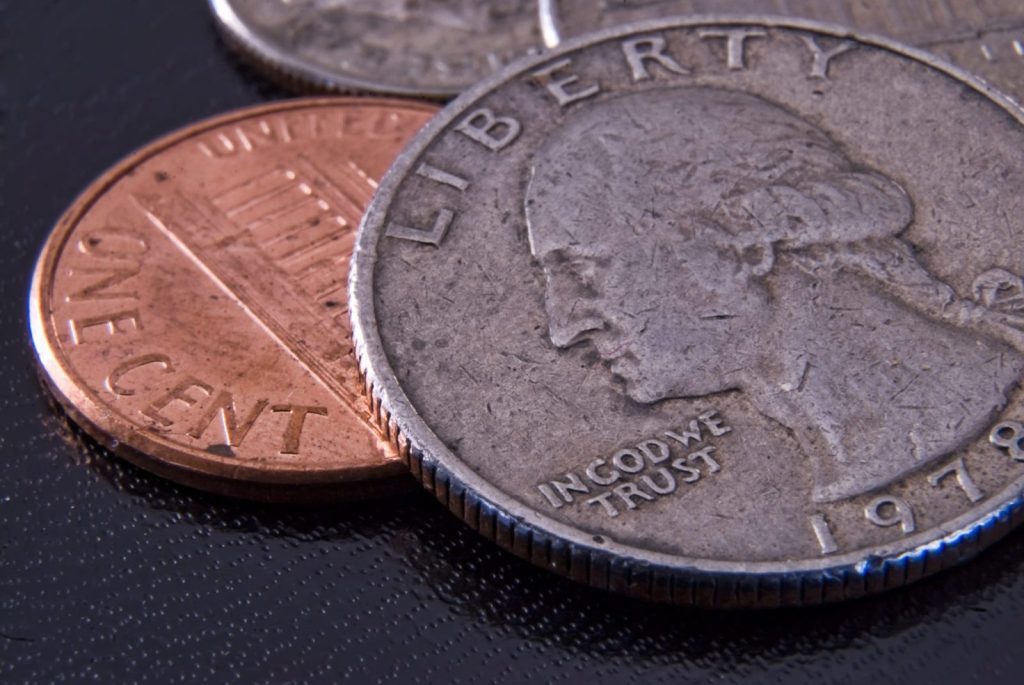
Location shifted in one clean break. Before 1968, mint marks generally lived on the reverse, the back of the coin. Starting in 1968 they moved to the obverse, the front, where they have stayed. On a modern nickel or dime you will find the letter on the obverse near the date. On a Morgan dollar you look on the reverse, beneath the eagle, between the wreath and the tail feathers. Knowing where to look saves a lot of squinting, and a cheap loupe helps more than good eyesight does.
Why the letter changes a coin’s story
Mintages varied wildly by facility and year, so the mint mark tells you how many friends a coin had when it was born. A branch mint that struck only a few thousand pieces of a given date leaves behind something genuinely scarce, while the main mint that ran millions leaves something common. This is why the “CC” of Carson City carries such weight among collectors: the mint operated for barely two decades, its output was small, and those coins have been prized ever since. The same date without the “CC” can be an ordinary coin.
You can see the pattern across the classic American series. The Morgan dollar was struck at five different mints, and collectors treat each mint-and-date combination as its own coin. The Peace dollar and the gold Saint-Gaudens double eagle tell similar stories, where a scarcer branch-mint year stands well above the common ones on collector demand rather than on metal content alone. Modern bullion follows the logic too, since the proof and West Point issues of the Silver Eagle carry marks that separate them from the plain bullion strikes.
None of this means a mint mark sets a price by itself. Condition, eye appeal, and grade matter enormously, and two coins sharing a date and a letter can be worlds apart in the market. What the mint mark gives you is the first clue, the thing to check before anything else. Once you can read it, you are no longer looking at a generic old coin. You are looking at a specific coin from a specific place in a specific year, and that is where collecting really begins. If you want to see how these details factor into what a coin is worth, our guide to how FMV Gold works is a good next stop, or you can simply browse the catalog and start checking letters for yourself.