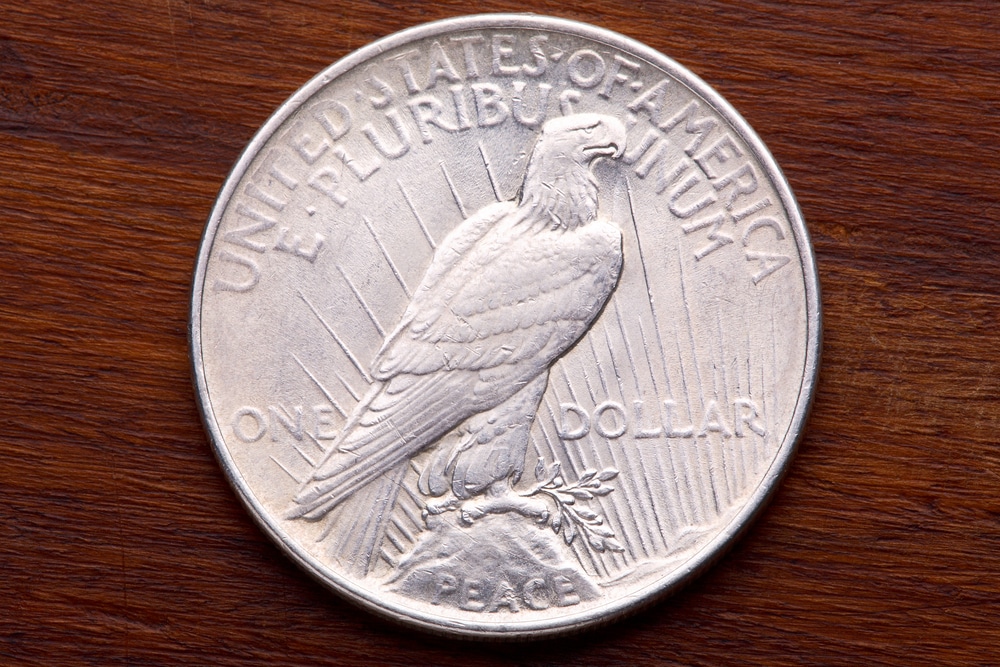



Editor’s note: Silver Eagles aren’t disappearing from America’s coin shops—not yet. But beneath the calm secondary market, new-coin flow from the U.S. Mint has slowed dramatically, and that matters. Jacob Barton breaks down why today’s inventory churn could become tomorrow’s premium problem if physical silver demand comes roaring back.
The Truth
I’ve watched the silver market long enough to know that shortages rarely announce themselves with a flashing red light.
They start quietly.
A dealer buys 200 Eagles here. Another wholesaler liquidates 500 there. Somebody walks into a coin shop with a Monster Box bought six years ago. Coins move from weak hands to stronger ones, and everybody assumes there’s plenty of metal because product is still changing hands.
That’s what I call inventory churn.
And right now, the American Silver Eagle market is running on churn.
The headline number is hard to ignore: the U.S. Mint reported zero bullion Silver Eagle sales in May 2026.
Zero.
During a year that has already seen extraordinary volatility and buying interest in physical silver, that’s an unusual number.
It does not prove the Mint stopped striking coins. It does not prove America has run out of Silver Eagles. And it certainly doesn’t guarantee silver is about to explode higher.
But combine slowing Mint sales, allocation, heavy movement in wholesale silver inventories, and a market increasingly dependent on older Eagles circulating back through dealers, and you have the ingredients for something every veteran bullion trader recognizes: a potential premium gap if demand comes back hard.
Before you pay somebody 30% over melt because he tells you Silver Eagles are “almost gone,” know what the market is actually worth. Sign up at FMVGold.com, start tracking your portfolio live, lock in a free trial membership, and learn what your gold and precious metals are worth today without all the hassle.
The Breakdown
Let’s start with the numbers instead of the rumors.
Through June, U.S. Mint bullion sales figures for the Silver Eagle looked like this:
| Month | Bullion Silver Eagles |
|---|---|
| January | 4,816,500 |
| February | 1,733,500 |
| March | 1,630,000 |
| April | 380,500 |
| May | 0 |
| June | 260,000 |
| January–June total | 8,820,500 |
Now look at the comparable first-half totals:
| Year | Bullion Silver Eagle sales |
|---|---|
| 2023 | 9,724,000 oz. |
| 2024 | 14,250,000 oz. |
| 2025 | 8,083,500 oz. |
| 2023–2025 average | 10,685,833 oz. |
| 2026 | 8,820,500 oz. |
That puts 2026 roughly 17.5% below the three-year average.
It’s also about 9.3% below 2023 and a whopping 38.1% below 2024.
One important qualification: 2026 is still approximately 9.1% ahead of 2025.
So anybody telling you these numbers alone prove an unprecedented Silver Eagle shortage is getting ahead of the evidence.
The more interesting story is when those coins were sold.
During January through March, the Mint recorded 8.18 million bullion Silver Eagle sales.
During April through June? Just 640,500.
That’s the number that gets my attention.
Zero Eagles in May
A zero print from the Mint is remarkable, but you’ve got to understand what it actually means.
The U.S. Mint doesn’t sell ordinary bullion Silver Eagles directly to guys like you and me. Those coins move through the Mint’s Authorized Purchaser network.
So zero reported sales in May means no bullion Silver Eagles were recorded as sold to Authorized Purchasers during that month.
It does not necessarily mean zero coins were struck, and it does not mean the presses were turned off.
And it certainly doesn’t mean there weren’t Silver Eagles sitting in dealer showcases from Miami to Montana.
That’s where people get themselves into trouble.
They confuse Mint flow with market inventory.
Those aren’t the same thing.
Where Are All the Eagles Coming From?
There is a perfectly reasonable explanation for why coin shops can still have Silver Eagles while Mint sales collapse.
The secondary market.
January was massively front-loaded, with nearly 4.82 million Eagles sold by the Mint. Then silver experienced an enormous price reversal. According to the Silver Institute’s 2026 survey, silver suffered a roughly 38% one-day peak-to-trough decline around that period.
When markets move like that, weaker hands shake loose.
People who bought higher sell.
Old Monster Boxes come out of closets and vaults.
Dealers buy back previous-year Eagles.
Wholesalers redistribute inventory.
Suddenly the guy behind the counter doesn’t necessarily need a truckload of freshly minted 2026 Eagles. He’s got 2015s, 2018s, 2021s and assorted backdates flowing through the system.
That’s inventory churn.
And for the moment, it can hide a developing supply problem.
June Wasn’t Exactly a Flood
After the May goose egg, the Mint reported 260,000 bullion Silver Eagles in June.
Some people will look at that and say: “See? Supply came back.”
Easy there, cowboy.
June volume was still roughly 32% below April and amounted to only about 5.4% of January’s sales volume.
That’s not exactly the cavalry arriving over the hill.
Call it tentative replenishment, not a return to normal.
Another distinction worth making.
The Mint resumed sales of the 2026-W Proof Silver Eagle on June 24.
That is a separate market.
Proof Eagles are retail collector products. Bullion Eagles move through Authorized Purchasers.
Through August 2, 2026, U.S. Mint cumulative sales reports showed Proof issues had recorded approximately 482,136 ounces in sales. That’s comparatively healthy.
The weakness we’re discussing is concentrated overwhelmingly in the bullion Silver Eagle market.
And bullion represents roughly 95% of the combined volume we’re looking at.
Allocation Changes the Equation
The Mint currently describes bullion Silver Eagles as being “on allocation.”
In plain English, Authorized Purchasers don’t necessarily get every coin they would like to order whenever they’d like to order it.
Now I’ve already heard the argument that the Mint is legally required to produce Eagles sufficient to meet public demand.
Careful about turning a complicated statutory and production question into a bumper sticker.
Allocation is real.
The dramatic decline in recent wholesale sales is real.
What has not been established by the Mint is that April and May’s numbers resulted specifically from a planchet shortage, production failure, institutional hoarding, or some deliberate refusal to meet demand.
Those are different claims, and evidence matters.
After four decades around this business, I’ve learned that rumors move faster than Monster Boxes.
Then Comes the Bigger Silver Story
Now widen the lens beyond the Mint.
Through July 27, 9,168 contracts were marked for delivery against the July 2026 COMEX silver contract.
A standard COMEX silver contract represents 5,000 troy ounces.
Do the math: 9,168 contracts × 5,000 ounces = 45,840,000 ounces of silver represented by delivery activity in a single contract month.
But before somebody turns that number into tomorrow morning’s “COMEX IS RUNNING OUT OF SILVER” headline, understand what it actually means.
A COMEX delivery generally involves the transfer of ownership through warehouse warrants. It does not automatically mean 45.84 million ounces were physically loaded onto trucks and removed from COMEX-approved vaults.
That’s an important distinction.
Separately, COMEX warehouse data showed approximately 96.3 million ounces of registered silver as of July 23—metal represented by registered warrants and available to satisfy delivery requirements.
Put those two figures next to each other and you can understand why traders are paying attention.
The July contract’s 45.84 million ounces represented nearly 48% of that 96.3-million-ounce registered inventory figure.
Again, that does not mean COMEX lost 48% of its registered silver. Delivery activity and warehouse withdrawals are two different things.
But nearly 46 million ounces represented by delivery notices is substantial physical-market activity, and it’s worth watching alongside what’s happening with American Silver Eagles.
Because here’s the part retail buyers need to understand:
COMEX silver and Silver Eagle inventory aren’t interchangeable.
A 1,000-ounce commercial silver bar sitting in a COMEX-approved warehouse doesn’t magically turn into a thousand Silver Eagles.
Silver has to move through the fabrication chain. Blanks have to meet U.S. Mint specifications. Coins have to be struck. Bullion has to move through Authorized Purchasers. Then dealers have to get their hands on it.
That’s where bottlenecks develop.
And that’s why you can have substantial quantities of silver existing in the wholesale market while premiums on a specific retail product suddenly move higher.
If demand for American Silver Eagles comes roaring back while new Mint supply remains constrained, don’t be surprised if the first shortage you notice isn’t silver itself.
It’s reasonably priced Silver Eagles.
The Burn
Here’s where I expect the nonsense to begin.
If Silver Eagles tighten further, somebody will inevitably dust off the old script: “There are almost no Silver Eagles left. You need to buy TODAY.”
Then comes the 25%, 30%, maybe 40% markup.
Same carnival. New tent.
Scarcity does not give dealers permission to charge whatever number they can fit on an invoice.
A legitimate premium increase occurs when wholesale acquisition costs rise because available inventory cannot satisfy demand.
A manufactured premium occurs when somebody takes a real supply story, adds three tablespoons of fear, puts an American flag behind it, and uses it to separate a nervous buyer from his retirement money.

Right now, secondary-market liquidation appears capable of supplying meaningful quantities of Silver Eagles. Older inventory keeps changing hands, easing the pressure on Authorized Purchasers and dealers to chase newly dated coins.
But suppose silver catches another serious bid.
Not a two-day headline rally.
A sustained physical buying wave.
Weak hands stop selling.
Retail buyers start accumulating again.
Dealer shelves begin thinning.
Authorized Purchasers go looking for replacement inventory.
And then everybody discovers that new Silver Eagle supply hasn’t been flowing through the pipeline at anything resembling January’s pace.
That’s when premiums can move faster than spot.
I’ve seen versions of this movie throughout my career.
The shortage doesn’t become obvious when everybody is selling.
It becomes obvious when they stop.
The Solution
Don’t panic-buy Silver Eagles because somebody tells you they’re disappearing.
And don’t ignore the numbers either.
Watch three things:
- Mint flow. Are monthly bullion sales returning toward historical levels, or do they remain unusually weak? The U.S. Mint bullion dataset is published monthly.
- Secondary-market supply. Are dealers still readily acquiring backdated Eagles from customers and wholesalers?
- Premiums. Is the spread between Silver Eagle prices and generic bullion beginning to widen materially?
Those three signals together tell you considerably more than a salesman shouting “shortage.”
And remember: an American Silver Eagle is one ounce of silver whether the market is calm or everybody suddenly decides the sky is falling.
The coin can deserve a premium because of liquidity, recognition and demand.
It does not deserve an unlimited premium.
If this developing inventory situation turns into a genuine Silver Eagle squeeze, the opportunity won’t belong to whoever panics first.
It will belong to the buyer who understands fair market value before the crowd arrives.
Track what you own. Know the spreads. Compare premiums. And don’t let somebody else’s definition of “scarce” determine what comes out of your wallet.
Learn what your gold and precious metals are worth without all the hassle at FMVGold.com.