
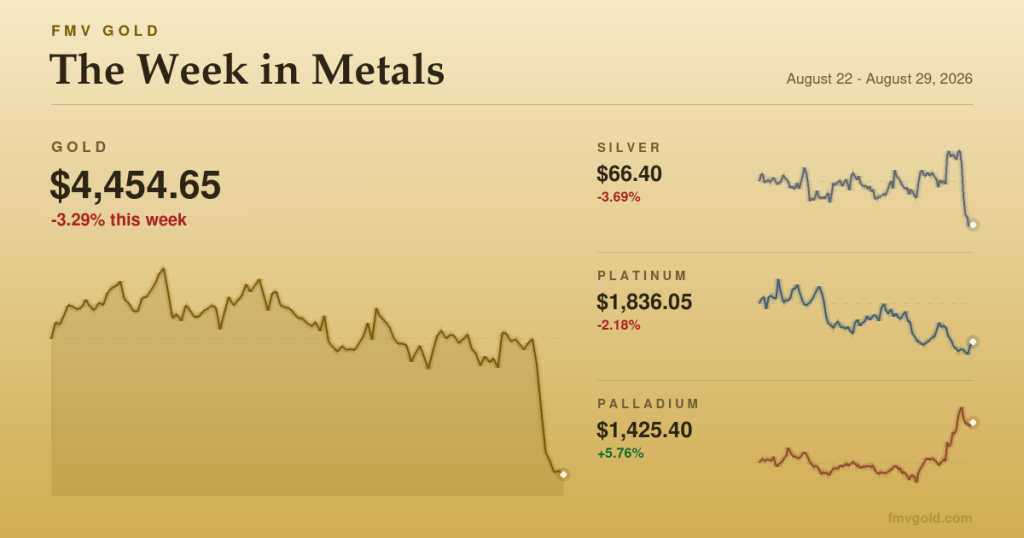
For four days the market acted as though nothing much was at stake. Gold drifted up to a Tuesday close of $4,658.44, its best of the week, then eased through Wednesday and Thursday in the sort of narrow, unhurried trade that usually means everyone is waiting for the same thing. They were. Friday morning in Jackson Hole, Federal Reserve Chair Kevin Warsh gave his first keynote at the Kansas City Fed’s symposium, and by the close gold had surrendered $149 an ounce and the whole week with it. Palladium, which spent the week ignoring the macro argument entirely, finished as the only metal of the four in the green.
The week in numbers
- Gold: down 3.2 percent, from $4,603.65 to $4,454.65. High close $4,658.44 on Tuesday, low close $4,454.65 on Friday.
- Silver: down 3.7 percent, from $68.98 to $66.40. High close $69.25 on Thursday, low close $66.40 on Friday.
- Platinum: down 3.1 percent, from $1,882.00 to $1,824.10. High close $1,880.15 on Monday, low close $1,824.10 on Friday.
- Palladium: up 5.5 percent, from $1,351.05 to $1,425.40. High close $1,425.40 on Friday, low close $1,327.51 on Wednesday.
Figures are Friday-close to Friday-close on a closing basis. Our minute archive was incomplete for part of this week, so highs and lows above are daily closes rather than intraday prints, for all four metals alike.
The stories that moved the market
Monday and Tuesday belonged to the buyers. Gold opened the week around $4,625 and worked steadily higher, closing Monday at $4,652.31 and Tuesday at $4,658.44, the highest close since the spring. Silver tracked it without quite matching it. The bid had carried over from the prior week’s Treasury buyback announcement, which had knocked long-end yields down and the dollar with them, and nobody seemed eager to sell into it ahead of Friday.
Midweek the air came out slowly. Gold slipped to $4,593.10 on Wednesday and recovered a couple of dollars on Thursday, closing at $4,601.10, while silver actually put in its best close of the week on Thursday at $69.25. This is the kind of two-sided, low-conviction tape that shows up when a scheduled event is doing all the thinking for the market. Positioning got trimmed, nothing got decided.
Then Friday. Warsh took the podium in Wyoming and delivered a speech that Wall Street had spent a month trying to anticipate. He put price stability first, citing PCE inflation running at 3.7 percent over twelve months and 4.1 percent annualized over six, both well clear of the 2 percent target, and said the Fed’s predominant focus right now should be on prices. On the other side of the mandate he judged labor markets broadly consistent with full employment, which removed the argument for patience. He also repeated his long-standing objection to forward guidance, arguing the practice has outstayed its welcome. Traders drew the obvious conclusion: CME FedWatch had a majority of them pricing a quarter-point hike at the September meeting by the time the dust settled.
Our own archive puts the break between 13:15 and 14:15 UTC, right as he spoke. Gold was $4,595 at a quarter past one and $4,554 an hour later, and it kept going, touching $4,448 late in the session before finishing at $4,454.65. Silver went with it, giving back nearly three dollars on the day. Platinum, which had been the strongest of the four through midsummer, drifted lower all week and simply kept drifting.
Palladium wrote its own story. It rose on Friday while everything else fell, closing at $1,425.40 and taking the week to plus 5.5 percent. The drivers cited around the trade were structural rather than monetary: production concentrated in Russia and South Africa, thin exchange inventories, steady catalytic-converter demand from hybrid vehicles, and the anti-dumping duty on unworked Russian palladium that has been reshaping North American procurement since the spring. Add short covering above a technical level and you get a metal that shrugs off a hawkish Fed chair.
What it means for American gold
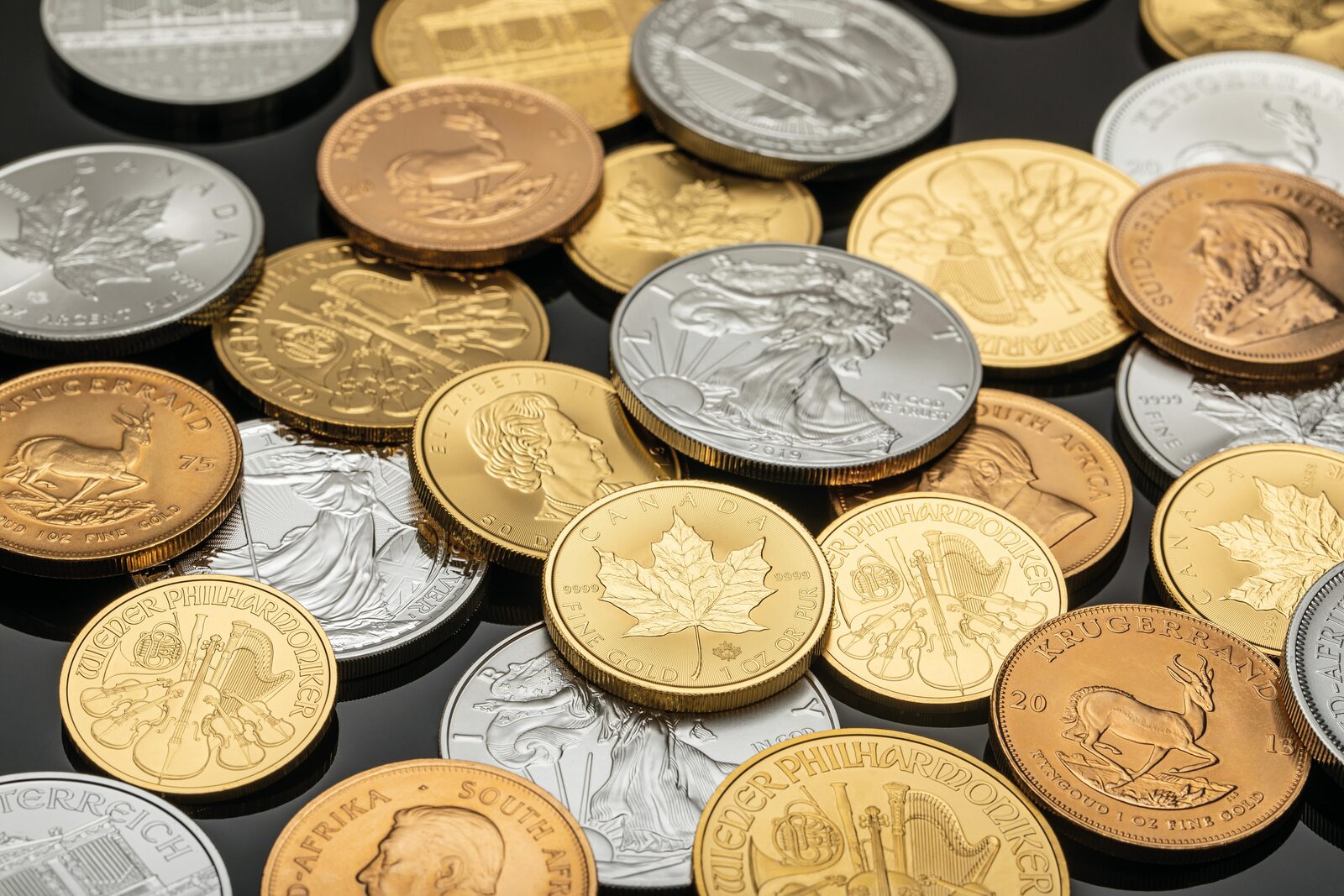
A week like this moves the floor, not the whole building. Gold’s metal value fell about $149 a troy ounce, which is what a plain one-ounce bullion coin such as the American Gold Eagle lost in melt terms between the two Friday closes. On the silver side, a one-ounce American Silver Eagle saw its metal value slip by roughly $2.58. Those are metal figures, the intrinsic floor beneath the coin, and they are the part of a holding that moves tick for tick with the spot market.
Everything above that floor moves on a slower clock. A $20 Saint-Gaudens Double Eagle carries 0.9675 troy ounces of gold, so its floor moved a little less than an Eagle’s did, but its price has never been a pure function of that arithmetic. Augustus Saint-Gaudens designed the coin at Theodore Roosevelt’s request in 1907, and the premium a collector pays for a well-struck example reflects that history, the date, the mint, and the grade far more than a three percent Friday. The same goes for Morgan dollars, and it goes double for proof, graded, and commemorative issues, where collector demand sets the price and metal is a rounding error. Holders of those coins had a duller week than the tape suggests, which is generally the point of owning them.
Where this leaves the market
Gold ends the week 17.7 percent below its record close of $5,414.49, set on January 28 of this year, and up 3.2 percent for the year to date. It also gave back the milestone we wrote about seven days ago: last Friday gold sat 2.0 percent above its 200-day average, and it now sits 1.6 percent below it. Silver is further from home, down 43.1 percent from its own January 28 record of $116.61 and off 7.2 percent on the year, trading 8.5 percent under its 200-day average. The gold-silver ratio barely moved, easing from 66.74 to 67.09, which tells you the two metals fell together rather than one leading. Platinum and palladium are both down double digits for the year, though palladium closed the week within reach of erasing that. You can follow all four on our charts, and the pricing method behind them is laid out in how it works.
The week ahead
Two labor prints carry the week. JOLTS job openings for July are due Tuesday, September 1 at 10:00 a.m. Eastern, and the August employment situation report lands Friday, September 4 at 8:30 a.m. Eastern. After Warsh’s framing, a firm payrolls number would harden the case for a September move and a soft one would complicate it. The Federal Open Market Committee decision itself is set for Wednesday, September 16.
Sources
- Fortune: Kevin Warsh at Jackson Hole, Wall Street at last has a glimpse on Fed thinking
- CNBC: Kevin Warsh sharpens inflation warning at Jackson Hole, signaling possible rate hike
- CNBC: Treasury yields tread water ahead of Warsh’s Jackson Hole speech
- PMI: The Precious Metals Week in Review, August 28th, 2026
- USAGOLD: Physical gold holds above $4,600 as silver steadies, markets eye Warsh’s Jackson Hole debut
- TradingKey: Palladium surges on Aug 28, key factors to watch
Price figures are from FMV Gold’s own minute-by-minute spot archive (UTC trading days).