
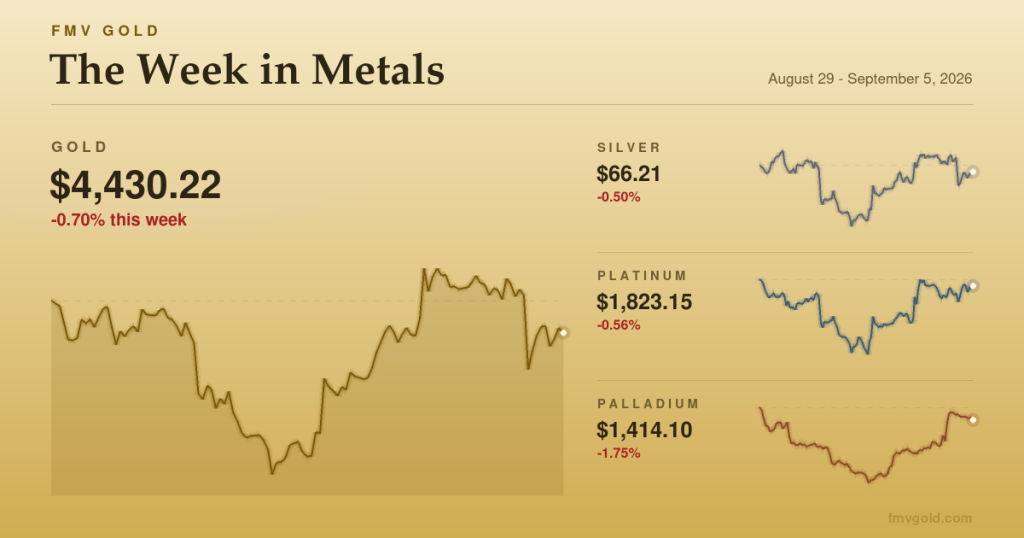
Four sessions, a $226 range in gold, and almost nothing to show for it. That is the honest summary of the trading week that ended Friday, September 4. Gold was sold hard on Tuesday and Wednesday in a rate-hike scare, bought back just as hard on Thursday after one Fed governor changed the arithmetic, then trimmed again Friday morning when the August payrolls report landed at roughly three times what economists had penciled in. When the archive closed for the week, spot gold sat within about half a percent of where it had finished the Friday before. Silver, platinum, and palladium traced nearly the same shape, which is usually the tell that the driver was interest rates rather than anything happening in any one metal.
The week in numbers
- Gold ended the week down 0.55% at $4,430.22. Week high $4,510.33 on Thursday, September 3. Week low $4,284.33 in the early hours of Wednesday, September 2.
- Silver ended down 0.29% at $66.21. Week high $67.41, touched Monday and matched again Thursday. Week low $63.40 on Wednesday.
- Platinum was essentially unchanged, off 0.05% at $1,823.15. Week high $1,837.90 on Monday, week low $1,714.80 on Wednesday.
- Palladium was the weak link, down 2.42% at $1,390.90, though it covered more ground than that suggests. Week high $1,440.80 at the Sunday reopen, week low $1,289.59 on Wednesday.
The stories that moved the market
Monday was the calm before everything. Gold traded up near $4,470 in the small hours, silver poked at $67.41 late in the London morning, and the complex drifted sideways on thin holiday-shortened flows. The backdrop was already hawkish: after the Jackson Hole symposium, futures markets had moved to price a September rate increase as more likely than not, and a metal that pays no interest tends to sit uncomfortably under that assumption.
Tuesday is when the assumption started charging rent. Gold gave up better than $125 across the session and closed near $4,325 in our archive, with silver slipping under $64.10 and platinum losing the $1,800 handle. Wednesday brought the week’s floor, and it arrived from an unexpected direction. Fresh U.S.-Iran strikes near the Strait of Hormuz pushed crude sharply higher, and instead of bidding gold as a haven, the market read the energy shock as one more reason the Federal Reserve would stay tight. The 10-year Treasury yield reached roughly 4.79%, its highest since early 2025, and money-market pricing put September hike odds near 70%. Gold printed $4,284.33 before dawn in New York, silver traded with a $63 handle, and platinum briefly dipped to $1,714.80. Dealers in the physical market reported steady coin demand through all of it, which is a reasonable description of a positioning washout rather than a demand collapse.
Thursday reversed it in a few hours. Fed Governor Christopher Waller signaled he would support holding rates steady at the September meeting, and the odds of a hike fell back toward a coin flip. Gold rose about 1.95% on the day and touched the week’s high of $4,510.33 during the New York afternoon. Palladium had its own catalyst layered on top: roughly 420 United Steelworkers members walked out at Sibanye-Stillwater’s Stillwater East mine and the Columbus metallurgical complex in Montana, the only primary palladium mine and the only PGM refinery in the United States. Palladium gained about 4.9% on the session, outpacing both platinum and gold, in a dispute reported to center on health insurance costs and disability benefits rather than wages.
Then Friday took some of it back. The Bureau of Labor Statistics reported nonfarm payrolls rose 162,000 in August against expectations closer to 55,000, with unemployment steady at 4.1%. Rate-hike pricing snapped higher within minutes, yields followed, and gold surrendered roughly a percent to finish at $4,430.22. It is worth noting what did not happen: the metal never revisited Wednesday’s low, and it closed the week more than $145 above it.
What it means for American gold
For anyone holding American Gold Eagles, the week was close to a wash at the metal level. The melt value of a plain one-ounce bullion Eagle, meaning its gold content alone, fell by roughly $24 from the previous Friday’s close. A plain one-ounce American Silver Eagle saw its metal value slip by about 19 cents. Those are metal-floor figures, not what anything trades for.
That floor matters less than it seems for the older material. Fractional gold, Saint-Gaudens double eagles at 0.9675 troy ounces of gold, and the Morgan dollars at 0.7734 ounces of silver all carry a collector component that moves on its own clock. Proof, graded, and commemorative issues especially: those premiums are set by grade, eye appeal, population, and how many people want them this month, and they generally do not swing $226 in four days because a governor gave a speech. A week like this one moves the floor under a coin without saying much about the coin. The catalog and our valuation method lay out where the metal value ends and the collector value begins.
The heritage footnote, since Saint-Gaudens came up: the design was commissioned by Theodore Roosevelt, who wanted American coinage to look like it belonged to a serious country, and it was struck from 1907 until 1933. It has outlasted a good many rate cycles.
Where this leaves the market
Gold’s record on our archive remains $5,414.49, set on January 28, 2026, which leaves Friday’s close about 18.2% below the high. Year to date, gold is still up 2.6%, and it is the only one of the four in the black: silver is down 7.5%, platinum down 11.6%, and palladium down 14.2%. Gold finished the week 2.3% under its 200-day average of $4,534.89, a gap that narrowed on Thursday and reopened on Friday. Silver is further adrift, roughly 9.2% below its own 200-day average near $72.93.
The gold-silver ratio ended at 66.9, almost exactly the 67.1 it carried into the week, after stretching to 67.7 at Wednesday’s low. Silver held its ground relative to gold through the worst of the selling, which is not always how these weeks go. Our charts show the full shape of it.
The week ahead
- August Producer Price Index, Thursday, September 10 at 8:30 a.m. ET.
- August Consumer Price Index, Friday, September 11 at 8:30 a.m. ET, five days before the Fed decides.
- FOMC two-day meeting September 15 and 16, with the policy statement at 2:00 p.m. ET on the 16th.
- Contract talks in Montana, where a settlement would remove a supply worry the palladium market only just started pricing.
Sources
- Physical Gold Slides To $4,420 As August Jobs Surprise Rekindles Rate-Hike Bets (USAGOLD, September 4, 2026)
- Gold’s week of whiplash sets up a payrolls-driven Friday (InvestingLive)
- Physical Gold Steadies Near $4,336 As Iran Strikes Lift Yields, Not Gold (USAGOLD, September 2, 2026)
- Fed Governor Waller indicates he will support holding rates steady at September meeting (CNBC)
- Gold, silver rally as Fed’s Waller cuts September hike odds (Kitco News)
- Palladium Climbs 4.9% to $1,441 as Montana Miners Walk Out (The Traders Spread)
- FOMC calendar, September 2026 (Federal Reserve)
Price figures are from FMV Gold’s own minute-by-minute spot archive (UTC trading days).