

The inflation reports came in hot, the bond market believed them, and gold spent the trading week that ended Friday, September 11 being sold ahead of a Federal Reserve meeting that now looks likely to deliver a rate increase. Producer prices on Thursday and consumer prices on Friday each printed a tenth above forecast, the ten-year Treasury yield climbed to a level last seen in the autumn of 2023, and futures pricing put the odds of a hike next Wednesday near 90 percent. Gold logged its third straight weekly loss, silver took a rougher version of the same ride, and palladium gave back the entire premium it had built on the Montana strike and kept falling. Yet the week’s last session was a rally, which says something about how much bad news was already in the price.
The week in numbers
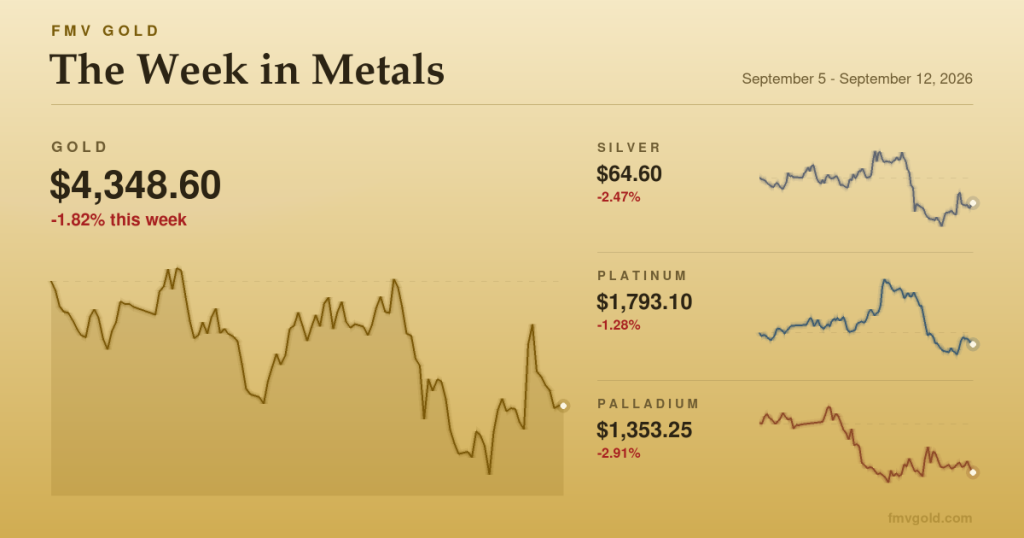
- Gold ended the week down 1.84% at $4,348.60. Week high $4,441.64 in the early hours of Tuesday, September 8. Week low $4,302.30 before dawn on Friday, September 11.
- Silver ended down 2.43% at $64.60. Week high $68.24 on Wednesday, September 9. Week low $63.07 on Friday.
- Platinum ended down 1.42% at $1,797.35 after a $158 round trip. Week high $1,928.42 on Wednesday, week low $1,770.62 on Friday.
- Palladium was the week’s casualty, down 6.30% at $1,303.25. Week high $1,409.53 on Tuesday, week low $1,278.05 on Friday.
The stories that moved the market
The Labor Day session was quiet, with gold holding between $4,383 and $4,433 on thin volume and palladium still carrying the bid it earned when roughly 420 union members walked out at Sibanye-Stillwater’s Montana operations the Thursday before. The selling started Tuesday. Gold printed the week’s high of $4,441.64 during Asian trading and then lost about $90 across the day amid hawkish remarks from Fed Governor Michael Barr, who said the central bank should stand ready to raise rates if inflation stays sticky, and a ten-year yield near 4.8 percent, a twenty-month high at that point. Crude near $100 a barrel, kept there by the U.S.-Iran exchanges around the Strait of Hormuz, was read as an inflation problem rather than a reason to own a haven. Sibanye-Stillwater added a supply headline the same day, opening formal consultations to close its Kwezi shaft at Rustenburg in South Africa, with about 1,114 jobs at stake, after two years of losses.
Wednesday brought a sharp rebound that turned out to be the week’s trap. A softer dollar drew physical buyers back, gold recovered about a percent to $4,401, and silver ran to $68.24 late in the New York morning. Platinum did the most, touching $1,928.42, up more than 4 percent on the day, as the Kwezi news collided with reports of U.S. strikes on Iranian tankers and Houthi attacks on Saudi facilities. The World Gold Council reported the same morning that physically backed gold ETFs took in $18 billion in August, the second-largest monthly inflow on record, lifting holdings to a record 4,189 tonnes. The World Platinum Investment Council’s quarterly report, also out that day, was less friendly: it now forecasts a 265,000-ounce surplus for 2026, reversing an earlier deficit call, on a 15 percent drop in jewelry demand led by China and a 4 percent decline in automotive use.
Thursday undid all of it. The August Producer Price Index rose 0.4 percent on the month and 5.4 percent on the year, a tenth above forecast, with energy costs up 4.2 percent and diesel up 24 percent. The European Central Bank raised its own rate a quarter point to 2.50 percent that morning. The ten-year yield reached roughly 4.95 percent, a level not seen since October 2023, and the complex was sold across the board: gold lost close to 2 percent, silver fell more than 5 percent to a $63 handle, platinum surrendered its entire Wednesday gain and then some, and palladium had its weakest close since early August. Silver falling three times harder than gold on a rates-driven day is the usual pattern.
Friday opened with gold at $4,302.30 before the London morning, the lowest print since early August, and then the Consumer Price Index landed: headline up 0.4 percent on the month and 3.4 percent from a year earlier, both as expected, with core up 0.3 percent against a 0.2 percent forecast and running 2.4 percent annually, gasoline doing much of the work. Hike odds for the September 15 and 16 meeting moved to roughly 90 percent, and gold rallied anyway, closing the week at $4,348.60, up about 0.7 percent on the session. University of Michigan one-year inflation expectations rose to 4.6 percent, the sort of reading that reminds people why they own metal in the first place.
What it means for American gold
For holders of American Gold Eagles, the metal value of a plain one-ounce bullion coin fell by roughly $82 over the week, from the previous Friday’s close. A plain one-ounce American Silver Eagle saw its metal value slip by about $1.61. Both are metal-floor figures, not prices anyone pays or receives.
The older coinage moves on a different clock. A Saint-Gaudens double eagle carries 0.9675 troy ounces of gold, so its floor moved a little less than the Eagle’s, and a Morgan dollar at 0.7734 ounces of silver saw its floor drop by about $1.25. What those coins trade for depends on grade, date, and collector appetite, and proof, graded, and commemorative premiums respond slowly, if at all, to a two-day inflation scare. Our valuation method is built around that distinction.
Palladium supplied the week’s coin story. The U.S. Mint’s sales report of September 9 confirmed that buyers took 4,778 of the 5,000 authorized 2026-W American Palladium Eagles within minutes of the September 3 release. The coin’s obverse is Adolph A. Weinman’s Winged Liberty, the design that ran on the dime from 1916 to 1945 and that the public promptly misnamed the Mercury dime. A sellout of a 5,000-coin issue and a 6 percent drop in the spot metal are unrelated events, which is rather the point.
Where this leaves the market
Gold’s record on our archive is still $5,414.49, set on January 28, 2026, and Friday’s close sits about 19.7 percent below it. Year to date the metal is up 0.7 percent, barely in the black, while silver is down 9.8 percent, platinum down 12.9 percent, and palladium down 19.6 percent. The gap to gold’s 200-day average of $4,538.98 widened from 2.3 percent to 4.2 percent this week. Silver closed 11.7 percent under its own 200-day average near $73.13. The gold-silver ratio ended at 67.3, up from 66.9 a week ago, after swinging from 64.8 at Wednesday’s silver high to 68.4 in the small hours of Friday. Our charts show the full week.
The week ahead
- FOMC two-day meeting, Tuesday and Wednesday, September 15 and 16, with the statement at 2:00 p.m. ET Wednesday and Chair Kevin Warsh’s press conference at 2:30 p.m. ET. Futures markets price a quarter-point increase from the current 3.50 to 3.75 percent range as the likely outcome.
- August retail sales, Wednesday, September 16 at 8:30 a.m. ET, a few hours before the Fed decision.
- The Montana strike continues into a second full week, with no settlement reported as of Friday.
Sources
- Physical Gold Holds $4,385 As August CPI Lifts Rate-Hike Odds To 90%; Silver Slides 2.6% (USAGOLD, September 11, 2026)
- Gold price dodges CPI shock as US yields hand bulls lifeline (FXStreet)
- Gold, silver prices tumble as hot PPI lifts Fed-hike risk (Kitco News)
- Investors Pour $18 Billion Into Gold ETFs As Physical Gold Holds Near $4,383 On Firm PPI (USAGOLD, September 10, 2026)
- Sibanye-Stillwater proposes restructure of South African PGM shaft; 1 114 jobs on the line (Mining Weekly)
- Platinum Quarterly Q2 2026: surplus of 265 koz forecast for 2026 (World Platinum Investment Council)
Price figures are from FMV Gold’s own minute-by-minute spot archive (UTC trading days).