

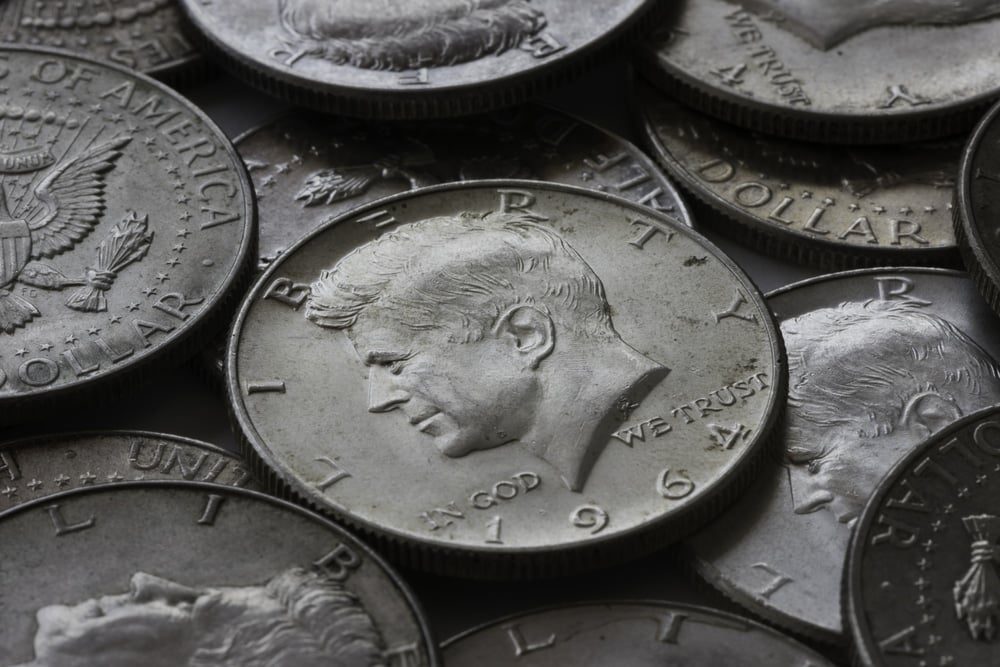
Half dollars stopped being pocket change a long time ago. The Mint issued none for general circulation between 2002 and 2020, striking them only for collectors, and the Federal Reserve did not begin ordering them again until 2021. Plenty of people under fifty have never received one from a cashier.
That is what makes September 14 worth a second look, and why the 2026 9/11 half dollar is suddenly worth knowing about. On that day the United States Mint shipped 250,000 half dollars to Federal Reserve Banks to be placed, in the Mint’s own phrasing, randomly into circulation across the nation. Every one of them carries a small mark honoring the dead of September 11. Nobody is selling these. If you want one, you have to find it.
What the 2026 9/11 half dollar actually is
Start with the coin underneath the mark. The 2026 Semiquincentennial Enduring Liberty half dollar is a one-year design issued for the nation’s 250th anniversary, carrying the dual date 1776 ~ 2026. Donna Weaver’s obverse is a close view of the Statue of Liberty. Beth Zaiken’s reverse shows Liberty passing her torch to a younger generation, with a line from James Madison running along the edge of the scene: KNOWLEDGE IS THE ONLY GUARDIAN OF TRUE LIBERTY.
It is worth pausing on that obverse. A circulating American half dollar has not carried a Liberty design since the Walking Liberty series ended in 1947, with Franklin arriving in 1948 and Kennedy taking over in 1964. Six decades of presidential portraiture, and then Liberty again for a single year.
The metal is ordinary. These are clad coins, 8.33 percent nickel with the balance copper, weighing 11.340 grams at 30.61 mm across with a reeded edge. There is no silver in them and no metal value to speak of. Whatever interest the 2026 9/11 half dollar holds is about the mark, the moment, and how few people will manage to pull one out of a till.
Two privy marks, two very different coins
A privy mark is a small added device struck into a die, historically used to identify a mint or an assayer and used now mostly to flag a special issue. The Mint put two different ones on this design, and the distinction matters if you are looking.
- West Point, W mint mark: the date 9-11-01 encircled by ALWAYS REMEMBER. These are the 250,000 coins now loose in circulation.
- Philadelphia, P mint mark: the same 9-11-01 date encircled by NEVER FORGET. These are sold by the Mint rather than spent.
The Philadelphia version went up for pre-order on September 10 in 20-coin rolls and 100-coin bags, both priced above face value, with the ordering window closing September 25 at 3 p.m. Eastern and shipping expected to begin December 3. The Mint announced no mintage limit, no product limit, and no household limit, which means the final number struck will be whatever the order book asks for. That is an unusual arrangement, and it is the single most important thing to understand before treating these as scarce. A coin with no announced cap is not a coin with a known supply.
The West Point coins are the opposite case. Their number is fixed at 250,000, they were released without ceremony through the banking system, and there is no order form. Both types honor the victims of the September 11, 2001 attacks and the February 26, 1993 World Trade Center bombing. Mint Director Paul Hollis described the privy mark as “a tribute to this solemn anniversary.”
The 2,983 coins that will never be spent
Before either of those releases, the Mint struck a third group at West Point in August: exactly 2,983 pieces, also bearing the ALWAYS REMEMBER privy. The number is not arbitrary. It matches the 2,983 names inscribed on the bronze parapets of the National September 11 Memorial, which include the six people killed in the 1993 bombing alongside those lost in 2001.
All 2,983 went to the National September 11 Memorial and Museum. The Mint did not offer them for sale and did not say how the museum intends to use them. One coin for every name is the kind of gesture that reads better than it photographs, and it is the part of this program most likely to be remembered in twenty years.
How to look for one without wasting your time
Finding a 2026 9/11 half dollar from West Point in the wild is a long shot, and it helps to be honest about the arithmetic. There are 250,000 of them in a country of roughly 340 million people, and half dollars barely move through commerce to begin with.
The usual approach is to ask a bank teller for half dollar rolls, search them, and return what you do not want. Some branches keep them, many do not, and a standing request with a teller you know tends to work better than walking in cold. Coin-counting machines at grocery stores and casino cages are the other places halves surface. Check the mint mark first, since anything without a W is not the circulation issue, then look for the small round privy device on the obverse.
Handle what you find gently and resist the urge to clean it. A coin pulled from circulation will have bag marks and handling wear, and that is normal for the issue. Our guide to how the market works covers why original surfaces matter more than bright ones, and the broader habits in Rules of Gold apply just as well to a fifty-cent piece as to bullion.
Buy, hunt, or neither
Three paths are open and they suit different people. Ordering a Philadelphia roll or bag from the Mint during the window is the certain route, with the caveat about unlimited mintage above. Hunting the West Point coins costs nothing but time and has a real chance of coming up empty. Doing neither is entirely reasonable, and anyone weighing the third option should keep in mind that modern clad commemoratives have a mixed record once the anniversary passes and the initial demand cools.
What is not in doubt is that this is a genuinely unusual moment in American coinage. A one-year Liberty design, two privy marks with different inscriptions, a quarter million coins deliberately scattered into circulation, and a presentation striking counted to match a memorial wall. The Mint does not often do this much at once. For context on the rest of the 250th anniversary program see our full guide to the 2026 Semiquincentennial coins, and for how these decisions get made at all, how the U.S. Mint decides which coins to make is the background piece. Another 2026 issue using a similar privy treatment is covered in our look at the American Palladium Eagle.
If you would rather track values than roll halves, the coin directory and the markets page are the places to start. And if you do turn one up in change, it cost you face value and it says something worth saying.