
A modern gold buyer can start with a calculator.
An early American gold collector needs a history book, a grading eye and a firm grasp of varieties.
That difference is on display at a new gallery in Beverly Hills that combines rare coins and paper money with precious metals, fine art and antiques. CoinNews reported several notable federal gold pieces among its offerings.
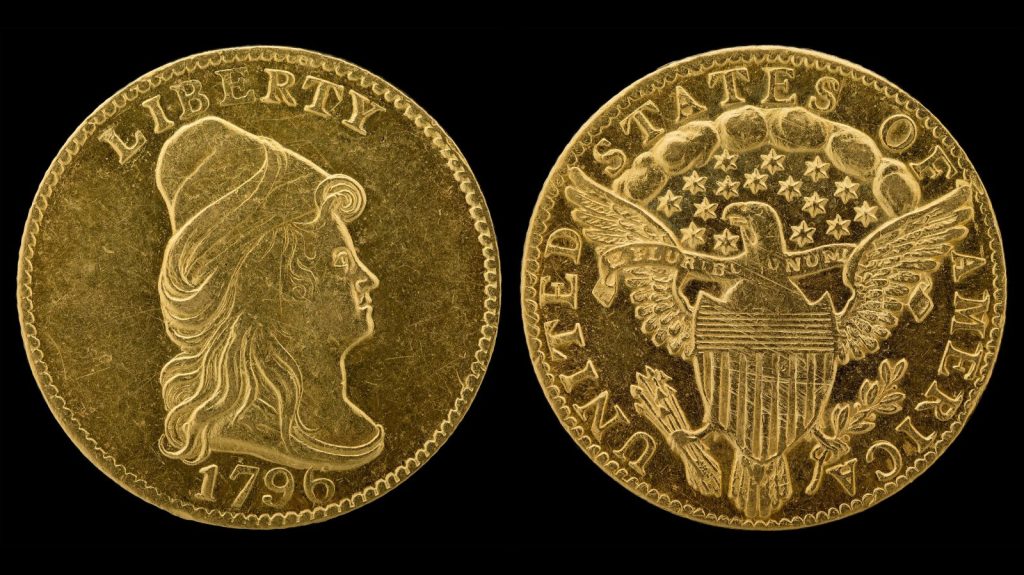
Reported highlights include a 1796 Capped Bust Right $2.50 quarter eagle, No Stars on Obverse, graded NGC MS60; a 1796/5 $5 half eagle graded NGC MS64; an 1804 Capped Bust Right $10 eagle, Crosslet 4, graded PCGS MS62; and an 1879 Flowing Hair $4 Stella graded NGC PF65 Cameo.
Because dealer inventory changes, that reporting should not be read as a guarantee that every piece remains available today.
More interesting than the inventory list is what those four coins can teach.
When “1796” Is Only the Beginning
The 1796 quarter eagle was the first $2.50 gold issue produced by the United States Mint. Its No Stars on Obverse designation immediately demonstrates how advanced American collecting works.
The date matters. The denomination matters. The design type matters. Then the variety matters.
The 1796/5 half eagle adds an overdate to that equation. The 1804 eagle introduces another identifying characteristic with its Crosslet 4 variety.
This is why serious numismatics cannot be reduced to “How much gold is in it?”
Gold establishes intrinsic metal value. It does not explain why collectors distinguish one die variety from another, or why two coins carrying the same denomination and general design can occupy entirely different places in the market.
Grade Is Part of the Coin’s Economic Identity
Now look at the certification labels: NGC MS60, NGC MS64, PCGS MS62 and NGC PF65 Cameo.
Those are not decorative alphabet soup.
A numerical grade describes assessed preservation within a recognized grading framework. Proof is a method of manufacture rather than simply another word for “really nice.” Cameo describes visual contrast between devices and fields.
On scarce American gold, these distinctions can materially affect collector demand.
That does not mean a holder automatically receives whatever a price guide says. Certification is one part of market analysis, not a guaranteed resale contract.
Then There Is the Stella
The 1879 Flowing Hair $4 Stella occupies yet another corner of American numismatics. It is a pattern gold issue and one of the better-known experimental products of the 19th-century U.S. Mint.
That is precisely why the denomination alone tells you so little.
A four-dollar inscription isn’t the story. The historical circumstances, design, format, rarity, condition and collector recognition are.
A $3 Million Bronze Is Still Bronze
There is one more object worth separating from the coins.
The gallery displays a roughly 3.5-foot gilded bronze reduction of Augustus Saint-Gaudens’ Victory, the figure from the General William Tecumseh Sherman Monument in New York’s Grand Army Plaza. The gallery says it carries a $3 million insurance valuation.
Three words matter there: gilded, bronze, insurance.
It is not gold bullion. And a $3 million insurance valuation is not evidence of a $3 million realized auction sale.
Nor should this sculpture be confused with the modern 2026 U.S. Mint Saint-Gaudens gold issue, covered separately in Saint-Gaudens Returns in Gold.
The Real Lesson in Early American Gold
Official American gold can represent several kinds of value simultaneously: precious metal, federal monetary history, artistry, scarcity, condition and identifiable die varieties.
The farther back into early federal coinage you go, the less useful it becomes to pretend melt value tells the whole story.
Start with the issuer. Confirm the date and denomination. Study the variety. Understand the grade. Check provenance and certification. Then study comparable market transactions before deciding what a particular example means financially.
Bullion begins with ounces.
Numismatics begins when the ounce stops answering all the questions.
Image: 1796 No Stars quarter eagle, obverse and reverse. National Numismatic Collection, Smithsonian Institution (public domain).