

Here is a puzzle that trips up a lot of otherwise careful buyers. The United States Mint struck a 24-karat gold coin with a final mintage under 2,000 pieces. It is a legal tender American coin, from a named federal program, in gold. By the arithmetic most people carry around in their heads, a thing that scarce should be expensive. It is not. A decade after the last one left West Point, most of the series still changes hands for a modest step above its metal value.
Those are the First Spouse gold coins, and the series is the single clearest lesson available on where the bullion market ends and the collector market begins.
What First Spouse Gold Coins Actually Are
The Presidential $1 Coin Act of 2005 (Public Law 109-145, signed December 22, 2005) created two things at once. One was the Presidential dollar series that most people remember. The other was a companion program in gold: a half-ounce coin honoring each first spouse, released in the order her husband served, running alongside the dollars from 2007 through 2016.
The specifications are straightforward. Each coin holds a half troy ounce of .9999 fine gold, weighs 15.55 grams, measures 26.50 millimeters across, carries a $10 face value and a reeded edge. The Mint issued both a proof and an uncirculated version of every design, struck at West Point with the W mint mark, and sold bronze medal duplicates of the same artwork for collectors who did not want the gold. It was also the first time the Mint put women on a consecutive series of coins, a genuine piece of American coinage history regardless of how the coins performed.
The program had an elegant solution for presidents who served without a wife. Rather than skip them, the Mint issued a Liberty design taken from circulating coinage of that president’s era, paired with a reverse drawn from his life. That produced Jefferson’s Liberty, Jackson’s Liberty, Van Buren’s Liberty, and a Buchanan’s Liberty whose reverse shows the lifelong bachelor as a young bookkeeper. Chester Arthur, whose wife died before he took office, got a different treatment altogether: the 2012 coin honors Alice Paul and the suffrage movement.
The Mintages Collapsed, and Almost Nobody Noticed
When the first coins went on sale in June 2007, the Mint set a combined limit of 40,000 pieces per design, later described as 20,000 proof and 20,000 uncirculated, with a household limit of five per option. The cap was cut to 15,000 per design in 2008 and trimmed further after that. None of it mattered, because sales never came close to any ceiling.
The first year did fine. Jefferson’s Liberty, the top seller of the entire program, finished at 19,823 uncirculated and 19,815 proof. Note who that coin depicts: not a first spouse at all. By 2008 the uncirculated issues had fallen into the 3,800 to 4,600 range. By the back half of the series they were in four digits and shrinking. Roughly a dozen uncirculated issues finished under 2,000 coins, including:
- 2016-W Betty Ford, 1,824
- 2016-W Pat Nixon, 1,839
- 2014-W Eleanor Roosevelt, 1,886
- 2015-W Lady Bird Johnson, 1,927
- 2014-W Lou Hoover, 1,936
- 2013-W Helen Taft, 1,993
Proofs held up somewhat better and generally stayed above 2,000, with the 2014-W Grace Coolidge the thinnest at 2,315. Congress revived the format once, authorizing a 2020 Barbara Bush coin under Public Law 116-112, which came in at 1,969 uncirculated and 2,967 proof.
Put those figures beside the classic American rarities that draw headlines and they look astonishing. Plenty of celebrated key dates were struck in far greater numbers.
Scarcity Is Only Half of the Equation
A premium is not a property of a coin. It is a property of a conversation between two people, and it requires somebody on the other side who specifically wants that coin. Mintage sets the ceiling on how many can exist. Demand decides whether anyone competes for them.
The First Spouse program never built the demand side. Writing a postmortem on the series for CoinWeek, Louis Golino put the active collector base at fewer than 2,000 people against 42 designs, or 84 if you counted both finishes. The cost of entry explains most of that. Keeping up meant buying four half-ounce gold coins a year at the Mint’s gold-linked pricing grid plus its markup, for a decade. That filtered out exactly the casual buyers who give a series its liquidity later. Design reception was mixed, sales windows stretched past two years in some cases, and the program lived in the shadow of the dollar coins it accompanied.
So the bid that shows up for First Spouse gold coins today is mostly the metal bid. Most issues trade for small premiums over bullion value, and a seller who needs to move a group of them will usually realize something close to spot. There is nothing scandalous about that. It is what happens to any coin whose only distinguishing feature is a number in a mintage table.
The contrast with a series that does have a collector base is instructive. When a modern bullion coin develops genuine key dates, as covered in our look at Silver Eagle key dates, the premium holds because a large, established group of people is trying to finish the same set. The same logic underwrites pre-1933 U.S. gold, where common dates survive in quantity but the collector market for them never went away. Scarcity plus demand is a premium. Scarcity alone is just a small print run.
The Exceptions That Prove the Rule
A handful of First Spouse issues do carry real premiums, and the pattern in which ones is revealing. The Liberty subset (Jefferson, Jackson, Van Buren, Buchanan) attracts buyers who like classic American design and want the coins for what is on them. The two Tyler coins, for Letitia and Julia, have their following. The Jacqueline Kennedy coin draws people who would not otherwise touch the series. And the 2014 Eleanor Roosevelt, the uncirculated key at 1,886, has firmed up since release on demand that grew while the supply stayed fixed.
Not one of those is the scarcest coin in the program. They are the most wanted. That is the whole lesson, and it generalizes well beyond this series, which is why we keep returning to the moment a bullion coin becomes a collectible.
How to Think About Them as a Buyer or an Owner
None of this makes First Spouse gold coins a mistake. It makes them a particular kind of holding, and the honest framing is simple.
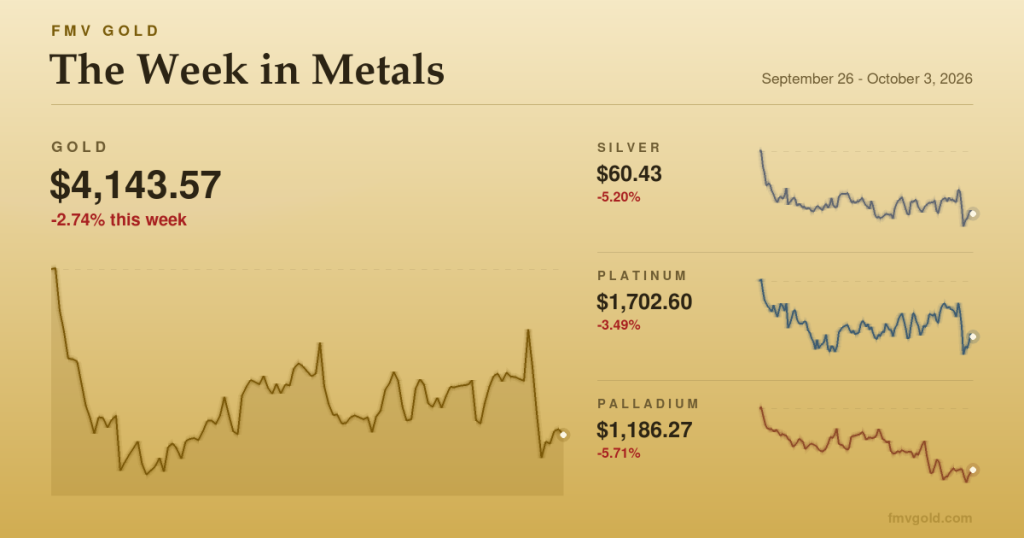
Start from the metal. You own half an ounce of .9999 gold, and with gold quoted around $4,373 an ounce in mid-September 2026, that floor does the heavy lifting in the value of a common issue. Everything above it is optional and should be treated as such. The rules of gold that apply to any bullion holding apply here first.
Keep the original packaging and the certificate. Sets and slabs that arrive intact are easier to place later, and the difference costs nothing to preserve. Understand that the round trip on anything priced as a collectible is wider than the round trip on plain bullion, so a premium you pay going in is a premium you need somebody else to pay coming out. If you are buying for the gold and want American fractional weight, compare the program honestly against a half-ounce Gold Eagle, which is liquid everywhere and priced by the ounce rather than by the story.
And if you are buying because you like the designs or the history, that is a perfectly good reason. Just underwrite the purchase on the metal and let the rest be a bonus. You can see how a piece is priced against live metal on our markets page, browse the broader coin catalog, or read how it works if you are new to valuing a coin against its content.
Twenty years from now, some of these may well be scarce and wanted at the same time. Coins occasionally find their audience late. But that would be a change in demand, not a change in mintage, and the mintage was never the part in question.