

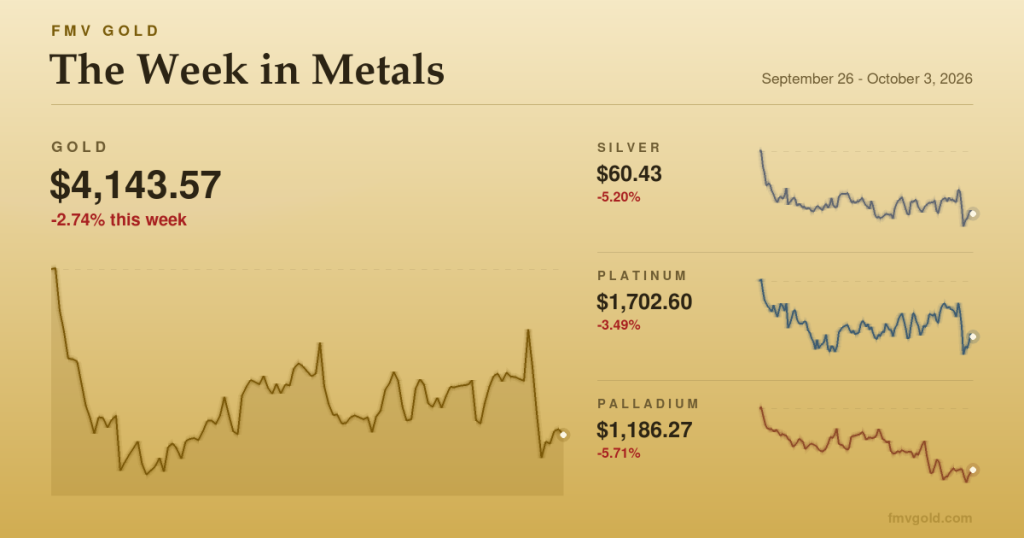
The best price of the week arrived in its first ten minutes. Gold reopened on Sunday evening, September 27, near $4,274, and that was as good as it got. President Trump had rejected Iran’s offer to reopen the Strait of Hormuz over the weekend, oil jumped, and by Monday’s close gold had lost almost 4 percent, its worst day since June. Softer economic data offered some relief after that, but the highest Treasury yields since 2002 outweighed it, and even a jobs report showing just 29,000 new positions could not hold a rally past lunchtime on Friday. Gold finished the trading week that ended Friday, October 2 down 3.31 percent, its steepest weekly loss since early June.
The week in numbers
- Gold ended the week down 3.31% at $4,143.57. Week high $4,274.47 minutes after the Sunday evening reopen, September 27. Week low $4,112.90 late Monday afternoon, September 28.
- Silver ended down 6.02% at $60.43, its weakest week since mid-July. Week high $64.09 at the Sunday reopen. Week low $59.77 on Friday, October 2, just before noon in New York.
- Platinum ended down 4.43% at $1,702.60. Week high $1,774.08 at the Sunday reopen, week low $1,682.47 on Friday, minutes after silver’s.
- Palladium fared worst, down 7.85% at $1,171.35. Week high $1,265.70 at the Sunday reopen, week low $1,162.89 on Friday. (Three lone prints near $1,150, each amid quotes above $1,200, are excluded as data errors.)
The stories that moved the market
Most of the damage was done before Americans were out of bed on Monday. Iran had offered the previous Friday to reopen the Strait of Hormuz in exchange for sanctions relief and an end to the U.S. naval blockade, and President Trump called the proposal “not acceptable” on Saturday. When markets reopened, Brent crude rose more than 3 percent to around $107 a barrel, futures odds of another Federal Reserve rate increase at the October 27 and 28 meeting climbed to about 70 percent, and the ten-year Treasury yield moved back above 5.2 percent. Gold slid to a session close of $4,115.73, down 3.96 percent and its lowest since early August. Silver lost 5.2 percent on the day and palladium 4.8 percent.
Tuesday brought a partial recovery on bad news of the useful kind. The Conference Board’s consumer confidence index fell to 81.9, its lowest reading since 2014. New York Fed President John Williams said there was “no need for urgency” on another rate move, October hike odds fell back to roughly even, and gold closed up 1.6 percent at $4,182. On Wednesday the August PCE price index, the Fed’s preferred inflation gauge, rose 3.4 percent from a year earlier against a 3.7 percent forecast, with the core measure at 3.0 percent against 3.3 percent, and gold touched $4,216.57 within a minute of the release. Long-dated Treasuries sold off anyway, amid an upward revision to second-quarter growth, and gold gave back the whole move to close at $4,157. That close also settled September: gold lost 6.5 percent on the month in our archive, and silver 9.2 percent.
The bond market took over on Thursday. The ten-year yield reached 5.34 percent, a level last seen in 2002, in a selloff that swept government debt from London to Tokyo. The dollar traded near a 17-month high and Brent climbed back above $100. Gold still managed to add 0.5 percent, to $4,177.83, amid Fed Vice Chair Philip Jefferson’s remark that judging the next move “may take more time.” Palladium fell another 1.8 percent amid the firm dollar and, by some accounts, weaker expectations for automotive demand, on its way to a fourth losing week in five.
Then came the jobs report, the week’s cleanest test, and gold failed it. The Bureau of Labor Statistics said payrolls grew by 29,000 in September against forecasts near 90,000, the unemployment rate rose to 4.2 percent, and August’s gain was revised down to 133,000. Futures odds of an October hike dropped to about 22 percent. Gold jumped to $4,224.15 five minutes after the release, turned around while the ten-year yield held near 5.3 percent, and by noon in New York was back at $4,127. Silver, platinum, and palladium all set their lows for the week within minutes of that. The plainest reading is that long-term yields, more than the next Fed meeting, are doing the pricing for now.
What it means for American gold
For holders of American Gold Eagles, the metal value of a plain one-ounce bullion coin fell by roughly $142 over the week, measured from the previous Friday’s close. A plain one-ounce American Silver Eagle saw its metal value drop by about $3.87. Those are metal-floor figures, the worth of the metal inside the coin, and say nothing about what any coin changes hands for.
Classic coins moved in proportion to what they contain. A Saint-Gaudens double eagle holds 0.9675 troy ounces of gold, so its floor slipped by slightly less than the Eagle’s. A Morgan dollar or Peace dollar, at 0.7734 ounces of silver apiece, gave up about three-quarters of what the Silver Eagle did. Premiums on proof, graded, commemorative, and pre-1933 pieces are a separate and slower story, set by collector demand over months and largely indifferent to one bad Monday. The Eagles have some seasoning of their own by now: Congress authorized them in 1985 and the first gold and silver pieces reached buyers in the autumn of 1986, forty years ago this season. They have seen worse weeks. The gap between metal and market is why our valuation method treats melt as a floor.
Where this leaves the market
Gold closed the week 23.5 percent below its record close of $5,414.49, set on January 28, compared with 20.9 percent a week earlier. It sits about 8.6 percent under its 200-day average of roughly $4,535, a gap that was 5.6 percent a week ago, and it is now down 4.0 percent for the year. The $4,250 floor that had held since late August is gone.
Silver is 15.6 percent lower on the year and 48.2 percent below its January 28 peak of $116.61, with its 200-day average near $73. The gold-silver ratio ended at 68.6, up from 66.6 a week ago, the mark of a week in which silver was sold nearly twice as hard as gold. Platinum is down 17.5 percent in 2026 and 38.7 percent below its January 23 high of $2,776.90. Palladium is down 27.8 percent this year and closed within 35 cents of its lowest finish of the past twelve months. All four are on our charts.
The week ahead
Monday, October 5 brings the ISM services index for September. On Wednesday, October 7 the Fed publishes the minutes of the September 15 and 16 meeting at which it raised rates. Weekly jobless claims follow on Thursday, and the University of Michigan’s preliminary October sentiment survey on Friday, October 9. China’s Golden Week holiday runs through Wednesday, which tends to thin trading in Asian hours, and the Fed’s next decision is due October 28.
Sources
- Oil prices surge after Trump rejects Iran’s plan to reopen Strait of Hormuz (Al Jazeera)
- Consumer confidence plunges to lowest level since 2014: Conference Board (Yahoo Finance)
- Gold Sells the Soft PCE Report as Surging Yields Overpower Falling Rate Hike Odds (The Gold Forecast)
- Global bond sell-off pushes 10-year Treasury yield to highest since 2002 (The Irish Times)
- Fed officials wash away market bets on October rate increase (Kitco)
- Gold heads for weekly drop as strong dollar, elevated Treasury yields weigh (Kitco)
Price figures are from FMV Gold’s own minute-by-minute spot archive (UTC trading days).