

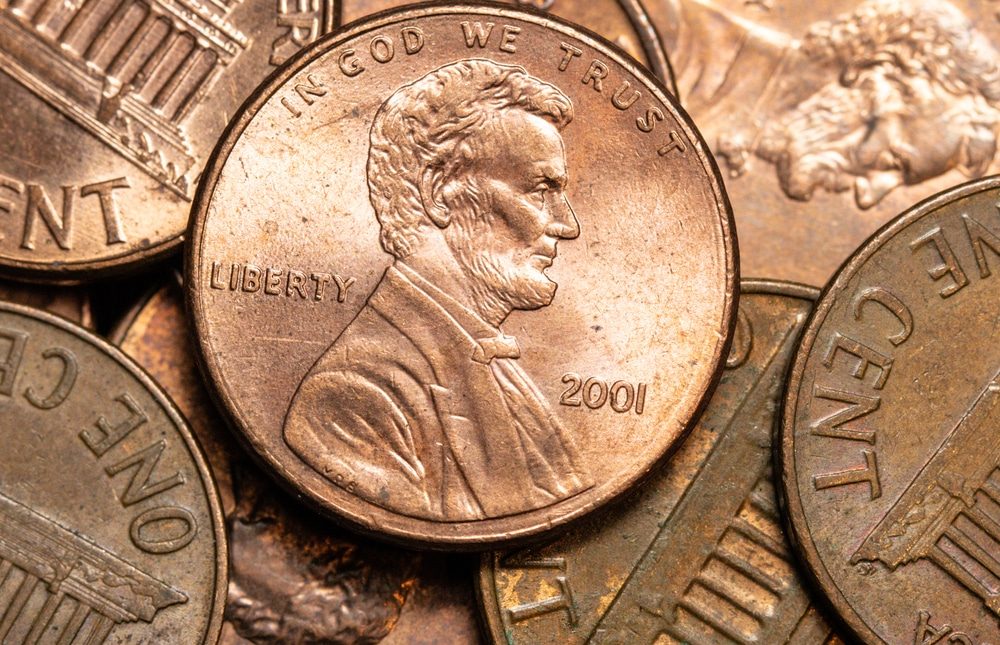
The Senate cleared the Common Cents Act on September 28, 2026 by unanimous consent, two weeks after the House passed it on a voice vote. The bill now sits on the President’s desk awaiting a signature, which had not been given as of this writing. Most of the coverage has treated it as the penny’s obituary, which is understandable and also a little late: the Mint struck its last circulating cent in November 2025. The provision worth a collector’s attention is three paragraphs further down, and it concerns the nickel.
What the Common Cents Act actually does
The measure that passed is H.R. 10167, sponsored by Representative Lisa McClain of Michigan and cosponsored by Representative Robert Garcia of California. It runs to seven short sections, and it does four separate things.
First, it amends Title 31 of the U.S. Code to direct the Treasury Secretary to cease production of one-cent coins for general circulation, while expressly allowing the Mint to keep striking cents as numismatic items. Every cent minted before enactment stays legal tender for all debts, public charges, taxes, and dues. Nothing in your album stops being money.
Second, it sets up a rounding framework for cash. If exact change cannot be made, a total ending in 1, 2, 6, or 7 cents may be rounded down to the nearest nickel, and one ending in 3, 4, 8, or 9 may be rounded up. Totals of one or two cents may be rounded up to five. The rounding is permissive rather than mandatory, it applies only to cash, and it exempts checks, cards, electronic transfers, gift cards, and money orders. Employers paying wages in cash must round in the employee’s favor.
Third, it gives the Federal Reserve homework: a public strategic plan, due within 90 days of enactment, on how commercial coin terminals will keep handling penny orders and deposits, plus a Treasury assessment of how the change lands on low-income, older, and unbanked Americans.
Fourth, and this is the part that reads differently if you collect coins, it changes the five-cent piece and it changes how any circulating coin can be killed off in the future.
The nickel clause
Section 2 rewrites the statutory description of the five-cent coin. Where current law fixes the weight at 5 grams, the amended text allows 5 grams for a copper-nickel coin or anywhere between 4 and 6 grams for a coin made to the new specification: an inner layer of zinc with an outer layer of nickel. The Secretary gets to prescribe the exact ratio, subject to testing showing that it lowers production cost and, in the statute’s words, has minimal adverse impact on machines designed to accept coins.
Put plainly, Congress has authorized a clad nickel with a zinc core and left the recipe to Treasury.
The arithmetic behind it is not subtle. The five-cent coin has been 75 percent copper and 25 percent nickel since the denomination was introduced in 1866, with one wartime exception. The Mint’s fiscal 2024 figures put the cost to make and distribute one at roughly 13 to 14 cents, well over twice face value, and that was the twentieth consecutive fiscal year in which both the cent and the nickel cost more than they were worth. Zinc trades at a fraction of copper’s price per tonne, so swapping the core is the obvious lever.
Collectors have seen this movie before. In 1982 the cent went from 95 percent copper to copper-plated zinc, and the Lincoln series split into two composition types that are still sorted by weight and by the sound they make when dropped. If Treasury acts on this authority, the Jefferson nickel will do the same thing. There is no date set, no composition chosen, and no guarantee the Secretary moves at all. But the statutory door, which has been shut since the Shield nickel debuted, is now open.
The quiet procedural change
Section 6 may outlast every other provision. It amends the Mint’s governing statute so that the Treasury Secretary may discontinue minting any currently circulating coin only after giving the House Financial Services Committee and the Senate Banking Committee 60 days’ notice, a written rationale covering fiscal and operational grounds, a comprehensive phase-out plan addressing the effect on consumers and businesses, and a briefing within 30 days of that notice.
Consider how the penny ended. Treasury simply stopped ordering blanks, and the ceremonial final strike in Philadelphia on November 12, 2025 was the public face of an administrative decision, not a legislative one. Treasurer Brandon Beach pressed the last circulating cent after a 232-year run that began with the Coinage Act of 1792. Whatever you think of the outcome, no one voted on it. Going forward, no denomination can slip out the back door that way. That is a real change in how American coinage is governed, and it arrived in a bill named after a pun.
What this means for what is in your album
Very little, in the short run, and that is worth saying plainly. The Mint’s own estimate puts about 300 billion cents in circulation, a supply that dwarfs anything commerce needs. Scarcity is not the story here, and a coin minted in the hundreds of billions does not become rare because Congress noticed. Cents remain legal tender, numismatic strikes continue, and the 2025 issues are interesting for what they mark rather than for how few exist.
The composition question is the one to watch. Collectors who assemble Jefferson nickels by date and mintmark may eventually be assembling them by alloy as well, and the only prior break in that series came between 1942 and 1945, when Congress pulled nickel out of the coin for the war effort and substituted an alloy of 35 percent silver, 56 percent copper, and 9 percent manganese. Those wartime pieces, with their oversized mintmark above Monticello, are the one place the five-cent coin has ever carried precious metal. Anyone who has worked through the end of circulating silver coinage will recognize the pattern: metal costs move, and the coins follow.
For the cent, the long arc is already written. Our history of the penny from 1793 to 2025 traces it from the Flowing Hair chain cent through the 1857 shrinkage, the Lincoln redesign of 1909, the steel cents of 1943, and the zinc conversion of 1982. The Common Cents Act writes the last line of that story into the United States Code, and it adds the cent to a list that already includes the half cent, the two-cent piece, the three-cent pieces, the twenty-cent piece, and the trade dollar. If that company interests you, the discontinued denominations are a good afternoon.
What happens next
Three things are worth tracking. Whether the President signs, which industry groups expect in the coming weeks but which has not happened yet. Whether the Federal Reserve’s 90-day report reveals real friction in the coin terminals, because the practical problem with retiring a coin is not minting it, it is collecting the ones already out there. And whether Treasury exercises the nickel authority, which is the decision that would actually change what comes out of the presses.
None of this alters metal content in anything already struck, and none of it is a reason to buy or sell anything. It is a reminder that circulating coinage is a policy instrument first and a collectible second, and that the two occasionally trade places. If you are sorting through what you have, our valuation walkthrough explains how metal content and condition are weighed separately, and the coin catalog covers the series in detail.
The penny is finished either way. The nickel is the one with an open file.