

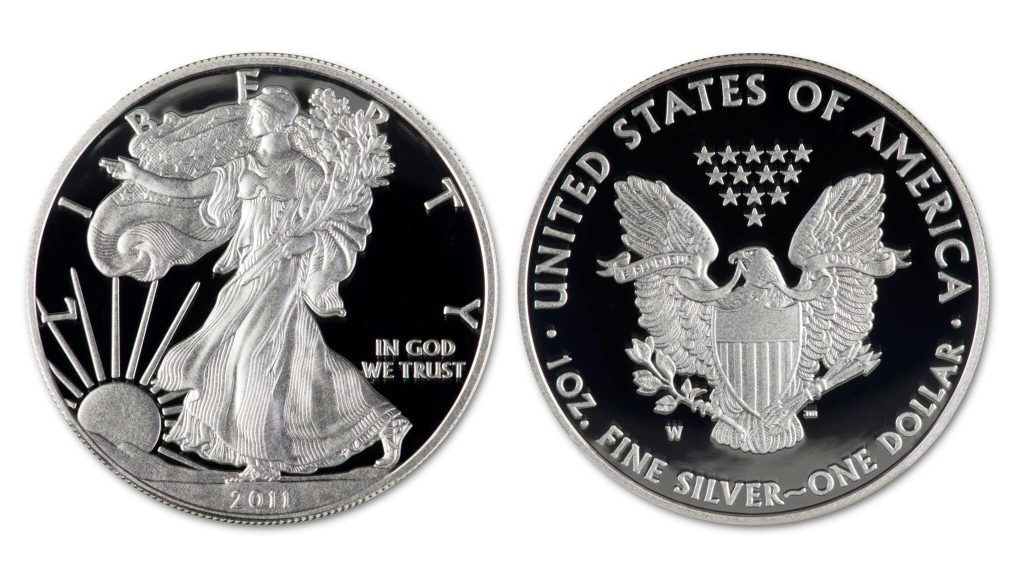
Two American Silver Eagles can sit side by side in the same case. Each holds one ounce of the same .999 fine silver, wears the same design, and carries the same one dollar face value. One sells for a small premium over its metal content. The other can bring the price of a used car. Nothing about the silver explains the gap. The difference lives in the numbers, the finish, and the story behind each coin.
That gap is the heart of a question every buyer eventually runs into: when does a bullion coin become a collectible? A coin struck by the million to track the metal price is not supposed to carry a collector premium, yet some do, and a few carry very large ones. Knowing why helps you tell the difference between paying for silver and paying for scarcity.
What “collectible” means for a bullion coin
Bullion coins exist to move metal. The U.S. Mint sells American Silver Eagles and American Gold Eagles first as a convenient, trusted way to own an ounce, and their price tracks spot closely. A numismatic coin, by contrast, is valued for rarity, condition, and history rather than metal alone. Between those two poles sits a wide gray band, the semi-numismatic zone, where a mass-produced coin picks up demand beyond its melt value. We walked through that boundary in our look at what retail investors are really paying for. This piece follows the thread further, into the specific triggers that move a coin across the line.
The forces that decide when a bullion coin becomes a collectible
Several forces can lift an ordinary bullion issue above its metal floor. Rarely does one act alone. Usually two or three stack up on the same coin.
- Low mintage. Scarcity is the oldest driver of coin value. When a mint strikes far fewer of one year or one variety, collectors compete for the survivors and the price separates from spot.
- Special finish. A proof coin, with mirrored fields and frosted devices, is made differently from a plain bullion strike. Burnished uncirculated, reverse proof, and enhanced reverse proof versions add further variety, each produced in its own smaller run.
- First-year and last-year issues. The debut of a series, or the final year of a design, tends to draw extra attention. When the Mint changed the Silver Eagle reverse partway through 2021, the retiring earlier design became a natural target for collectors closing out the run.
- Condition and grading. Independent services such as PCGS and NGC assign a numerical grade. A coin certified at the top of the scale, MS70 or PR70, can command a premium over the identical coin one point lower, because flawless examples are a thin slice of any batch.
- Errors and varieties. A doubled die, a missing mint mark, or a struck-through flaw can turn an otherwise common coin into a sought-after oddity.
Two coins that show the pattern
The Silver Eagle series, running since 1986, offers two clean examples of a bullion coin crossing into collectible ground.
The 1995-W Proof Silver Eagle is the acknowledged key date of the series. It was never sold on its own. The only way to get one was to buy the 10th Anniversary American Eagle Proof Set, a five-coin package that paired the silver proof with four gold proofs and cost far more than most buyers wanted to spend for a single silver coin. Roughly 30,000 of those sets sold, so only about that many of the silver proofs exist, against a regular 1995 proof struck in the hundreds of thousands. Decades on, top-graded examples of the 1995-W have changed hands at auction for well into five figures, more than the four gold coins that once shipped in the same box.
The 2019-S Enhanced Reverse Proof Silver Eagle is the modern echo of that story. The Mint capped production at 30,000 coins and released it in November 2019. It sold out in under twenty minutes, and the certified population sits just below that ceiling. A coin barely a few years old, made of the same silver as every other Eagle, trades today as a genuine rarity for one reason: almost none were ever available to begin with.
What this means when you buy
For a stacker who simply wants ounces, the lesson is reassuring. Standard bullion Eagles do their job, tracking the metal at a modest premium, and you can watch that premium against live spot on our markets page. You are paying for silver, and you will get silver back.
The caution runs the other way. When a coin asks a large multiple of its melt value, that price rests on collector demand rather than metal, and collector demand can move independently of the spot chart. We traced a version of that split in how smart money decides to buy or bail when gold sets records but coins stay quiet. A proof or a low-mintage key date can hold or grow in value, or it can drift if tastes change.
The single most useful habit is to know which coin you are buying before the money changes hands. Ask what it would be worth if the collector premium vanished and only the metal remained. For a plain bullion Eagle, the answer is most of the price. For a graded key-date proof, the answer is a small fraction, and the rest is the market’s judgment of scarcity. Our rules of gold lay out the principles we think hold up over time, how it works explains the way we value coins on the site, and you can browse the full range in the coin catalog.
The short answer
So when does a bullion coin become a collectible? The moment enough buyers decide its scarcity, its finish, or its condition is worth more than its silver. That decision belongs to the market, not the mint, and it can build over decades or arrive in a single afternoon of a fast sellout. Learn the handful of triggers, and you can usually see it coming.