

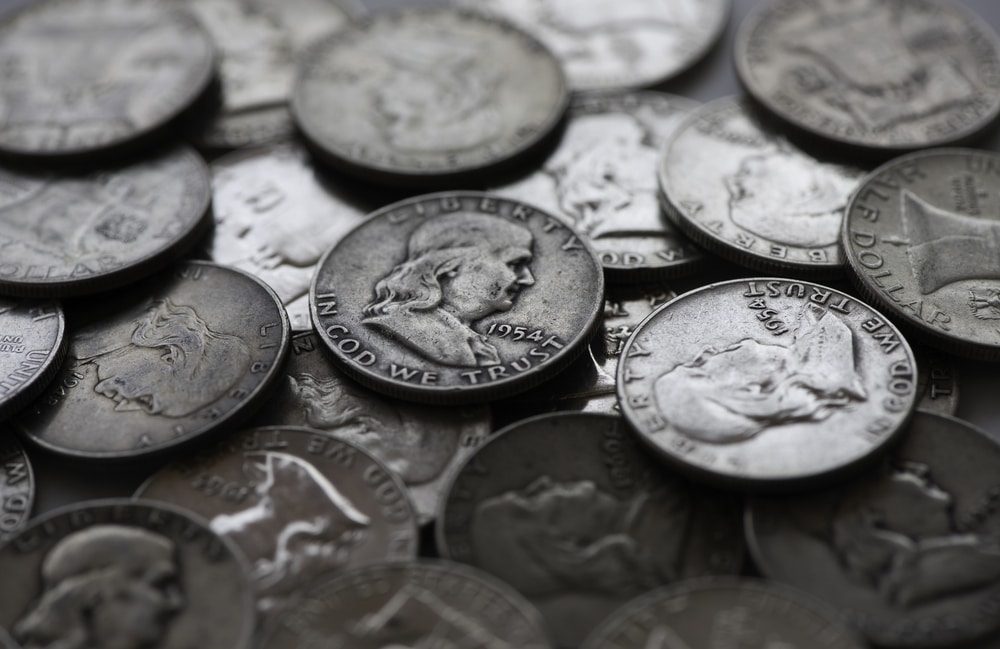
Half dollars stopped being pocket change a long time ago, so when one turns up in a coffee can of old coins it gets a second look. If it shows Benjamin Franklin on the front and the Liberty Bell on the back, it is ninety percent silver and it left a mint between 1948 and 1963. Sixteen years is a short life for an American coin design, and that brevity is part of why the Franklin half keeps drawing buyers who want silver with some history attached.
The Coin Nellie Tayloe Ross Wanted
Mint Director Nellie Tayloe Ross had been thinking about a Franklin coin for years before it happened. The U.S. Mint’s own January 1948 announcement of the new design says plainly that “Mrs. Ross envisaged several years ago a new half dollar honoring Franklin and the Liberty Bell.” She instructed Chief Engraver John R. Sinnock to develop it, and the timing worked because the Walking Liberty half dollar it replaced had been in service since 1916. An 1890 statute let the Mint change a design after twenty-five years without going back to Congress, and the Walking Liberty, beautiful but notoriously difficult to strike well, had long since passed that mark.
Sinnock finished his models a few weeks before he died in May 1947. Gilroy Roberts completed the reverse. The obverse portrait follows an eighteenth century bust of Franklin by the French sculptor Jean-Antoine Houdon. The reverse bell was adapted from John Frederick Lewis’s sketch for the 1926 Sesquicentennial half dollar, a connection numismatic author Don Taxay turned up decades later.
That small eagle perched to the right of the bell was not an artistic choice. Federal coinage law requires an eagle on the reverse of the dollar, half dollar, and quarter, so one had to go somewhere, and Sinnock tucked it in beside the bell. The Commission of Fine Arts was unimpressed. It complained that “the eagle shown on the model is so small as to be insignificant and hardly discernable when the model is reduced to the size of a coin,” and it also objected to the crack in the bell on the grounds that “to show this might lead to puns and to statements derogatory to United States coinage.” The Mint Director went ahead anyway and production began in the spring of 1948.
One quiet distinction: Franklin was only the fifth person to appear on a regular issue American coin, after Lincoln, Washington, Jefferson, and Franklin D. Roosevelt, and the first of them who had never been president. Everything before that had been an allegorical Liberty or a Native American portrait.
What the Coin Actually Contains
The specifications are simple and worth committing to memory. A Franklin half is ninety percent silver and ten percent copper, weighs 12.5 grams, measures 30.6 millimeters across, and has a reeded edge. Its actual silver content is 0.36169 troy ounces, a little more than a third of an ounce.
That number matters because it is not one ounce, and confusing the two is the fastest way to misjudge what a coin is worth as metal. Silver spot sat near $63.87 an ounce on September 11, 2026, according to Forbes Advisor, and you can watch the live figure on our markets page. Multiply spot by 0.36169 and you have the metal floor under a circulated Franklin. Anything above that floor is being paid for condition, date, or the fact that somebody wants that particular coin.
Bulk buyers usually skip the per-coin math entirely and trade these by face value instead. A dollar in worn ninety percent silver coinage, whether that is ten dimes, four quarters, or two Franklin halves, holds roughly 0.715 troy ounces of silver. If that convention is new to you, our guide to junk silver walks through how bags and rolls are priced.
Key Dates, Mint Marks, and the Bell Line Problem
Philadelphia coins carry no mint mark. Denver and San Francisco coins show a D or an S above the wooden yoke the bell hangs from on the reverse. San Francisco participated in only five years of the series, 1949 and then 1951 through 1954, because the old facility suspended coining operations in March 1955. It was downgraded to an Assay Office in 1962, brought back for coinage in 1965, and formally restored as a Mint in 1988.
The low mintage dates are easy to list. Philadelphia struck 3,006,814 in 1948, 2,668,120 in 1953, and 2,498,181 in 1955, when it was the only mint making halves at all. San Francisco produced 3,744,000 in 1949, 4,148,000 in 1953, and 4,993,400 in 1954. Thirty-five business strike combinations of date and mint mark make up the complete set, which is one reason the series appeals to people who like finishing things. Proofs came out of Philadelphia from 1950 through 1963, with mintages climbing from 51,386 in the first year to more than three million by 1962 as the hobby boomed.
Condition is where the Franklin series gets genuinely tricky. Graders look for Full Bell Lines, meaning the horizontal lines across the bottom of the Liberty Bell run complete and separated from one side to the other. Weak strikes were common, and some issues almost never came out right. The 1953-S is the notorious case: on a mintage above four million, perhaps two hundred coins in all Mint State grades qualify as Full Bell Lines, and PCGS reports having encapsulated just two in MS65+FBL and two more in MS66FBL. Those trade in the five figures and up when they surface, which is a remarkable spread for a coin that was ordinary change in 1953. Denver coins tend to show the bell lines most often.
Collectors also chase the 1955 “Bugs Bunny” variety, where a die clash left marks from the eagle’s wing across Franklin’s mouth that look like buck teeth. A die accident rather than a rarity, but it has a following.
So Are Franklin Half Dollars a Good Investment?
Asking whether Franklin half dollars are a good investment is really two separate questions, and mixing them up causes most of the disappointment buyers report.
The first question is about silver. A worn Franklin is a bar of metal in coin form, priced off spot with a modest markup, and it behaves the way silver behaves. It rises and falls with the metal, it is small enough to sell in pieces, and Americans recognize it on sight, which helps when you want to move it. The generally understood appeal of ninety percent coinage is divisibility and familiarity rather than any premium advantage, and our Rules of Gold covers how that kind of recognition affects liquidity.
The second question is about the numismatic side, and there the answer turns entirely on grade and strike. A common date Franklin in Mint State is an inexpensive coin because millions survive in rolls and bags. The same coin certified with Full Bell Lines, or a scarce date with them, sits in an entirely different market. Whether Franklin half dollars are a good investment in that sense depends on your ability to judge a strike, or your willingness to pay for third party certification so somebody else has judged it. The premium is real, but it is a premium on a specific attribute, not on the series as a whole.
Two habits keep buyers out of trouble. Decide before you shop which of the two markets you are in, because a metal buyer paying a collector price and a collector buying unattributed rolls both end up unhappy. Then compare offers from more than one source; our dealer directory and the listings on our coin pages make that easier, while how FMV works explains the valuation method behind them.
The series ended abruptly. Franklin’s design had run only sixteen of the twenty-five years that would have let the Mint retire it on its own authority, so when President Kennedy was assassinated in November 1963, Congress authorized a replacement half dollar on December 30 of that year. If you like coins that mark a turning point, this one sits right at the edge of the era before base metal took over. Readers working through the rest of that era may also want the companion profiles of the Walking Liberty half dollar that came before it and the Mercury dime.