

Pull a tray of Mercury dimes across a coin show table and something happens: people who never look twice at a modern quarter slow down. The little silver dime with the winged head is one of the most admired designs the United States ever put into pocket change, and it circulated by the billions from 1916 into the 1940s. That combination, beloved and common, is exactly what makes it worth understanding before you buy. So are Mercury dimes a good investment, or just a handsome piece of history? The honest answer depends entirely on which Mercury dime you are holding.
What a Mercury dime actually is
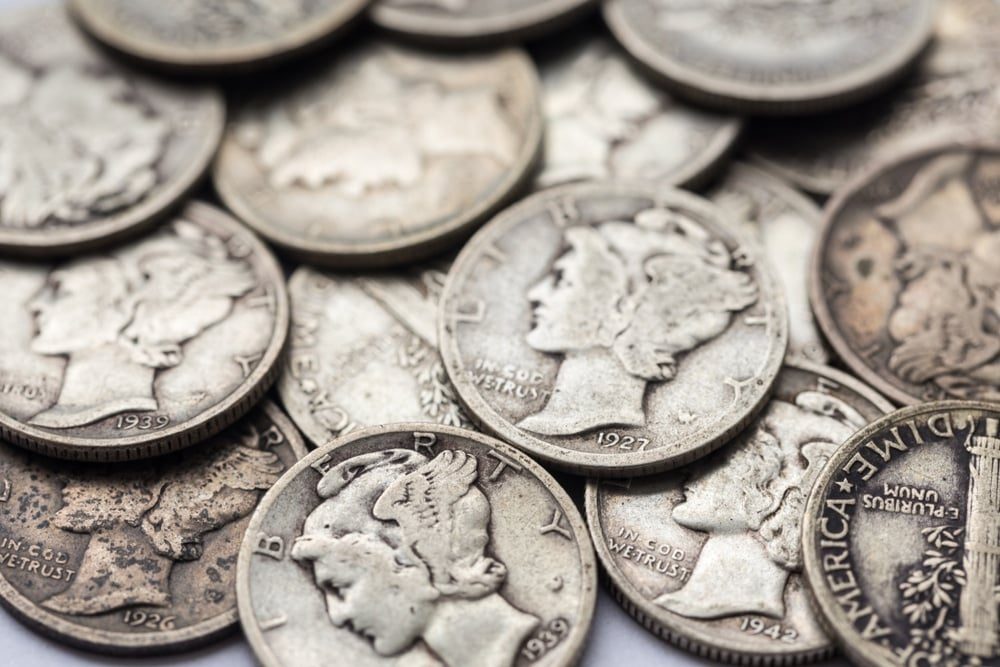
The coin’s real name is the Winged Liberty Head dime. Sculptor Adolph A. Weinman designed it, and the U.S. Mint struck it from late 1916 through 1945. It replaced the Barber dime, and after Franklin Roosevelt died in April 1945 the Mint retired Weinman’s design and introduced the Roosevelt dime in 1946, the coin we still carry today.
Each Mercury dime is 90 percent silver and 10 percent copper, weighs 2.5 grams, and measures 17.9mm across with a reeded edge. That works out to roughly 0.0723 troy ounces of silver per coin, the same content as every other pre-1965 U.S. dime. Hold ten of them and you are holding close to three-quarters of a troy ounce of silver. That number matters, and we will come back to it.
The nickname is a friendly mistake. Weinman put a small wing on Liberty’s cap to stand for freedom of thought. To most Americans the winged head looked like the Roman messenger god Mercury, the name stuck, and it has outlived every attempt to correct it. Weinman himself always called the figure Liberty.
The design and the story behind it
Weinman had a remarkable year in 1916. The same artist gave the country the Walking Liberty half dollar in the same twelve months, two designs still considered high points of American coinage. Liberty on the dime is widely believed to be modeled on Elsie Stevens, wife of the poet Wallace Stevens, from a bust Weinman had sculpted a few years earlier.
Turn the coin over and you find something most people never stop to read. The reverse shows a fasces, a bundle of rods bound around an axe, wrapped by an olive branch. The bundle stands for strength through unity, the branch for peace. Weinman chose it on the eve of American involvement in World War I, a quiet statement of a nation ready to defend itself but hoping for peace. The symbol later picked up heavy political baggage in 1920s Europe, but on a 1916 dime it is pure classical Rome, the way Washington’s own era understood civic virtue.
Key dates and varieties collectors chase
Most Mercury dimes are common. The Mint made more than 2.6 billion of them, so the great majority you will encounter are ordinary circulated coins worth their silver plus a modest collector premium. A handful of dates and varieties are the reason the series has a devoted following.
- 1916-D is the series key. Denver struck only 264,000 that first year, a tiny figure next to the millions made at Philadelphia, and genuine examples in any grade carry a strong premium over common dates.
- 1921, 1921-D, and 1926-S are the classic scarce dates, each with low mintages that make a complete date-and-mintmark set a real project.
- The 1942/1 overdate is the famous wartime error. During the busy 1941-to-1942 changeover, a working die took one impression from a 1941 hub and was then finished with a 1942 hub, leaving a faint 1 beneath the 2. It happened at both Philadelphia (the bold 1942/1) and Denver (the fainter 1942/1-D, not widely recognized until the early 1960s). PCGS estimates only a few thousand survivors of each across all grades, and far fewer in mint condition.
Full Bands: the detail that changes everything
On the reverse, the central band that wraps the fasces has two thin horizontal lines. When a coin was struck sharply enough that those lines show fully separated, graders add a Full Bands (FB) designation. It sounds like a triviality. In practice a Full Bands example of a scarce date can be worth many times an otherwise identical coin without the designation, because a sharp full strike was uncommon on this small, intricate design. If you ever buy a Mercury dime for the premium above its silver, the strike is often what you are paying for.
Are Mercury dimes a good investment?
Here is where a buyer has to be honest about which game they are playing, because there are two very different ones.
The first is the metal play. Circulated common-date Mercury dimes trade as 90 percent junk silver, valued for the roughly 0.0723 troy ounces of silver each contains. With silver as metal value near 67 dollars an ounce in late August 2026, a bag of these is a way to own recognizable, divisible silver in small units. As an investment, this behaves like silver, no more and no less. The design is a bonus; you are buying weight.
The second is the numismatic play. A 1916-D, a 1942/1, or a high-grade Full Bands coin is a scarcity or condition bet, and its value comes from how few exist and how many collectors want them, not from its silver. Those coins have historically held and grown their premiums, but they demand knowledge, authentication, and patience, and their prices move with the collector market rather than with spot.
Neither approach is wrong. The mistake is confusing them: paying a rare-coin premium for a common date, or expecting a bag of worn dimes to appreciate like a key date. Decide which one you are buying before you reach for your wallet. If you want a broader silver position rather than a collectible, the American Silver Eagle is the modern one-ounce standard, while the classic Morgan and Peace dollars sit between metal and collectible the way key-date Mercuries do.
How to buy Mercury dimes well
For the metal buyer, common circulated dimes bought close to their silver content are the cleanest entry, and mixed-date lots are fine because you are buying ounces. Sort for dates only if you enjoy the hunt.
For the collector, three habits protect you. Learn to read the date and mintmark, since the 1916-D and the overdates are the coins counterfeiters and alterers target most, and a raw key date without third-party certification deserves real skepticism. Pay attention to strike and the Full Bands question, because it drives premiums more than most beginners expect. And buy the coin, not the story: a genuine, accurately graded example is worth more than any tale attached to it.
Whichever way you go, keep a simple written record of what you bought, when, and what you paid, and store the coins somewhere dry and stable. You can see how FMV Gold frames metal value versus collector premium on our how it works page, and browse the wider silver and gold series in the coin catalog. The Mercury dime rewards both kinds of buyer. It just asks you to know which one you are.