

Bond traders ran the metals market this week, and they were not in a generous mood. The ten-year Treasury yield pushed through 5 percent on Wednesday, September 23 and kept going to a level last seen in 2007, after a business survey came in far hotter than expected and a Federal Reserve governor said out loud that more rate increases are coming. Gold, which had opened the week within reach of $4,400, was sold through $4,300 that afternoon and spent Thursday probing lower. A modest Friday recovery, helped by talk of a phased reopening of the Strait of Hormuz, trimmed the damage but did not undo it: gold finished the trading week that ended Friday, September 25 down 2.12 percent, its fourth weekly loss in five.
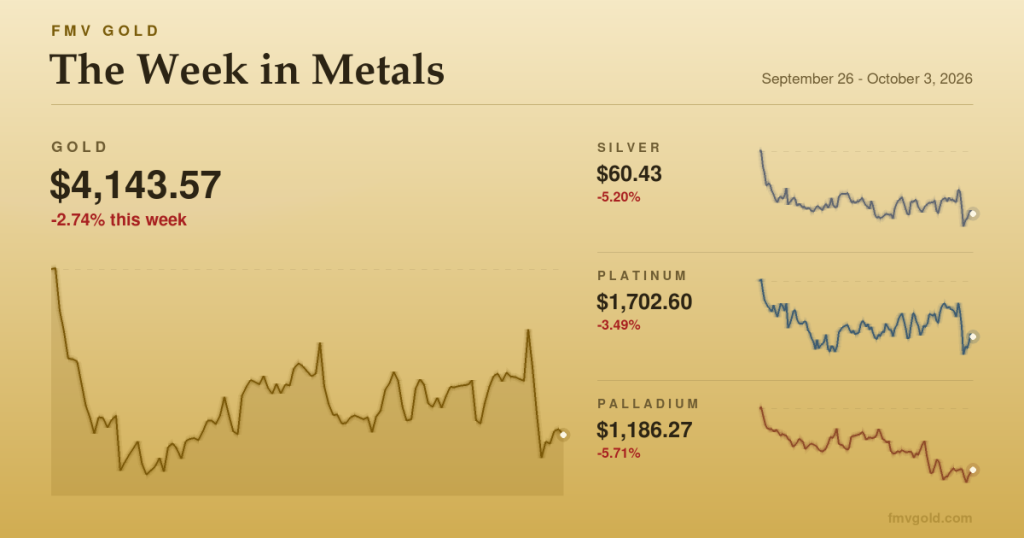
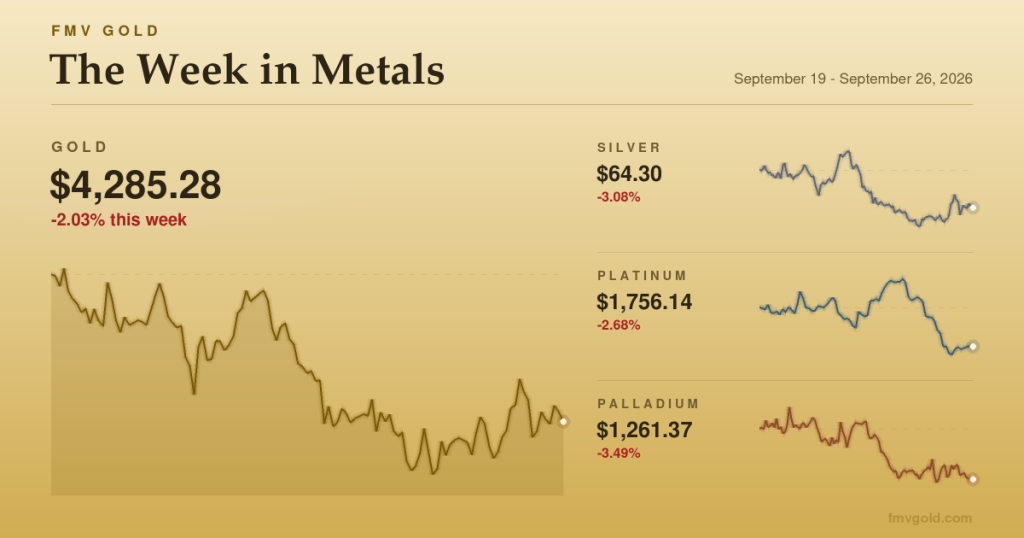
The week in numbers
- Gold ended the week down 2.12% at $4,285.28. Week high $4,383.50 in the opening hours of Monday, September 21 (Sunday evening in New York). Week low $4,247.57 late Thursday morning, September 24.
- Silver ended down 2.96% at $64.30. Week high $67.52 on Tuesday afternoon, September 22. Week low $63.17 on Thursday, in the same hour as gold’s.
- Platinum held up best, down 1.15% at $1,781.60. Week high $1,842.97 on Tuesday afternoon, week low $1,732.93 on Thursday.
- Palladium ended down 2.46% at $1,271.10. Week high $1,332.50 on Monday morning, week low $1,251.17 in the early hours of Friday. (A lone $1,238.88 print late Tuesday, amid quotes near $1,310, is excluded as a data error.)
The stories that moved the market
The week opened with the complex still digesting the Fed’s unanimous quarter-point increase of September 16, which took the target range to 3.75 to 4.00 percent. Gold set its high for the week, $4,383.50, before Monday’s London open and then eased amid comments from St. Louis Fed President Alberto Musalem that more hikes would likely be needed to cool prices, while Brent crude fell more than 3 percent to just above $100 on signs of easing tension in the Gulf. Palladium put in its best level of the week that morning and then followed the group lower.
Tuesday was the bright spot, and a deceptive one. Gold dipped to about $4,296 during the London morning and then rallied more than $75 into the New York afternoon as the dollar softened and crude fell below $98 on hopes that Saudi Arabia’s restored East-West pipeline would keep exports moving. Silver led, printing $67.52, its best since early September, amid hopes for the state visit of Chinese President Xi Jinping to Washington, with rare earth export controls on the agenda. Platinum touched $1,842.97 in the same hour. At Tuesday’s close the week was roughly flat.
Wednesday changed the subject. S&P Global’s flash PMI for September showed private-sector output growing at its fastest pace in more than five years, with the manufacturing gauge at 57 against a forecast near 53.6. Fed Governor Michael Barr said the same morning that additional increases are needed to bring down sticky inflation. The ten-year yield jumped to roughly 5.12 percent, its highest since 2007, and the thirty-year reached about 5.37 percent, a level not seen since 2004. Futures pricing for another quarter-point move at the October 27 and 28 meeting rose to about 70 percent. Gold lost close to 2 percent and closed below $4,300 for the first time since September 16; silver fell more than 3 percent to a $64 handle. Crude, a help on Tuesday, climbed back above $100 amid a proposed ban on U.S. diesel exports.
Thursday extended the slide. Initial jobless claims came in at 197,000, below the 201,000 consensus, and new home sales jumped 6.4 percent, the kind of data that gives a hawkish Fed cover. The dollar index reached a two-month high near 101, gold broke below its 50-day moving average to the week’s low of $4,247.57 late in the New York morning, and silver bottomed at $63.17 in the same minute. Friday brought a partial reprieve. Reports from the United Nations General Assembly described a seven-day Iranian proposal to reopen the Strait of Hormuz in exchange for an end to the U.S. naval blockade, Brent slid toward $97, and gold recovered to $4,285, while the Trump-Xi visit ended with a two-month extension of the trade truce and little else of substance.
What it means for American gold
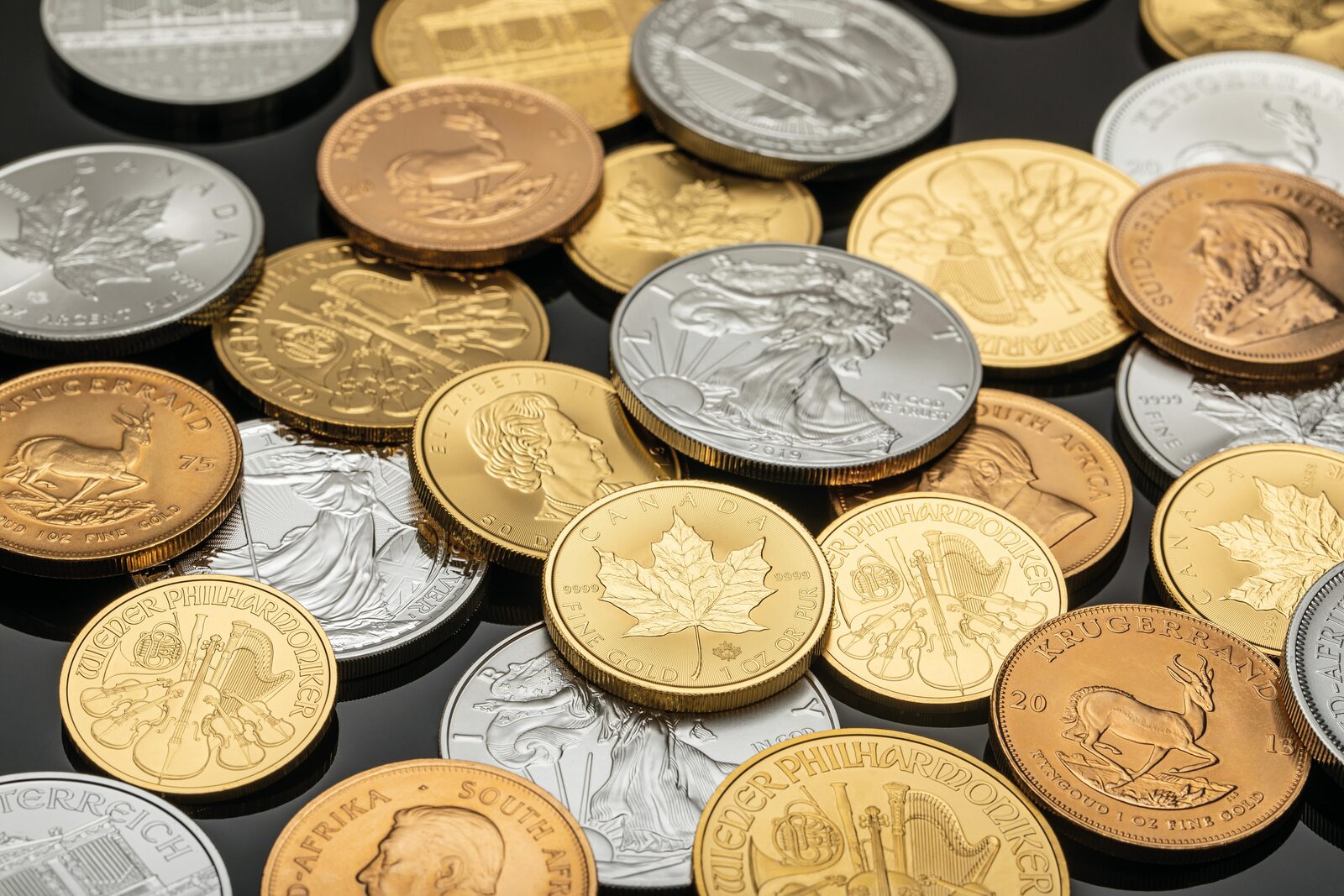
For holders of American Gold Eagles, the metal value of a plain one-ounce bullion coin fell by roughly $93 over the week, measured from the previous Friday’s close. A plain one-ounce American Silver Eagle saw its metal value drop by about $1.96. Those are metal-floor figures, the value of the metal inside the coin, not what any coin changes hands for.
A Saint-Gaudens double eagle carries 0.9675 troy ounces, so its floor gave up a little under $90. A Morgan dollar or Peace dollar, each with 0.7734 ounces of silver, lost about $1.52 of metal value. The Peace dollar has a fitting pedigree for a week spent talking about reopening a sea lane: it was conceived to commemorate the peace that followed the First World War and first struck in December 1921. What a given dollar trades for depends on date, mint mark, and grade, and the premiums on proof, graded, and commemorative pieces answer to collector appetite over months, not to a two-day bond selloff. That distinction is why our valuation method treats melt as a floor rather than a price.
Where this leaves the market
Gold closed the week 20.9 percent below its record close of $5,414.49 on January 28 and about 5.6 percent below its 200-day average of roughly $4,542. It is now down 0.8 percent for the year, having given back the last of a 2026 advance that once exceeded 25 percent. The range of roughly $4,250 to $4,475 that has held since late August remains intact, with the floor now tested twice.
Silver is 10.2 percent lower on the year and 44.9 percent below its January 28 peak of $116.61, with the 200-day average near $73. The gold-silver ratio ended the week at 66.6, up from 66.1 the previous Friday: silver was sold a little harder than gold, with nothing like the panic of early September. Platinum, at $1,781.60, is 13.7 percent lower on the year and 35.8 percent below its January 23 high of $2,776.90. Palladium remains the year’s laggard, down 21.6 percent and far below its 2021 peak. All four metals, over any window you like, are on our charts.
The week ahead
The calendar is crowded. Tuesday, September 29 brings the Conference Board’s consumer confidence index and the August JOLTS job openings report. Wednesday, September 30 carries the ADP payrolls estimate, the final revision of second-quarter GDP, and the August PCE price index, the inflation measure the Fed prefers and the release most likely to move October hike odds. Thursday, October 1 has the ISM manufacturing index and weekly jobless claims, and Friday, October 2 delivers the September jobs report, the last before the Fed meets on October 27 and 28. Beyond the data, the market will watch whether Washington accepts Iran’s seven-day Hormuz proposal, and whether the ten-year yield holds above 5 percent once the PMI excitement fades.
Sources
- Federal Reserve issues FOMC statement, September 16, 2026
- 10-year Treasury yield hits highest level since 2007 as market prices in another Fed rate hike (Yahoo Finance)
- Physical silver tumbles 3% to $65 as hawkish Fed firms the dollar; gold slips to $4,304 (USAGOLD)
- Gold price breaks 50-day support as oil rebound lifts inflation pressure (Kitco)
- Crude oil prices slide after Iranian and U.S. negotiators discuss opening Strait of Hormuz (Fox News)
- Takeaways from the Trump-Xi state visit: pageantry and pandas (NPR via WAMC)
Price figures are from FMV Gold’s own minute-by-minute spot archive (UTC trading days).