

A production increase of nearly 50% sounds like a booming business.
A year-to-date decline of more than 36% sounds like the opposite.
Welcome to the wonderful world of statistics, where both headlines can be accurate and neither tells the entire story.
According to CoinNews’ October 23 report, the United States Mint produced 342.5 million circulating-quality coins in September 2026, compared with 232.4 million in August.
That represents a rounded monthly increase of 47.4%.
But production for January through September totaled approximately 2.6427 billion coins, compared with 4.17044 billion during the same period in 2025.
That’s a year-over-year decline of approximately 36.6%.
The figures describe different comparisons, not a contradiction. CoinNews also notes a changed production mix: circulating cents were produced during part of 2025 but not in 2026. The aggregate comparison therefore does not measure an unchanged basket of denominations.
The Denominator Changes Everything
September’s increase compares one month with the immediately preceding month.
The year-to-date decline compares nine months with the corresponding nine months of the previous year.
Those are different questions.
A factory can increase output sharply in September while still producing substantially less across the year.
Imagine a collector buying two coins in August and three in September. Monthly purchases increased 50%.
If that collector bought twenty coins during the first nine months of last year but only ten during the same period this year, the longer-term trend is still down.
The arithmetic is not complicated.
The discipline is remembering which period the numbers describe.
Production Is Not Circulation
Here is another distinction that matters.
Coins produced by the Mint are not necessarily coins already circulating in the public’s hands.
Production, distribution and everyday use are separate stages.
The U.S. Mint’s circulating-coin production reporting also notes that its figures may include coins made for numismatic bags, rolls and boxes.
That means collectors should not treat the September total as a count of coins newly received in change during September.
Nor should they mistake production volume for retail sales.
The Mint manufactures coins. The Federal Reserve and banking system help move circulating coinage into commerce. Collector products follow their own distribution channels.
Each stage produces different data.
Does Lower Production Mean Rare Coins?
Not automatically.
A decline in overall circulating-quality production does not establish that a particular denomination, date or mint-mark combination is scarce.
To evaluate a specific coin, collectors need the relevant production and population information for that issue, not an aggregate number covering many different coins.
Condition matters, too.
A heavily circulated example and an exceptional uncirculated example may attract very different interest, even when they share a date and mint mark.
And an impressive asking price online does not establish a realized market value.
The September report provides useful information about Mint operations. It does not provide a resale forecast.
The Industrial Side of American Numismatics
Collectors often begin with design: Lincoln, Liberty, an eagle or a commemorative subject.
But behind those designs is a manufacturing system capable of producing hundreds of millions of consistent pieces of coinage in a single month.
That is American industrial craftsmanship on an enormous scale.
Dies, presses, materials, quality controls and production planning all contribute to the finished coins.
The design gives a coin its identity. Manufacturing makes that identity reproducible.
The U.S. Mint publishes monthly production information, although reporting dates and later updates can affect the available figures. The specific September comparisons here are attributed to CoinNews rather than presented as independently extracted historical Mint-table data.
For collectors, the lesson is simple.
A monthly rebound can coexist with a year-to-date decline. Production is not distribution. And lower aggregate output is not proof that a particular coin will become valuable.
Those distinctions are worth remembering the next time a dramatic percentage appears in a coin-market headline.
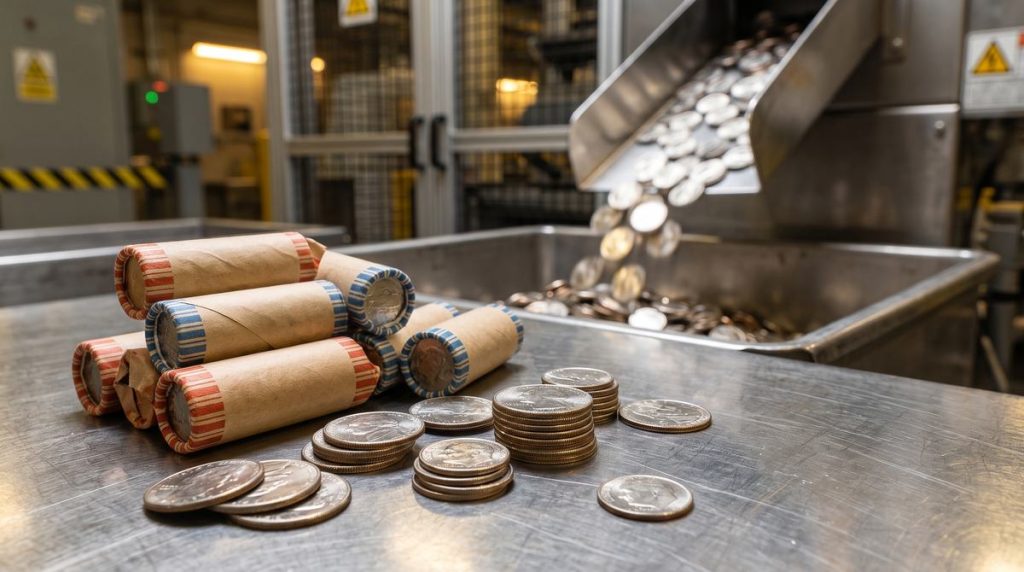
Image: illustration, not a photograph of U.S. Mint production.