

Before Augustus Saint-Gaudens gave the $20 gold piece its striding Liberty, another double eagle carried American commerce for more than half a century. The Liberty Head double eagle, also called the Coronet type, ran from 1850 to 1907, longer than any other regular gold coin the United States has produced. It was born out of the California Gold Rush, it circulated through the Civil War and the great mining booms of the West, and it went down with treasure ships. For collectors and metal buyers weighing older U.S. gold, it is one of the most important coins to understand.
So are Liberty Head double eagles a good investment? The honest answer is that it depends entirely on which one you are looking at, because this single design spans common bullion-grade survivors and some of the rarest coins in American numismatics.
A coin the Gold Rush made necessary
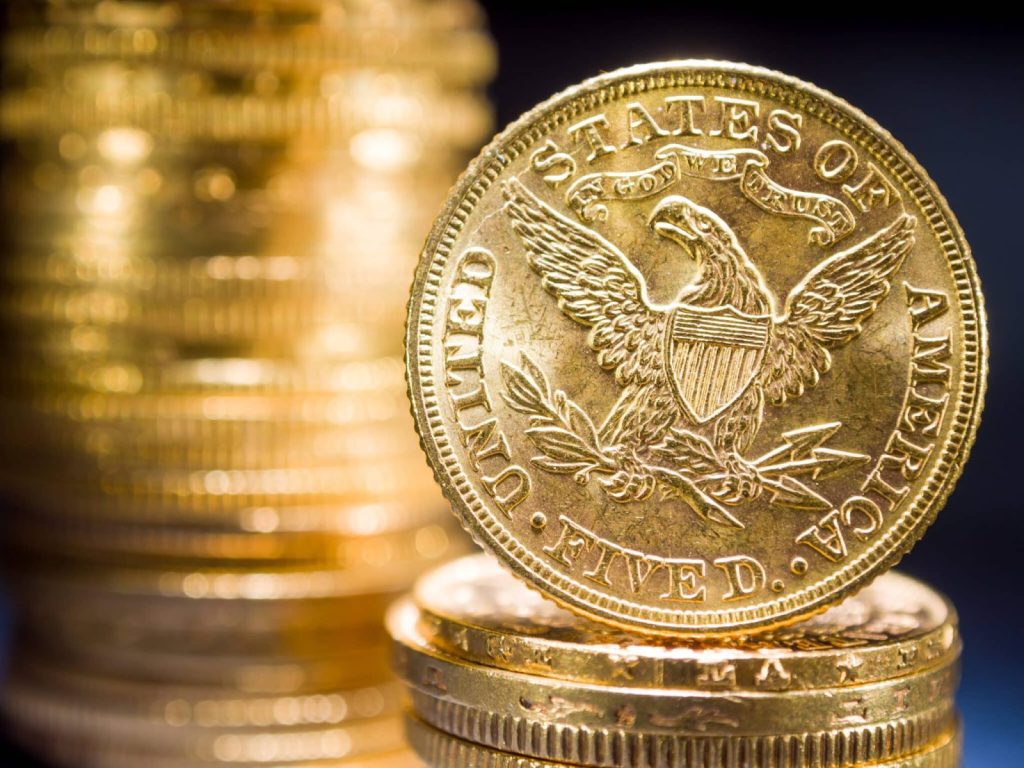
When gold poured out of California after 1848, the country suddenly had far more metal than its existing coins could absorb efficiently. Congress responded by authorizing two new denominations, the gold dollar and the double eagle, so that large sums could move in fewer coins. James B. Longacre, the Mint’s chief engraver, adapted the Liberty head he had designed for the gold dollar, enlarging it into the coronet-crowned portrait that gives the type its name. The reverse shows a heraldic eagle with the Union shield on its breast, holding arrows and an olive branch.
A handful of pattern pieces were struck in 1849. One of those, considered unique, resides today in the Smithsonian’s national collection and is treated as one of the great trophies of American coinage. Regular production began with coins dated 1850. From then on the double eagle became the workhorse of the gold standard, the largest coin ordinary commerce and international settlement relied on.
Three types, one design
Collectors sort the Liberty Head double eagle into three types, and knowing them is the first practical step in evaluating any example.
- Type 1 (1850 to 1866): No motto on the reverse, with the denomination abbreviated as TWENTY D. These are the Gold Rush and Civil War era coins.
- Type 2 (1866 to 1876): The motto IN GOD WE TRUST was added in a small oval above the eagle in 1866, a change that followed the same wave of religious sentiment during the Civil War that put the motto on other coins. The denomination still read TWENTY D.
- Type 3 (1877 to 1907): The denomination was spelled out fully as TWENTY DOLLARS. This is the most abundant type, since production climbed sharply in the coin’s later decades.
Every type shares the same physical recipe. Each coin weighs 33.436 grams and is struck in the classic .900 fine standard, ninety percent gold and ten percent copper for durability, on a 34 millimeter planchet with a reeded edge. That works out to 0.9675 of a troy ounce of pure gold, just under a full ounce. That metal content is the floor under any Liberty Head double eagle, and with gold trading around $4,450 an ounce in late summer 2026, even a worn common-date piece carries meaningful metal value before any collector premium is considered.
Where they were struck, and why it matters
Four mints produced the type, and the mint mark does much of the work in separating a common coin from a rare one. Philadelphia struck double eagles without a mint mark for the entire run. New Orleans (O) made them in the 1850s up to the Civil War. San Francisco (S) began in 1854, feeding freshly mined California gold straight into the largest denomination. Carson City (CC) opened in 1870 and struck double eagles from Comstock Lode silver country’s neighboring gold, and CC coins carry a devoted following today.
One curiosity belongs to 1861. Assistant engraver Anthony Paquet reworked the reverse with taller, narrower lettering. The Mint quickly decided the new design was unsatisfactory and ordered it withdrawn, but word reached San Francisco too late, and that branch had already struck more than nineteen thousand Paquet reverse pieces before stopping. The Philadelphia Paquet coins were nearly all melted, leaving only a couple known, while the 1861-S Paquet survives as a recognized and closely studied variety.
The bullion coins versus the trophies
Here is where the investment question splits in two. Millions of later Type 3 coins survive, many in circulated or low uncirculated grades, and these trade largely as gold with a modest numismatic premium over their metal value. Interestingly, a large share of nicer surviving Type 1 coins owe their existence to disaster. The SS Central America, the so-called Ship of Gold, sank off the Carolinas in 1857 carrying gold from California, including quantities of 1857-S double eagles. When the wreck was recovered in the late twentieth century, it delivered a hoard of pristine double eagles that had never circulated, and those shipwreck coins remain a distinct and well-documented segment of the market.
At the opposite end sit the ultra-rarities. Dates such as the 1854-O, the 1856-O, and the 1870-CC are six-figure coins in essentially any grade, prized because so few were made and so few survived. Certain Philadelphia issues of the 1880s were struck in tiny numbers, one year seeing only a few hundred business strikes, and low-mintage Carson City dates command strong premiums as well. These are not bullion. They are condition and rarity plays, and their value moves with the collector market far more than with the price of gold.
This is exactly why melt value matters as a starting point but never as the whole story. The metal content is the floor. What a specific coin trades above that floor depends on its date, mint mark, and grade, and for the genuinely rare issues the premium dwarfs the gold entirely. FMV Gold’s approach to fair market value is built around exactly this distinction between the metal beneath a coin and the collector demand layered on top.
Are Liberty Head double eagles a good investment for you?
For a buyer who mainly wants gold in a historic American form, common-date Type 3 double eagles offer close to an ounce of gold in a coin that circulated during the gold standard, usually at a reasonable premium over the underlying metal. For a collector, the type is a deep and rewarding series, with date-and-mint sets that can be pursued for a lifetime and headline rarities that anchor major auctions. The two goals call for very different coins and very different budgets, so the first question is always which of those buyers you are.
The Liberty Head double eagle also makes more sense once you see it alongside its successors. Its reverse eagle and its role as the nation’s largest gold coin passed directly to the Saint-Gaudens double eagle in 1907, and the broader idea of a flagship American gold coin lives on in the modern Gold Eagle. If you are comparing older gold to today’s bullion, it helps to read the family together. You can browse the Saint-Gaudens series and the current Gold Eagle listings to see how design and premium have shifted over more than a century.
As with any older coin, buy the grade and authentication before you buy the story. Learn the three types, respect the mint marks, and keep an eye on where gold is trading so you always know the metal floor. A Liberty Head double eagle can be a straightforward way to own nearly an ounce of gold with a piece of nineteenth century history attached, or it can be a serious numismatic pursuit. Just be clear about which one you are buying, and let the coin’s own facts, not its romance, set the price. For more on separating metal value from collector value, our rules of gold and the full coin catalog are good next stops.