

Ask a longtime collector to name the most beautiful coin the United States ever struck, and more often than not you will hear the same answer: the Saint-Gaudens double eagle. It is a $20 gold piece from a vanished era, designed by a sculptor at the height of his powers and pushed into existence by a president who thought American money looked cheap. More than a century later it remains one of the most sought-after gold coins a person can own, both for its metal and for the history pressed into it.
How the Saint-Gaudens double eagle came to be
The story starts with Theodore Roosevelt. He considered the coinage of his day drab and uninspired, and he set out to fix it in what he cheerfully called his “pet crime.” Roosevelt turned to Augustus Saint-Gaudens, the leading American sculptor of the age, and asked him to redesign the nation’s gold. Saint-Gaudens (1848 to 1907) delivered a design of real ambition, but he died of cancer in 1907, before the coins reached everyday circulation the following year. The double eagle that carries his name was, in a sense, his final major work.
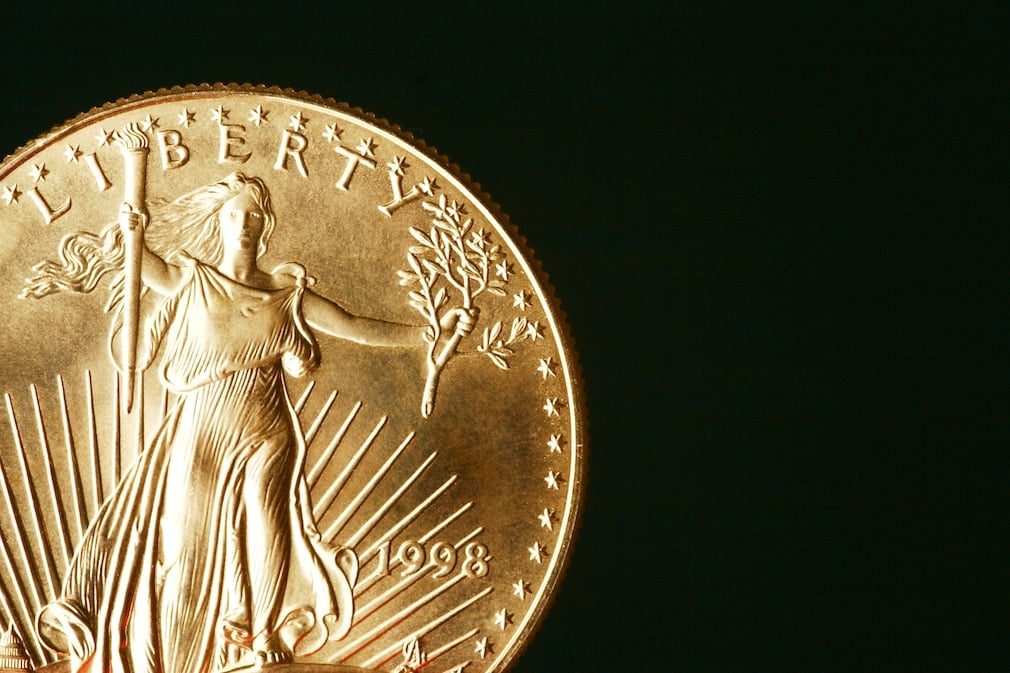
The result broke sharply from the flat, engraved look of earlier coins. The obverse shows Liberty striding forward out of a burst of sunlight, a torch raised in one hand and an olive branch in the other, with the dome of the U.S. Capitol at her feet. The reverse carries an eagle in flight above the rising sun, its rays fanning upward. Even people who have never held one recognize the image; it was revived for the modern one-ounce gold bullion coin that the Mint sells today.
High relief, and why it did not last
Saint-Gaudens wanted the coin to look like a small sculpture rather than a stamped disc, so the earliest 1907 pieces were struck in dramatic relief. A tiny run of extremely high relief patterns came first, fewer than two dozen made, with concave fields and a date rendered in Roman numerals as MCMVII. A larger high relief issue followed, about 11,250 coins for circulation, still carrying that Roman-numeral date.
The trouble was practical. Those deep, sculptural strikes required several blows from the press and did not stack neatly, which made them a headache for banks and commerce. The Mint flattened the design to a workable low relief and switched to ordinary Arabic numerals, and the double eagle rolled off the presses in that form for the rest of its run. The high relief coins of 1907, produced in that brief window, are prized today precisely because the Mint gave up on them so quickly.
A motto that came and went
There is another quirk to the early coins. Roosevelt left the words “In God We Trust” off the design, believing it was irreverent to stamp the name of God on money that would pass through gambling houses and worse. The public did not agree, and Congress stepped in to restore the motto in 1908. That single change splits the series into two collectible groups: the “No Motto” coins of 1907 and early 1908, and the “With Motto” coins struck from 1908 through the end. It is a small detail that matters a great deal to how a given date is classified.
What a Saint-Gaudens double eagle actually contains
Under the artistry, this is a substantial gold coin. It weighs 33.436 grams and is struck in the classic .900 fine standard, nine parts gold to one part copper for durability, at 34 millimeters across with a lettered edge reading E PLURIBUS UNUM. That works out to roughly 0.9675 troy ounces of pure gold, just under a full ounce. With gold trading around $4,600 an ounce in late summer 2026, the metal alone in one of these coins carries real weight as a floor of value.
That floor is worth keeping in mind. Melt value is the metal price, not the market price. A common-date Saint-Gaudens in circulated condition trades close to its gold content, while scarce dates and high grades carry a collector premium on top. This is the same bullion-versus-collector split that runs through most of American numismatics, and the double eagle sits right on the seam of it.
The dates collectors chase
Most surviving Saint-Gaudens double eagles are common dates. Large numbers were struck through the 1920s, and many were shipped to European banks as reserves, where they sat in vaults and survived the melting that consumed so many coins at home. That is why a collector can still buy a handsome pre-1933 example without hunting for years.
The rarities are a different matter. Among regular issues, dates such as 1908-S, 1920-S, 1921, 1927-D, and 1930-S are genuinely scarce, and the 1927-D in particular is considered one of the great prizes of the series because so few escaped the vaults before the gold recall. For most buyers these dates are trophies to admire rather than acquire, but knowing they exist explains why two coins that look identical can sit in very different worlds.
The 1933 double eagle and the end of the line
The series ended in the same year the country left the gold standard. In 1933, with the Depression grinding on, Franklin Roosevelt halted the circulation of gold coin. The Mint had struck 1933 double eagles by the hundreds of thousands, but they were never officially released, and in 1934 the order came down to melt them.
A handful escaped. Nearly all that surfaced were reclaimed by the government as never having been lawfully issued, and two sit in the Smithsonian. Exactly one 1933 double eagle has been cleared for private ownership. It sold for $7.59 million in 2002, and then, at a Sotheby’s auction on June 8, 2021, it brought $18.9 million, the highest price ever paid for a single coin. That lone survivor is the exclamation point on the whole series: the most beautiful American coin, ended by history, its rarest example now the most valuable coin in the world.
Is a Saint-Gaudens double eagle a good fit for you?
For a buyer, the appeal is that a Saint-Gaudens double eagle does two jobs at once. It holds close to an ounce of gold, so it never strays far from metal value, and it carries a century of American design and history that a modern bullion round simply does not. Common dates give you that history at a modest premium over the gold; scarce dates and high grades move into serious numismatic territory where condition and rarity drive the price far more than the metal does.
If you are weighing one, it helps to know where you sit on that spectrum. Someone who mainly wants gold with a bit of soul is well served by a common-date coin close to melt. Someone chasing a specific date or grade is buying a collectible first and bullion second, and should learn the grading and the date rarity before spending. Either way it is worth comparing the piece against the modern options, from the American Gold Eagle that revived this very design to the 24-karat Gold Buffalo, so you understand what you are trading in premium and purity. You can browse Saint-Gaudens double eagles or look across the wider catalog, read how buying and selling works, and keep an eye on where the metals are trading. For the ground rules of owning physical gold, our rules of gold are a sensible place to start.
None of this is investment advice, and no one should read a coin’s beauty as a promise about its future price. But of all the ways to hold gold, few carry the story that this one does. A hundred years on, the coin Roosevelt commissioned to make American money worthy of the country still does exactly that.