
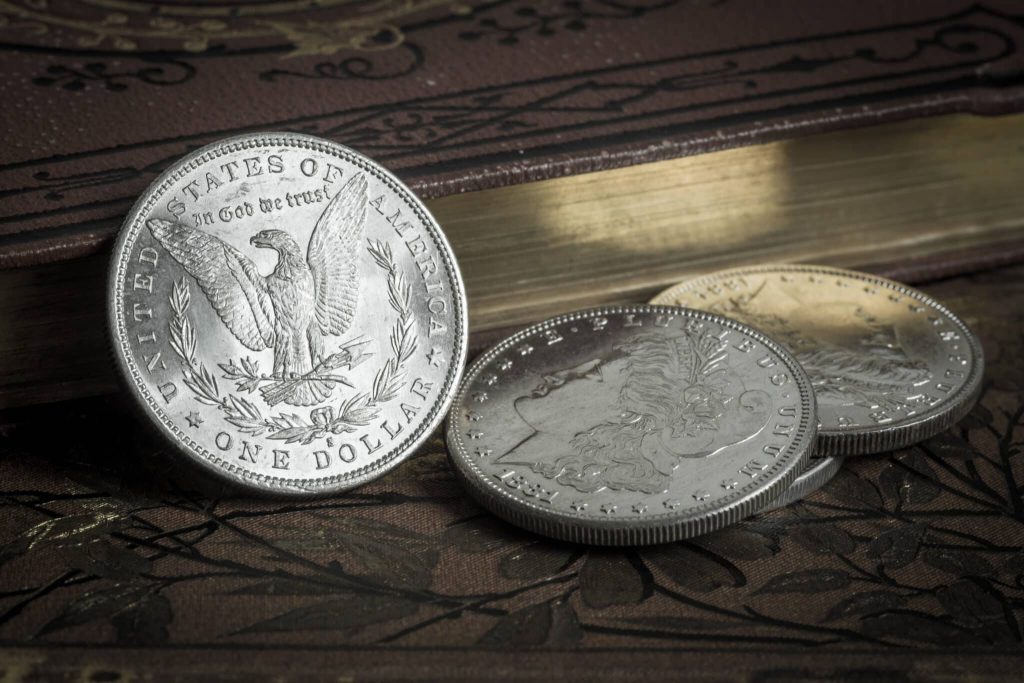
Few American coins carry as much romance as the Morgan silver dollar. It jingled across saloon bars in the mining West, sat in Treasury vaults for generations, and today anchors more beginner collections than any other classic U.S. coin. If you are weighing your first purchase, the honest question is whether Morgan silver dollars are a good investment or simply a good story. The answer, as usual with coins, depends on what you buy and why. You can browse the Morgan dollar series to see just how wide that range runs.
A coin born of politics
The Morgan dollar owes its existence to a fight over money itself. The Coinage Act of 1873 had ended the free coinage of silver, and Western mining interests wanted it back. Congress obliged with the Bland-Allison Act of February 1878, which ordered the Treasury to buy millions of dollars of silver every month and strike it into dollar coins. Demand for the coins in daily commerce was modest, so hundreds of millions piled up in government vaults, a detail that shapes the market to this day.
The design came from George T. Morgan, a young English engraver recruited to the Philadelphia Mint. For his Liberty he used a Philadelphia schoolteacher, Anna Willess Williams, rather than a Greek ideal, giving the obverse a distinctly American face. A powerful eagle spreads its wings on the reverse. Morgan signed his work with a discreet initial M, and collectors have called the coin by his name ever since. It was struck from 1878 through 1904, revived for a single year in 1921, and brought back in modern form in 2021.
Five mints, five stories
Morgan dollars came from five facilities, and the small mint mark under the eagle tells you which one. Philadelphia coins carry no mark. The others show CC for Carson City, O for New Orleans, S for San Francisco, and D for Denver, the last used only in 1921. The Carson City pieces are the romantics’ favorites, struck in small numbers near the Comstock Lode silver that fed them. That CC mark still commands a premium of its own, less for the metal than for the frontier history stamped into it.
Why so many disappeared
Here is the twist that makes the series so interesting. During the First World War, the Pittman Act of 1918 authorized melting silver dollars by the hundreds of millions, largely to support wartime ally Britain. The Treasury eventually melted more than 270 million of them. Whole date-and-mint combinations grew scarce overnight, not because few were made, but because so many were destroyed.
Then came the reversal. In the early 1960s the Treasury found roughly 2.8 million uncirculated Carson City dollars still sitting in its vaults. The General Services Administration sold them off through a famous run of mail-bid sales in the 1970s, many still in their original mint bags. Those GSA dollars, in their black holders, remain a collecting niche in their own right.
The key dates collectors chase
Most Morgan dollars are common, which is good news for a first-time buyer. A handful are legendary. The 1893-S has the lowest business-strike mintage of the series, just 100,000 coins, and a top example has brought seven figures at auction. The 1895 exists, for Philadelphia, only as a proof issue of 880 coins, earning it the nickname King of the Morgan Dollars. The 1889-CC and other Carson City dates round out the classic want list. You do not need any of these to enjoy the series, but knowing they exist explains why values span such an enormous range. If date-by-date collecting appeals to you, it helps to first understand how buying and selling works.
So, are Morgan silver dollars a good investment?
Start with the floor. Every Morgan contains about three-quarters of a troy ounce of silver, so its metal value tracks the silver price and sets a hard bottom under any genuine, worn example. Above that floor sits the collector premium, and this is where judgment matters. A well-worn common-date Morgan trades close to its silver content and behaves much like bullion. A gem-graded rarity trades on numismatics, and its value can rise or fall independent of the metal.
For most buyers, the sensible move is to decide which game you are playing. If you mainly want silver you can hold in your hand, common-date Morgans are a charming way to own it, though you will pay more over melt than you would for a plain modern silver bullion coin. If you are collecting for history and condition, the Morgan series offers a lifetime of dates, mint marks, and grades to pursue, and demand for the best pieces has proven durable across decades. What no one can promise is a specific return. Like all collectibles, Morgan dollars can sit flat for years and reward patience rather than timing.
A few habits protect a new buyer. Learn to read a mint mark and a grade before you spend heavily. Favor coins certified by a major grading service once you move past common dates, since condition drives most of the premium. And treat the metal value as your safety net, the number that does not depend on anyone’s opinion of the coin. Understood that way, whether Morgan silver dollars are a good investment becomes a question you can actually answer for yourself, coin by coin.
The Morgan is not the only classic dollar worth knowing. Its successor, the Peace dollar of 1921, tells the other half of the story, and the wider classic coin catalog is a good place to see where the Morgan fits among America’s silver.