
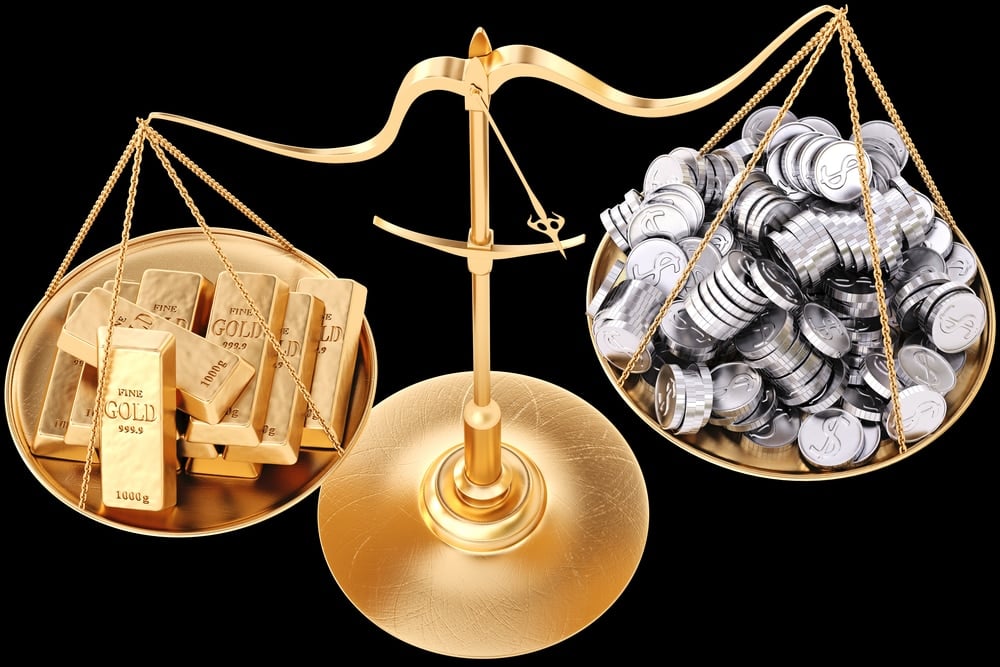
Same shelf, different functions
Gold and silver are often grouped as “precious metals” and bought from the same dealers, but they answer to different masters. Gold’s price is driven overwhelmingly by monetary and investment demand. Silver’s is driven by both investment demand and a large, cyclical stream of industrial consumption. That structural difference cascades into nearly everything that matters to a portfolio: how much each metal swings, how easily it trades, and how it behaves when markets are calm versus stressed.
Gold: the monetary metal
Gold’s defining characteristic is that very little of it gets consumed. Most of the gold ever mined still exists, sitting in vaults, jewelry, and official reserves. That gives it an enormous, stable above-ground stock relative to annual mine supply — and that stock-to-flow profile is precisely what makes it useful as a monetary asset and store of value.
Demand comes mainly from investors, central banks, and jewelry buyers (much of which, in major markets, is itself a form of savings). Because gold is held rather than used up, its price reflects the world’s collective demand to own it as a hedge and reserve, not its usefulness in a factory. Central banks hold gold as a reserve asset and have been persistent buyers through this cycle, reinforcing its monetary identity.
The portfolio implication: gold behaves like insurance and diversification. Its appeal is its low long-run correlation to stocks and bonds and its tendency to hold purchasing power across decades and currency regimes.
Silver: the dual-role metal
Silver shares gold’s monetary heritage — it circulated as money for centuries — but today roughly half of its demand comes from industry: electronics, electrical contacts, solar photovoltaics, medical and antibacterial applications, and a long tail of specialized uses that exploit its unmatched electrical conductivity. The other half comes from investment and jewelry/silverware.
This dual identity is the single most important fact about silver. It means silver responds to two sets of drivers that can either reinforce or fight each other: the monetary drivers that move gold (real yields, the dollar, safe-haven demand) and the industrial cycle (manufacturing activity, the pace of electrification and solar buildout, global growth). When both align — say, falling real yields and booming industrial demand — silver can move explosively. When they conflict, silver can be frustratingly directionless.
The portfolio implication: silver carries a monetary hedge plus a growth/industrial tilt. It offers more upside torque than gold in favorable conditions, at the cost of more volatility and a partial exposure to the business cycle that gold largely lacks.
Volatility and liquidity: the practical gap
Volatility. Silver is reliably the more volatile of the two, often meaningfully so. Two forces drive this. First, its market is far smaller than gold’s in dollar terms, so a given flow of money moves the price more. Second, its industrial demand layer adds cyclical sensitivity on top of monetary sensitivity. The practical signature is that silver tends to fall faster than gold in selloffs and rebound harder in recoveries — a recent week in which silver swung in the low double digits peak-to-trough while gold moved single digits is a textbook illustration.
Liquidity. Gold is one of the deepest, most liquid markets in the world, with tight spreads across coins, bars, ETFs, and futures, and it trades around the clock globally. Silver is liquid but a tier below — spreads, especially on physical product, are wider, and the same dollar order has more price impact. For large allocations, the cost of moving in and out of silver is simply higher.
Behavior in risk-on vs. risk-off regimes
Risk-off (stress, fear, flight to safety). Gold is the cleaner safe-haven. In genuine crises it has more consistently attracted defensive flows, because buyers want the monetary asset, not the industrial one. Silver often participates in safe-haven rallies thanks to its precious-metal half, but its industrial half can drag if the same crisis threatens growth — so silver’s risk-off performance is less reliable and more two-sided.
Risk-on (growth, reflation, rising industrial demand). Here silver’s dual role can shine. A reflationary, pro-growth environment that lifts manufacturing and electrification demand can drive silver to outperform gold, sometimes dramatically. Gold tends to lag in pure risk-on regimes because its monetary appeal is less in demand when investors are chasing growth.
The summary heuristic: gold is the defensive metal; silver is the higher-beta cousin that leans more cyclical.
The gold-silver ratio, in plain language
The gold-silver ratio is simply how many ounces of silver it takes to buy one ounce of gold — divide the gold price by the silver price. If gold is near $4,300 and silver near $70, the ratio is roughly 61.
The ratio is a quick gauge of the two metals’ relative valuation and of the market’s mood. Historically it has spanned a wide band — from the low 30s in periods of silver enthusiasm to well above 100 in moments of acute stress. Because silver is the more volatile metal, the ratio tends to rise (gold outperforming) when fear dominates and silver’s industrial half is being marked down, and to fall (silver outperforming) in reflationary, risk-on phases.
What extremes may signal: a very high ratio is often read as silver being historically cheap relative to gold — frequently coinciding with risk-off conditions — while a very low ratio suggests the opposite. These are descriptive observations about relative value and regime, not timing signals. The ratio can stay stretched for long stretches, and “cheap relative to gold” is not the same as “about to rise.” Treat it as context, not a trigger.
Investor takeaways
Gold is best understood as monetary insurance. Its use-cases center on diversification, long-run purchasing-power preservation, and defensive ballast in a portfolio. It is the deeper, calmer, more liquid market and the more dependable behavior in a crisis.
Silver is a hybrid: a monetary hedge with an industrial-growth engine bolted on. Its use-cases center on higher-torque exposure for those willing to accept materially more volatility, and on a tilt toward electrification and industrial demand themes. It can outperform gold in the right regime and underperform sharply in the wrong one.
Held together, they are complementary rather than redundant. Gold supplies the stability and crisis behavior; silver supplies the cyclical upside and a different driver mix. The right balance depends entirely on an investor’s objectives and risk tolerance — a question of personal circumstances, not a one-size answer.
This article is informational and does not constitute a recommendation to buy, sell, or hold any metal. Relative-value observations are descriptive, not timing signals.
More from this series · FMV Gold News & Analysis
- Gold Whipsaws Into the Fed Meeting: A Mid-June Recovery That Settled Nothing
- Gold and the Macro Machine: How Rates, Inflation, and the Dollar Set the Tone
- The Official Bid: How Central Banks Shape the Gold Market
- Five Ways to Own Gold — and What Each One Actually Gets You
- When the Hedge Gets Tested: Tail Risks in the Gold Market
- The Slow Forces: How ESG, Technology, and Mining Supply Will Shape Gold for Decades