
In the spring of 1989, a broker at a national brokerage house could call a client and pitch a certified silver dollar in roughly the tone he used for municipal bonds. The coin arrived sealed in plastic with a grade printed on the label, the sales material carried performance charts, and for about eighteen months the whole arrangement worked beautifully. Then it stopped working, and it kept not working for most of the next two decades.
That episode is the most useful piece of history a metals buyer can carry around, because it is the cleanest natural experiment anyone has run on the difference between what a coin’s metal is worth and what its collectors are willing to pay on top.
Are rare coins a good investment? Start with 1989
The late 1980s rare coin boom did not come out of nowhere. It was built on a genuine innovation. The Professional Coin Grading Service was founded in 1985 by a group of dealers and opened for business in February 1986, guaranteeing its grades. The Numismatic Guaranty Company followed in 1987, started in Parsippany, New Jersey by John Albanese, who had been among the PCGS founders. For the first time, a coin’s condition came with a third party’s name attached to it.
The commercial consequence was immediate. A dealer in Dallas could buy a coin from a dealer in Boston over the telephone without ever looking at it, because the grade on the holder was the product. John Sack of Shearson put it plainly at the time:
The plastic holders did it; that’s it in a nutshell.
Coins had become fungible. Anything fungible can be packaged, and Wall Street packages things for a living.
When the wirehouses arrived
Merrill Lynch got there first, working with the dealer Numismatic Fine Arts on the Athena Fund in 1986, which began with about $7.3 million in ancient coins and antiquities. Athena Fund II followed in August 1988 with a ceiling of $40 million. By the thirty month mark the first fund was reporting a net gain of roughly 36 percent, which is the sort of number that makes other firms pay attention.
They did. In February 1989, Kidder, Peabody & Co. launched a limited partnership aimed at rare United States coins, structured with dealers Hugh Sconyers and Kevin Lipton and sized at up to $40 million. It was not retail product: the minimum subscription was $50,000, and investors needed a million dollars of net worth and $200,000 of income in each of the two preceding years. Two months later Shearson Lehman Hutton began offering certified coins to roughly three million customers through about 11,000 brokers.
Consider what that meant for the market. A category that had been priced by a few thousand dealers and serious collectors was suddenly being bid on by pools of capital whose managers were measured quarterly and whose clients had no particular attachment to the objects themselves.
What the index did next
PCGS maintains the PCGS3000, an index tracking its experts’ assessments across roughly three thousand rare coins. Its all time high is $181,088.48, set on May 31, 1989, within weeks of the Shearson rollout. By December 1, 1994 the index stood at $46,818.77, a decline of about 74 percent from the peak.
The recovery has been partial and slow. As of September 28, 2026 the index was $73,004.42. That is up substantially from the 1994 floor and still roughly 60 percent below where it stood in May 1989, more than thirty seven years later, before adjusting for three and a half decades of inflation.
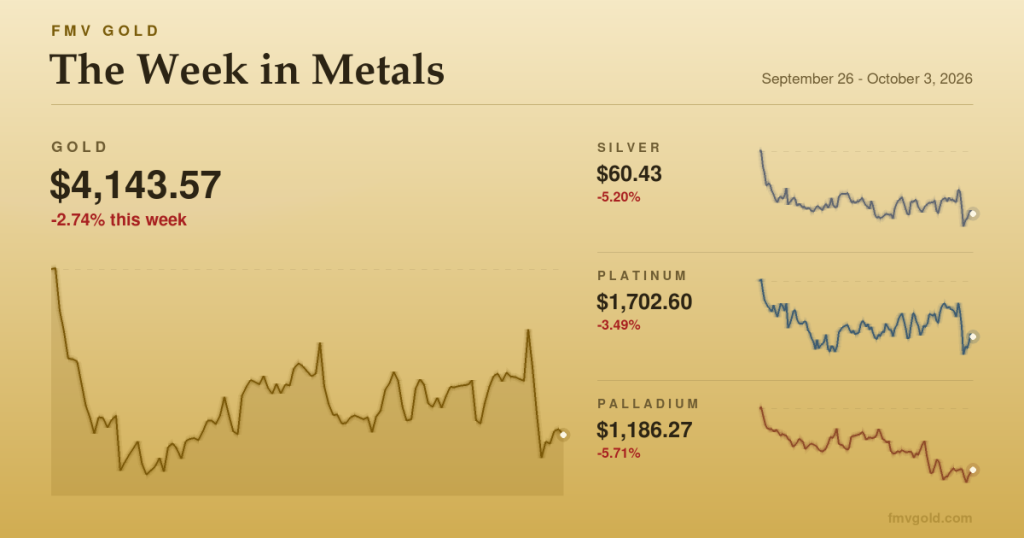
Now set the metal beside it. Gold averaged $381.27 an ounce in 1989, with a high of $417.15. On September 29, 2026 it was trading around $4,160. The metal is up roughly elevenfold in nominal terms over the same stretch in which the rare coin index lost most of its value. You can follow current spot levels and check that arithmetic yourself.
Two honest qualifications belong here. The PCGS3000 begins its most famous chapter at the exact top of a mania, which flatters the comparison. And an index is an average: particular coins, especially genuine condition rarities and established key dates, have done perfectly well. But the direction of the lesson is not in doubt. Someone who bought the metal was made whole and then some. Someone who bought the premium, at that moment and at those prices, largely was not.
The part that was not a market cycle
Some of what happened was an ordinary boom unwinding. Some of it was fraud. The Federal Trade Commission has brought 17 cases against firms that sold overpriced or misgraded historic coins as investments, and in its own account of that enforcement work the markups ran as high as 100 to 300 percent over prevailing market prices. A buyer paying triple the market cannot be rescued by a rising market. He needs the market to triple before he is even.
The pattern did not end with the 1990s. Between 1998 and 2001 the Ohio Bureau of Workers’ Compensation placed $50 million into rare coin funds managed by the dealer Thomas Noe. When investigators finished, only about $13 million of the original $50 million could be accounted for. Noe was convicted in November 2006 of theft, money laundering, forgery and corrupt activity, and sentenced to 18 years. A state insurance fund with lawyers and auditors got taken. The retail buyer on the phone had less protection than that.
What a coin holder should actually take from this
None of this is an argument against collectible coins. It is an argument for knowing which of two things you are buying, because they behave differently and they fail differently.
- The metal floor is durable. An ounce of gold is an ounce of gold whether the collector market is euphoric or asleep. That floor is why bullion and semi-numismatic pieces sit in different mental buckets.
- The collector premium is an opinion. It is real, it is sometimes large, and it can compress hard. The modern commemorative programs of the 1990s made the same point on a smaller scale.
- Grade is a service, not a guarantee of value. Certification solved authentication and consistency. It did not make the premium attached to a high grade permanent, which is worth remembering when weighing what a slab is actually buying you.
- The exit matters more than the entry. Premium coins are sold into a narrower market than bullion is, and the round trip costs more. Anyone asking whether rare coins are a good investment should price the sale, not only the purchase. That is part of how the transaction works on both ends.
Practically, the people who came through 1989 best were not the sharpest traders. They were the ones who bought coins they wanted to own, paid close to fair value, held for decades rather than quarters, and treated any collector premium as a bonus rather than the thesis. That describes plenty of holders of Morgan dollars and Saint-Gaudens double eagles who never once looked at an index.
So, are rare coins a good investment? As a category, bought on a pitch, at a markup, with a horizon measured in quarters, the historical record is discouraging and occasionally worse than that. Bought knowingly, for their history and their craftsmanship, with the metal understood as the floor and the premium understood as an opinion that may not hold, they have been a perfectly reasonable thing to own for a very long time. The basic rules have not changed much since 1989. The marketing around them changes constantly.