

Most bullion coins ask for a certain amount of trust. You check the weight and the diameter, maybe you know the ring a good coin makes, and past that you are relying on the seal and the person who sold it to you. The Royal Mint decided that was not quite good enough. In the autumn of 2020 it loaded four anti-counterfeiting features onto a plain bullion coin, the sort that normally goes into a tube and never gets looked at again.
That coin is the Britannia, and it has been struck in gold since 1987. It is one of the longest-running modern bullion programs in the world, older than the Gold Eagle by a year. For an American buyer it tends to sit in the second tier of awareness, behind the domestic coins and the Canadian Maple Leaf. That is a shame, because on the merits it is one of the better-made one-ounce coins available.
What the coin actually is
The one-ounce gold Britannia carries a face value of £100 and measures 32.69mm across. The Royal Mint also strikes it at a half ounce (£50), a quarter ounce (£25) and a tenth ounce (£10), and since 2013 it has added a five-ounce coin at £500 and a twentieth-ounce at £5. Mintages are unlimited, set each year by demand rather than by a published cap, which is the normal arrangement for a bullion coin and the opposite of how a collector issue works.
The obverse carries the reigning monarch. Queen Elizabeth II appeared through three different effigies over the life of the series, and from 2023 the coins have shown King Charles III. If you are buying by the tube, you will end up with a mix.
The 2013 switch from 22 karat to pure gold
This is the detail that trips people up, and it matters more than most buyers realize.
From 1987 through 2012 the gold Britannia was a 22-karat coin, .9167 fine. It was alloyed with copper until 1989, which gave those early coins a slightly reddish cast, and with silver from 1990 onward, which gave later ones a paler, cooler look. Starting in 2013 the Royal Mint moved the coin to .9999 fine, a full 24 karats.
Both versions hold one full troy ounce of pure gold. The difference is what else is in there. A 22-karat Britannia weighs roughly 34 grams gross because it is carrying about three grams of alloy on top of the gold, while a modern .9999 coin weighs 31.1035 grams and is essentially all gold. Same metal content, different coin in the hand. The older ones are harder and take a knock better. The newer ones are softer and will pick up marks if you handle them carelessly, the same trade-off that separates the 22-karat Gold Eagle from the pure Gold Buffalo.
The consequence that actually costs people money is the retirement account rule. The IRS sets a .995 minimum fineness for gold held in an IRA. A 2013-or-later Britannia clears it comfortably. A pre-2013 22-karat Britannia does not, and there is no statutory carve-out for it the way there is for the American Eagle. If you are buying for an IRA, the date on the coin decides whether it is eligible. Confirm with your custodian before you buy, not after.
The security features, and why they are unusual
The Royal Mint announced the new technology on 28 September 2020 and put it on the 2021-dated coins. Four features, all of them on a coin that sells on metal content:
- A latent image that shifts between a padlock and Britannia’s trident depending on the angle you hold it. The technique came off the UK’s £2 circulating coin.
- Surface animation, created with picosecond lasers, so the waves behind Britannia appear to roll when the coin is turned.
- Micro-text reading DECUS ET TUTAMEN, an ornament and a safeguard, in a ring around the figure.
- Tincture lines, the old heraldic convention for showing color in engraving, worked into the Union flag on Britannia’s shield.
None of this makes the gold worth more. What it does is shorten the conversation when you go to sell. A coin a dealer can authenticate in a few seconds by tilting it under a lamp is a coin that gets bid tightly, and that shows up in the buyback spread rather than on the sticker.
A design that wandered, then settled down
Philip Nathan won the original Royal Mint competition and gave the series its defining image: Britannia standing on a coastal rock in a Corinthian helmet, trident in her right hand, olive branch and a Union flag shield in her left. Strong without being martial, which was the point.
That design ran from 1987 to 1996, then the Mint got restless. From 1997 the reverse changed in most years, sometimes back to Nathan in a seated or charioted pose, sometimes to another artist entirely. Christopher Le Brun put Britannia under a tree in 2007. John Bergdahl set her among waves beside a lighthouse in 2008. From 2021 the Mint settled back on the Nathan standing figure and has kept it, because the security features needed a fixed canvas to live on.
For a stacker this is trivia. For anyone who likes the object as well as the metal, the 1997 to 2020 run is a varied series to assemble, and buying those years deliberately rather than at random costs nothing extra.
Are gold Britannias a good investment?
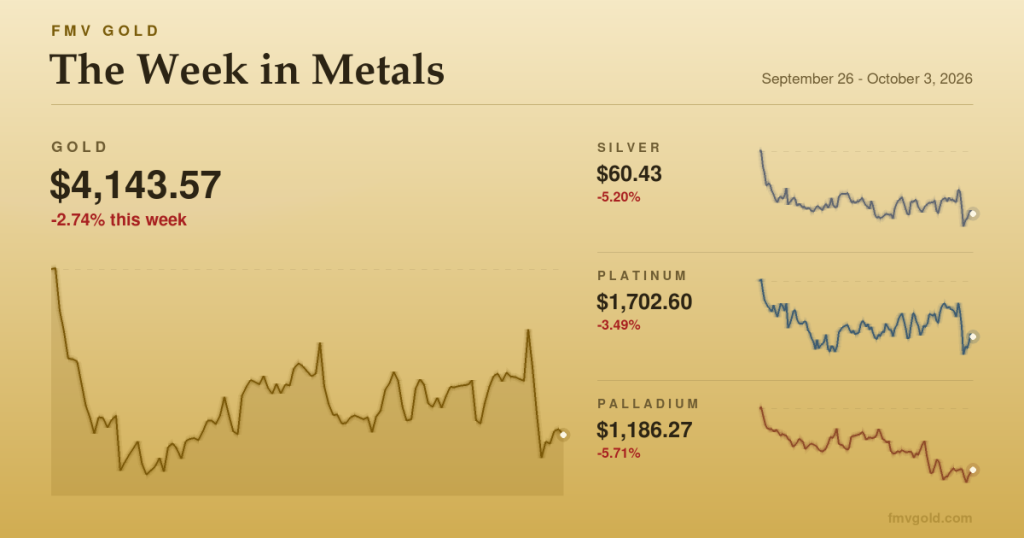
Treat the answer the way you would for any bullion coin. The Britannia is a metal position first. With gold trading around $4,170 an ounce in late September 2026, a one-ounce Britannia holds roughly that much metal value, and everything above it is premium you pay for minting, distribution and recognition.
Where it earns its keep is on the sell side. It is a sovereign-mint coin from a mint with three centuries of standing, it is recognized everywhere metal trades, and since 2021 it authenticates on sight. Premiums on the one-ounce coin sit in the same general neighborhood as other major one-ounce sovereign coins, which is to say modest, and random-year coins cost less than current-year ones for identical metal. If the goal is ounces, buy random years and ignore the date.
The case against is simple enough. Gold Britannias do nothing a Gold Eagle, a Krugerrand or a Maple Leaf does not also do, and in an American market the domestic coin usually has the thicker bid. Diversifying across mints helps if you ever want to sell abroad and very little if you never will.
The tax point Americans get wrong
You will see the Britannia marketed on its tax treatment. Because it is legal tender under the Coinage Act 1971 and the Currency Act 1983, it is exempt from UK Capital Gains Tax, and as investment gold it is VAT-free in Britain. British buyers can realize a gain of any size on Britannias without a CGT bill.
That exemption is a British statute and it stops at the British border. A US taxpayer selling a Britannia is in exactly the same position as one selling any other gold coin. Section 1(h)(5)(A) of the Internal Revenue Code specifically overrides the IRA-eligibility exception in Section 408(m)(3) for income tax purposes, so bullion coins are collectibles when you sell them, with a maximum long-term rate of 28 percent. Buy the Britannia for the coin. Do not buy it for a tax break you are not entitled to.
Where it fits
If you already hold American coins and want a second sovereign mint in the stack, gold Britannias are a sound pick, and the modern .9999 coins are the ones to hold in a retirement account. If you want British gold with more history behind it, the sovereign has been running since 1817 and comes in a smaller, more divisible unit.
Either way, the rules do not change: know the metal content before the design, know what your exit looks like before you buy, and let premium rather than story decide the purchase. Our rules of gold and our guide to how buying works cover the rest, and you can browse current inventory or compare against American Gold Eagles if you want the domestic side of the comparison.