

Most American coins earned their wear in pockets and cash drawers. The capped bust half dollar earned its wear in canvas bags, shuffled from one bank vault to another and counted by weight as often as by piece. That single fact explains nearly everything a buyer needs to know about the series: why so many have survived, why they survived looking the way they do, and why a coin struck before the first railroad reached Chicago is not nearly as hard to own as you would guess.
Struck from 1807 through 1839, this was the workhorse silver coin of the early republic. It is also one of the few genuinely old American series where a patient buyer can still assemble a real run without chasing museum pieces.
The Coin America Used When There Were No Silver Dollars
The Mint stopped striking silver dollars after 1804 and did not resume regular production until the 1830s. For roughly three decades, the half dollar was the largest silver coin the country made, and the banks knew it. They requested halves from the Mint in quantity, used them to pay wages and settle merchant accounts, and held them in reserve against their own paper.
Reserve duty is why the survival pattern looks so odd. A coin that sits in a strapped bag for forty years, moved between institutions and occasionally recounted, does not wear down the way a coin does crossing a thousand palms. It gets nicked instead. The result is a pre-1840 series where Very Fine, Extremely Fine and About Uncirculated examples are comparatively available, often with the bag marks and rub that tell you exactly where the coin spent its life. When the silver dollar finally came back in force with the Morgan dollar in 1878, the half dollar had already done the heavy lifting for two generations.
John Reich’s Design, and the Break of 1836
John Reich was a German engraver who reached the United States as an indentured servant, having left Europe during the Napoleonic wars. The Mint hired him in 1807, and his Liberty faces left in a soft cap with LIBERTY across the band, thirteen stars around her and the date below. The reverse carries an eagle with a shield on its breast, an olive branch and arrows in its talons, a scroll reading E PLURIBUS UNUM above, and the denomination as 50 C. Chief Engraver William Kneass later remodeled the portrait into something fuller and more matronly, a change collectors notice immediately and most reference books treat as a style shift rather than a separate type.
The edge was the security feature. FIFTY CENTS OR HALF A DOLLAR is impressed into it, which made clipping silver off the rim obvious. Even the punctuation moved around: stars separate the words on coins from 1814 to 1831, vertical lines from 1832 to 1836.
In 1836 the Mint installed steam-powered presses, and the series changed shape. Working with a close collar, Christian Gobrecht adapted Reich’s design, dropped E PLURIBUS UNUM from the reverse, and the diameter came down from about 32.5 mm to exactly 30 mm. The lettered edge gave way to ordinary reeding. The reverse read 50 CENTS in 1836 and 1837, then HALF DOL. for 1838 and 1839, after which Gobrecht’s Seated Liberty took over the denomination entirely. Three recognizable types, then, inside one design family.
What the Silver Is Actually Worth
Lettered edge halves weigh about 13.48 grams at .8924 fine, the odd standard set in 1792. The Mint Act of 1837 moved American silver to a cleaner .900 fine at 13.36 grams, the specification the late reeded edge coins carry. Run either set of numbers and you land in the same place: roughly 0.39 troy ounce of silver per coin, give or take a whisker of wear.
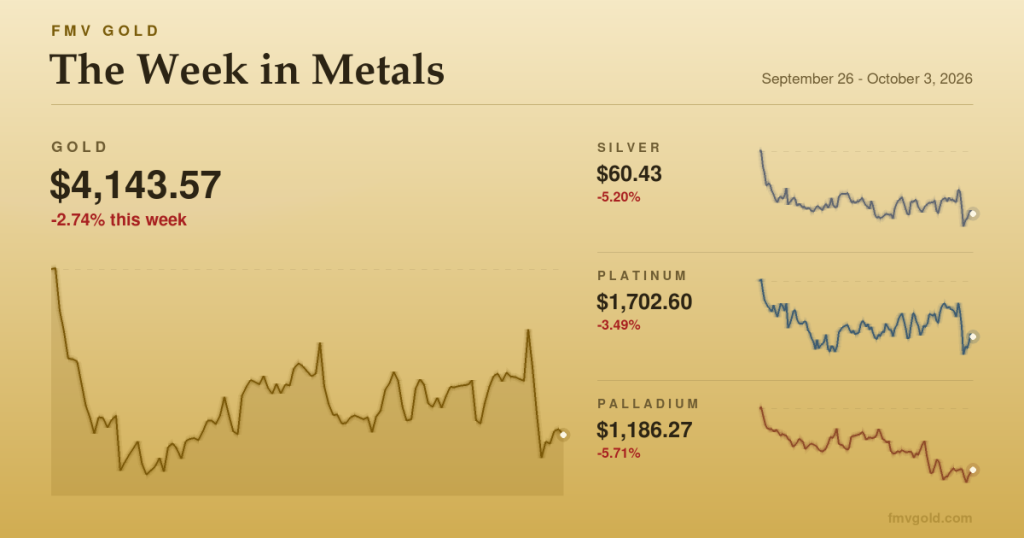
With silver near $61 per ounce in early October 2026, that content is a meaningful metal floor. It is a floor and nothing more. These coins have not traded at melt in living memory, because age, history and a deep collector base put a premium on every one of them, including the slick ones with the date barely readable. If your interest is purely the metal, common-date 90 percent coinage from the twentieth century is the efficient way in, and our guide to junk silver covers that ground. Current spot for both metals sits on our markets page.
Key Dates, Overdates, and the Overton Rabbit Hole
- 1815/2, mintage 47,150, the lowest of the regular issues. Every example is the overdate, and no half dollars at all carry an 1816 date after a fire interrupted work at the Mint.
- 1817/4, the series trophy. Roughly eight are known and none of them is mint state.
- 1836 reeded edge, about 1,200 struck, a transitional issue that collectors chase precisely because it bridges the two halves of the series.
- 1838-O, reported at about twenty pieces, proof only, and the first half dollar ever struck at a branch mint. The O sits on the obverse above the date, an unusual placement for an American coin.
- 1839-O, 116,000 pieces, the first New Orleans half made for circulation.
Underneath the dates lies the real obsession. Al C. Overton’s Early Half Dollar Die Varieties, 1794-1836, first published in 1967 and still the standard, catalogs hundreds of individual die pairings, each with an O-number and its own rarity rating. The Bust Half Nut Club has been organized around that pursuit since 1969. Variety collecting is where the series becomes a lifelong project rather than a shelf of thirty-odd dates, and it is also where a casual buyer can overpay for something they cannot later explain to a dealer.
Are Capped Bust Half Dollars a Good Investment?
Two different bets hide under one question, and conflating them is how people get disappointed.
The first is the type coin: a pleasing circulated example of a common date, bought for its history and its silver. The premium over metal is real but moderate by early-American standards, the market is broad because nearly every serious U.S. collector eventually wants one, and the downside is cushioned by the metal underneath. It behaves like an old coin with a floor, not like a growth asset.
The second is the scarcity bet: key dates, rare die marriages, or common dates in grades that are genuinely hard to find. Those can appreciate on collector demand independent of silver, and they can also sit for years. That market is thinner, the price gaps between adjacent grades are wide, and the difference between a solid coin and a problem coin is worth more than most beginners realize. Certification is close to mandatory at that level. Neither path is advice, and both reward buying fewer, better coins slowly.
Buying One Without Getting Burned
- Watch for cleaning. Unnaturally bright surfaces, fine parallel hairlines, or a muted gray sheen where luster should be usually mean the coin was scrubbed. Cleaned coins sell at a discount forever.
- Check the edge. On a lettered edge coin the inscription should be crisp and the right style for the date, stars before 1832 and vertical lines after.
- Buy certified above a certain level. Cast and struck counterfeits of early halves exist, and a slab from a major grading service answers both authenticity and grade.
- Buy the coin, not the label. Two coins in identical holders can differ sharply in eye appeal, and eye appeal is what you recover on resale.
- Ask how the seller buys back. Knowing the exit before you enter is the single most useful habit in this hobby. Our pages on how valuation works and on finding reputable dealers are a reasonable starting point.
The capped bust half dollar rewards the kind of buyer who likes knowing where a coin has been. These pieces moved the money of a country that was still arguing about whether it needed a central bank, and they survived because somebody decided they were worth keeping in a vault. For the later chapters of the same denomination, see our profiles of Walking Liberty halves and the 40 percent silver halves that closed the silver era out, or browse what is currently listed in our coin directory.