

Most coin damage doesn’t happen in a dramatic moment. Nobody drops the coin or scrubs it with a toothbrush. It happens slowly, inside a holder somebody picked because it was cheap, soft, and handy, and it shows up years later as a hazy film, a green spot, or a faint line across Liberty’s cheek. By then the holder has done its work.
The good news is that the choices are few and the rules are simple. Know what each kind of coin holder is made of and what it was built to do, and you can avoid most of that slow-motion damage.
The main kinds of coin holders
Plastic flips fold over a coin and hold it in a pocket. Cardboard holders, usually called 2x2s for their two-inch square size, sandwich a coin between two panels with a clear window. Folders press coins into holes in a cardboard page. Albums do the same thing but add clear plastic slides over both sides. Capsules are hard, round plastic cases that close around a single coin. Tubes hold a stack of identical coins. And slabs are the sealed, labeled holders that grading services use for certified coins.
Each has a failure mode. The trick is matching the holder to the coin and to how long it will sit there.
Flips: convenient, and the most common culprit
Flips are everywhere because they are cheap and easy to label. The trouble is with the soft ones. According to NGC, the grading service, many soft flips contain a plasticizer added to make the plastic pliable, and that compound migrates out of the holder and collects on the coin inside. Collectors call it PVC damage.
NGC describes the progression plainly. It starts as a light white or pale green haze. Left alone, it turns into green spots and then shiny green globs, and in severe cases a green layer can cover the whole surface. Worse, the residue begins to corrode the metal beneath it, and that corrosion is permanent. Humidity, warmth, and ordinary air speed the process along. A conservation service can often remove the residue itself, but it cannot undo etching that has already eaten into the surface.
NGC’s own advice is that flips are meant as short-term storage, and that the safer choice is a hard flip made without that plasticizer. Telling them apart is easy. A soft PVC flip smells like a vinyl shower curtain, and if you fold it, it slowly unfurls back to shape. A hard flip feels stiff, folds sharply, and may even crack. If an old collection arrives in limp, sticky flips, get the coins out of them that day.
Cardboard 2x2s, folders, and the chemistry of paper
The 2×2 with a clear Mylar window has been a workhorse for decades because it is cheap, stackable, and easy to write on. It is a sensible choice for inexpensive coins and for sorting. Older paper products could contain sulfur and acids, and the Wikipedia summary of coin storage, drawing on PCGS guidance, warns collectors of expensive coins away from cardboard and any other container that is not chemically inert.
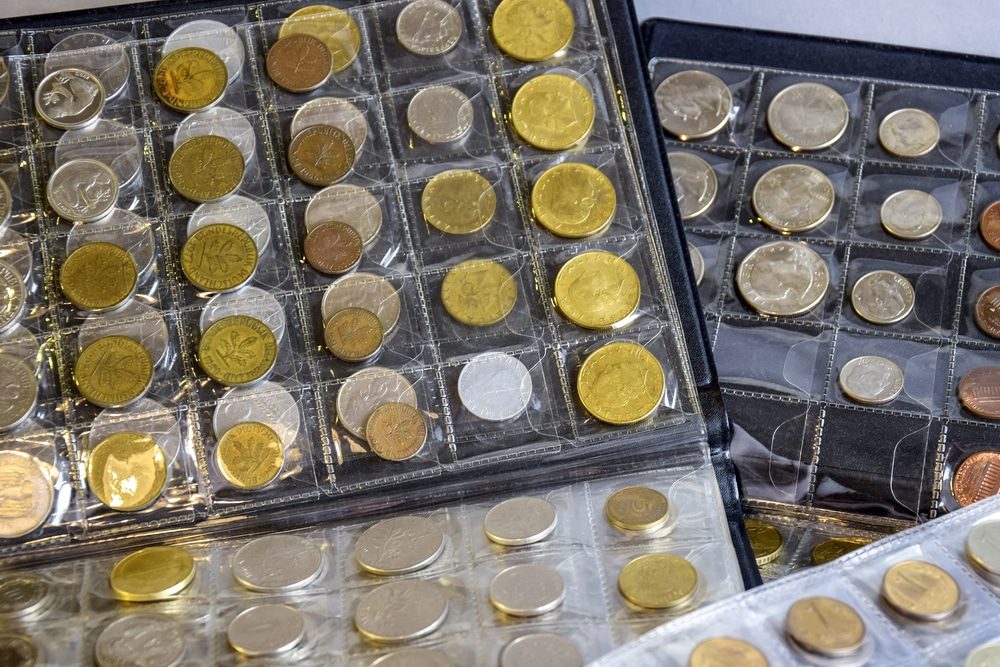
Folders carry the same concern, plus another. A coin pressed into a folder hole shows only one side and leaves the other side exposed to air and to fingers. Many old folders and albums also leached sulfur or acids into the coins they held, which is why so many coins from grandparents’ collections wear rings or patches of color. Sometimes that toning is attractive and sometimes it is dark and blotchy, and nobody gets to choose which. Manufacturers say modern pages use acid-free materials, which helps, but a folder is still a display tool more than a vault.
Albums with slides
Albums with clear plastic slides solved the one-side problem by covering both faces of the coin. They introduced a new one. When a slide is pushed in or pulled out, its edge can drag across the highest points of the coin and leave fine scratches that collectors call slide marks or hairlines. On a sharp uncirculated piece it can cost a grade or more, and collectors have posted stories about coins that were near-perfect until someone slid a panel across them. If you use a slide album, pull the slide out before you seat or remove a coin, and never slide a panel back over a coin that sits proud of the page.
Capsules and tubes
Hard plastic capsules, of which Air-Tite is the best-known brand, are made of rigid acrylic and close around the coin so that both sides are protected and nothing presses on the design. They suit bullion coins you want to keep pristine and proofs that have left their original packaging. Capsules come in sizes matched to specific coins, so buy the one made for yours.
Tubes are built for quantity, not display. They are how mints and wholesalers ship stacks of identical bullion coins, and they are fine for that job. Coins in a tube touch each other face to face, though, so tubes are not ideal for premium uncirculated or proof coins. We cover how mint tubes, monster boxes, and assay cards fit into the bullion supply chain in what bullion packaging tells you.
Slabs
A slab is a tamper-evident hard plastic holder sealed by a grading service, with a label recording the coin’s identity and grade. It is the strongest everyday protection a coin can have, and it also locks in the grade opinion, which is much of its value. Once a coin is slabbed, leave it there. Cracking it out to put it in an album or a flip throws away the certification and exposes the coin all over again. Whether a coin is worth sending for grading in the first place is a separate question, and we walk through it in is it worth getting your coins graded.
Which coin holders are safe for long-term storage?
For coins you plan to keep for years, the safe choices share one trait: they are chemically inert and they don’t rub. In practice that means hard, non-PVC flips or 2x2s with Mylar windows for inexpensive pieces, rigid capsules for bullion coins and raw proofs, and slabs for anything that has been certified. Soft vinyl flips belong in the short-term column, if they belong anywhere. Old cardboard folders and albums are best treated as a way to enjoy a set, not as a place to park valuable coins for a decade.
The type of coin changes the stakes. A silver dollar like the Morgan Dollar lives or dies on the quality of its surfaces, so a single hairline from a slide or a spot of PVC haze can matter a great deal to a collector. A brilliant uncirculated American Silver Eagle bought for its metal is more forgiving, but spotting and haze still make it harder to sell as a clean coin.
A few habits that matter as much as the holder
Even the best holder can’t protect a coin from the room it lives in. Heat, humidity, and stray chemicals speed up every kind of reaction described above, so keep coins somewhere cool, dry, and stable, and away from rubber bands, which contain sulfur. Check stored coins now and then; a haze caught early is a far smaller problem than one found at selling time.
Resist the urge to fix things yourself. If a coin comes out of an old flip with residue on it, a professional conservation service is a far safer bet than a home remedy, and our guide on how to clean coins without destroying their value explains why most cleaning does more harm than good. And remember that holders protect individual coins, not the collection as a whole. Where the boxes go, whether a home safe, a bank box, or a depository, is a different decision, compared in how to store gold and silver safely.
Finally, write things down. A coin in a well-labeled holder, listed in a simple inventory, is far easier for you or your heirs to value and sell later. You can look up the metal content and specifications of the coins you own in our coin database, and if you are ready to sell, our dealer directory lists coin and bullion dealers. Good holders cost little. The damage cheap ones do is the expensive part.