

Most pre-1933 United States gold coins wear their designs proudly on the surface, the way a Saint-Gaudens double eagle does. The little $2.50 Indian Head quarter eagle does the opposite. Its portrait and its eagle sit below the field, sunk into the metal rather than raised above it. Hold one at an angle and the surface looks almost blank until the light catches the recesses. For a coin that passed through ordinary commerce more than a century ago, it remains one of the quietly radical objects the U.S. Mint ever released, and one of the most approachable ways to own a piece of classic American gold.
A gold coin with the design carved inward
The story starts with Theodore Roosevelt’s campaign to make American coinage beautiful again. He had already pushed Augustus Saint-Gaudens to redesign the twenty-dollar double eagle and the ten-dollar eagle. When it came to the smaller gold pieces, a Boston physician and Roosevelt friend named Dr. William Sturgis Bigelow floated an unusual idea: instead of copying the larger coins, why not sink the design into the coin in incuse (recessed) relief? Roosevelt was intrigued by the novelty. Bigelow recommended the Boston sculptor Bela Lyon Pratt for the job.
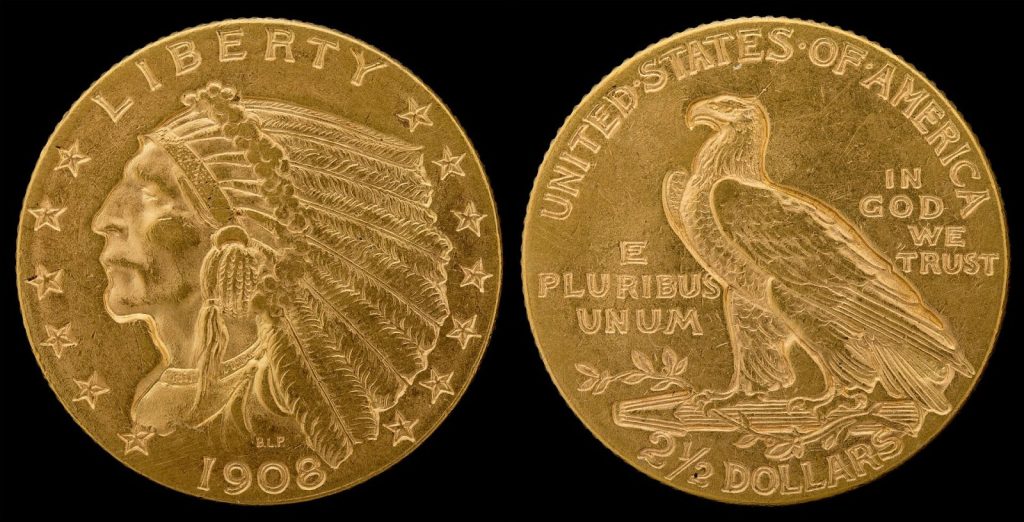
Pratt was a natural pick. He had taken classes from Saint-Gaudens at the Art Students League and worked briefly in his studio, so the new quarter eagle carries a thread back to the same artistic circle that produced the Saint-Gaudens double eagle. Pratt finished his models in January 1908, and the Mint Director quietly reimbursed his $300 fee through Bigelow. The result, struck in both the $2.50 quarter eagle and the $5 half eagle, is unique in the history of American coinage. No raised rim, no raised devices: the lettering and the imagery all lie in sunken relief. To this day they remain the only regularly circulating U.S. coins with recessed designs.
What the Indian Head quarter eagle actually is
The obverse shows a Native American man facing left in a full feathered war bonnet, rendered with a realism that set it apart from the idealized Liberty figures on earlier coins. Just who modeled for the portrait has been argued over for a century. Various names have been attached to it, and the Mint’s own records leave the question open, so any single name you see is better treated as tradition than as settled fact. The reverse carries a standing eagle perched on a bundle of arrows with an olive branch, part of the same 1907 to 1908 wave of eagle imagery that reshaped the larger denominations.
Physically it is a small coin. The Indian Head quarter eagle weighs 4.18 grams, measures 18 millimeters across with a reeded edge, and is struck in the traditional 90 percent gold, 10 percent copper alloy. That works out to roughly 0.12094 troy ounces of pure gold, the same fine-gold content the earlier Liberty Head Coronet quarter eagle carried. With gold trading around $4,400 an ounce in early September 2026, that fractional gold content amounts to a fraction of one ounce of metal value, which is exactly why these coins ended up in pockets and money clips rather than bank vaults.
The years, the mintages, and the key date
Quarter eagles ran from 1908 through 1915, paused for a decade, then returned from 1925 through 1929 before the series ended for good. The companion half eagle ran 1908 through 1916 with a final 1929 issue. The break matters to collectors because it splits the set into an earlier and a later run, and the scarce dates cluster at the edges.
The undisputed key to the quarter eagle series is the 1911-D, struck at Denver with a mintage of just 55,680. It was the only branch-mint issue in the entire quarter eagle run and is by far the toughest date to find. The mintmark itself is famously weak on many examples, so collectors learn to look closely at the D before paying a premium for one. On the half eagle side, the 1909-O from New Orleans (mintage 34,200) and the low-mintage 1929 are the coins that command real money in any grade. Almost everything else in the series is relatively available, which is a large part of the appeal.
The controversy that quietly fizzled
Not everyone loved the sunken design. The Philadelphia dealer Samuel Chapman wrote to Roosevelt to complain that the recesses would trap dirt and germs, that a forger could counterfeit the coin by carving a disc of metal, and that the Native American looked, in his word, emaciated. The germ worry made for lively newspaper copy but never amounted to much in practice. Defenders argued the opposite would prove true: because the highest points of an incuse design are the flat field rather than the raised detail, the imagery is shielded from the worst of circulation wear. More than a century on, that claim has largely held up. Many surviving Indian Head quarter eagles still show crisp detail for coins that did real work.
Where a quarter eagle fits in a holding
This is where honesty matters. A common-date Indian Head quarter eagle is first and foremost a small slug of classic American gold, and its floor is metal value: roughly one-eighth of a troy ounce moving with the spot price. On top of that floor sits a collector premium that reflects the coin’s age, its 90 percent fineness, and the simple fact that it is genuine pre-1933 gold rather than modern bullion. Common dates in circulated grades carry a modest premium over their gold content. The 1911-D and the scarce half eagle dates carry a much larger one that has little to do with the metal and everything to do with rarity. To see how that metal floor is set in the first place, it helps to understand how melt value works.
For a buyer, the practical takeaways are simple. If you want the most gold per dollar, a modern bullion coin such as the American Gold Eagle will always beat a numismatic quarter eagle on premium. If you want a tangible piece of American history that still tracks the gold price, a common-date Indian Head quarter eagle is one of the most affordable pre-1933 gold coins you can buy, and it costs far less to enter than its larger half eagle sibling. Buy the coin for what it is, know whether you are paying for metal or for scarcity, and follow the same basic rules you would with any purchase, and you will not be surprised later.
The Indian Head quarter eagle sits at an unusual crossroads. It is a circulating coin that looks like nothing before or since, tied by its designer to the wider family of Saint-Gaudens era gold, and small enough that ordinary collectors can actually own one. That mix of art, history, and accessible gold content is why, a century after the last one left the presses, people still reach for them. If you are weighing where a piece like this belongs next to modern bullion, the full range of coins we cover is a useful place to compare.