

Ask most Americans when they last spent a fifty-cent piece and you will get a blank look. The half dollar is still legal tender, still struck by the U.S. Mint, and still the largest coin the country makes for circulation. It simply stopped turning up in pockets sometime in the mid-1960s and never really came back.
That absence is the interesting part. For most of the nineteenth century this was the coin that did the heavy lifting in American commerce. Tracing the history of the U.S. half dollar from a hand-struck 1794 rarity to a collector curiosity shows how silver, politics, and plain public habit decide what ends up in a cash drawer.
The history of the U.S. half dollar begins in 1794
The Mint Act of 1792 authorized the denomination, but Philadelphia needed silver on hand and a press big enough to strike it. The first delivery came on December 1, 1794: roughly 5,300 pieces of Robert Scot’s Flowing Hair design, Liberty facing right with her hair loose, a rather thin eagle on the reverse. Another eighteen thousand or so followed in January 1795 from the same 1794 dies, which is why the reported mintage for the date sits near 23,464 even though survivors are scarce. Examples with real detail remaining bring well into six figures at public auction.
Scot’s Draped Bust design replaced Flowing Hair in 1796, paired first with a small eagle reverse that lasted only through 1797. Then the denomination went quiet: no half dollars at all were struck for the 1798, 1799, or 1800 dates. Production resumed in 1801, and from that point the coin’s role in daily commerce grew quickly.
The workhorse years, 1807 to 1891
John Reich, a German-born engraver, gave the coin its Capped Bust design in 1807. These pieces weigh about 13.5 grams at ninety percent silver, and instead of reeding they carry lettering on the edge reading FIFTY CENTS OR HALF A DOLLAR.
Here is the fact that explains everything about the coin’s early importance: the Mint struck no silver dollars at all from 1804 through 1835. For roughly three decades the half dollar was the largest silver coin in American circulation, doing the work a dollar coin would otherwise have done. Silver dollars only came back in force in 1878 with the Morgan dollar, by which time the half had long since settled into second place.
Christian Gobrecht’s Seated Liberty half arrived in 1839 and ran until 1891, the longest single design the denomination has ever had. The New Orleans Mint, which opened in 1838, produced one of the great American rarities almost immediately. Coiner Rufus Tyler recorded that no more than twenty 1838-O half dollars were struck. He got ten good impressions in January 1839 after rigging an extension onto a die so it would fit a medium-sized press, the extension worked loose, and he stopped. Nine examples are confirmed today. It belongs with the other famous rarities collectors chase. Our guide to the U.S. branch mints covers where each mint mark came from.
Barber, Weinman, and a design that outlived its coin
Charles E. Barber’s Liberty Head half ran from 1892 to 1915 and is remembered more for its durability than its beauty. In 1916 Mint Director Robert W. Woolley, under the belief that the law required a new design after twenty-five years, asked the Commission of Fine Arts to hold a competition. The Commission passed over Barber’s own sketches and chose Adolph A. Weinman for both the dime and the half dollar.
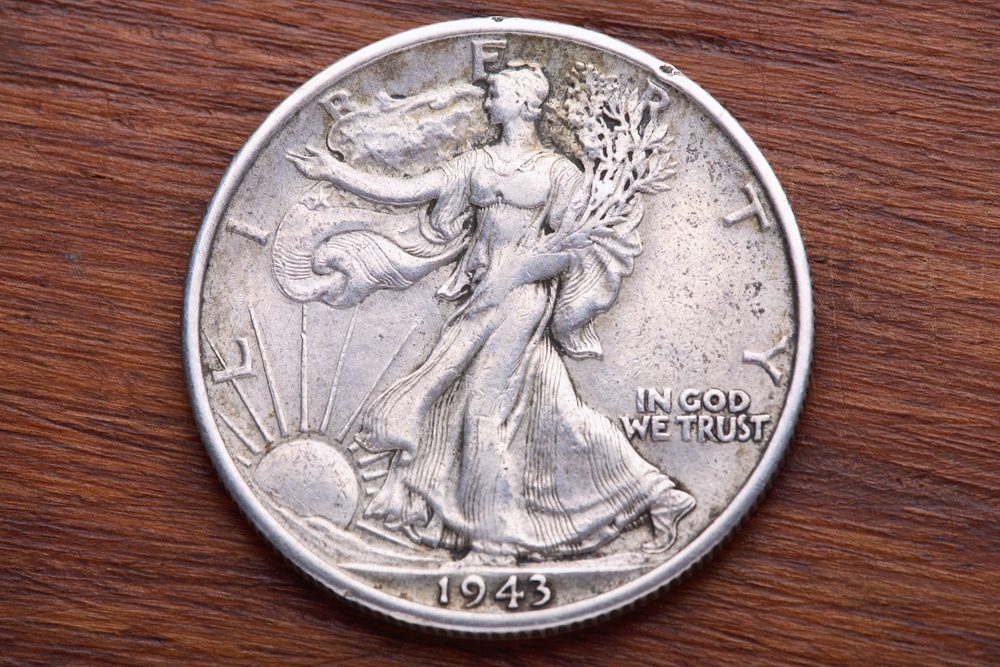
Weinman’s Liberty strides into a sunrise with a branch in her arm and the flag across her shoulder. The relief was high enough to cause fins and uneven thickness at the rim, and working dies were not finalized until late November 1916. The design ran through 1947, with 1921 and 1921-D notably scarce in mint state.
Seventy years later the Mint needed an obverse for its first silver bullion coin and went back to Weinman. Since 1986, a modification of his Walking Liberty, strengthened for the larger format by John Mercanti, has appeared on the American Silver Eagle. Buyers who have never held a Walking Liberty half know the figure anyway.
Franklin’s short run, then November 1963
John R. Sinnock’s Franklin half covered 1948 through 1963: Benjamin Franklin in profile, the Liberty Bell on the reverse with a small eagle tucked alongside it. Sixteen years is a brief career for an American coin design.
President Kennedy was assassinated on November 22, 1963. Congress moved quickly. President Johnson endorsed a Kennedy half dollar on December 10, and the authorizing bill passed on December 30, 1963. Gilroy Roberts cut the obverse portrait and Frank Gasparro adapted the presidential seal for the reverse. Roughly 430 million pieces dated 1964 were struck in ninety percent silver, holding about 0.36 troy ounce of silver each, and the public treated them as keepsakes rather than money. They vanished into dresser drawers about as fast as the Mint could make them.
Silver leaves, and the half dollar goes with it
The Coinage Act of 1965, signed on July 23 of that year, took silver out of the dime and quarter completely and cut the half dollar to forty percent, the only circulating denomination permitted to keep any silver at all. Outer layers of eighty percent silver bonded to a copper-rich core preserved the familiar look, and each coin holds roughly 0.147 troy ounce of silver. Production of the new composition began on December 30, 1965. Those 1965 through 1970 coins largely disappeared from circulation anyway as silver rose. We traced that whole transition and what it left behind in when the U.S. stopped making silver coins, so it is worth reading alongside this one. From 1971 the half dollar has been copper-nickel clad.
The collector-only decades, and a surprise in 2021
The pattern after 1970 is a slow retreat from circulation. The 1970-D was struck only for that year’s mint sets, 2,150,000 pieces. In 1987 both Philadelphia and Denver made halves for collector sets alone, 2,890,758 of them. The last circulating production of the twentieth century came in 2001, and beginning in 2002 the Mint struck the denomination for numismatic buyers only. Cash drawers had no slot for it and banks stopped ordering it.
Then in 2021 the Federal Reserve ordered 2021-P and 2021-D Kennedy halves for general circulation, the first such order since 2001. Whether that was groundwork for getting the coin moving again or a nudge toward collecting has never been spelled out, but the halves exist and some of them did reach tills.
One footnote deserves a mention on a site that pays attention to gold. For the design’s fiftieth anniversary the Mint released a 2014-W Kennedy half struck in three-quarters of a troy ounce of .9999 fine, 24-karat gold, dual dated 1964-2014 and issued on August 5, 2014. A fifty-cent piece in pure gold is an odd object, and it sits closer to the American Gold Eagle shelf than to anything that ever bought a sandwich.
What this past means for a buyer today
Dates matter more here than in almost any other denomination, because three different silver stories sit inside one coin. A 1964 Kennedy carries about 0.36 troy ounce. A 1965 through 1970 Kennedy carries about 0.147. Anything from 1971 forward, outside collector issues struck in silver, carries none. Sorting a jar of halves by date is not busywork, it is the whole job.
Beyond the metal, condition is what separates a common Kennedy from a Walking Liberty or Franklin worth a collector’s attention. Circulated common dates trade on their silver content, and you can follow the metal side on our markets page. Earlier types in genuinely high grade, along with the branch-mint rarities, live in a different market where grade and eye appeal set the terms. Our coin listings are organized by series and metal.
The half dollar never failed. It got too valuable to spend, then too awkward to carry, and the country moved on without it. For anyone holding American silver, the history of the U.S. half dollar makes it one of the more honest coins in the drawer: a denomination that was once the backbone of commerce and is now mostly a record of what silver used to be worth.