
The United States Mint has spent the Semiquincentennial year finding new ways to dress up old favorites, and its latest idea lands on two of the most loved designs in American coinage. On November 5, 2026, the Mint announced a two-coin set pairing a 2026 Morgan silver dollar with a 2026 Peace silver dollar, each struck with a finish the Mint calls “diamond field.” Sales open on November 12 at noon Eastern. Before the order button goes live on the diamond field Morgan and Peace dollars, here is what collectors should understand about the coins, the finish, and how the set fits into a silver holding.
What are the diamond field Morgan and Peace dollars?
The product is a single set holding one Morgan dollar and one Peace dollar. Both coins carry the dual date 1776 ~ 2026 and a small Liberty Bell privy mark bearing the numeral 250, the same anniversary device the Mint has used across its 250th-year lineup. Both were struck at Philadelphia, and coverage from CoinNews and CoinWeek reports a P mint mark on each coin.
The headline is the surface. In the Mint’s announcement, the diamond field finish is “created using laser-engraved tooling” and “produces a distinctive diamond pattern designed to reflect light from multiple angles.” The Mint describes the set as the debut of the finish and frames it as “a unique visual alternative to the traditional proof finish.” CoinWeek reports the Mint’s statement that no previous U.S. coin has carried it.
The Mint has set a product limit of 262,500 sets. At announcement, both CoinNews and CoinWeek reported that no household order limit was listed, though the Mint can and sometimes does adjust limits around launch day. Third-party coverage also notes a certificate of authenticity in the packaging.
How the finish differs from a proof
A modern proof coin is a study in contrast. The fields (the flat background around the design) are polished to a mirror, while the raised devices such as Liberty’s portrait are frosted. Tilt a cameo proof under a lamp and the portrait seems to float over black glass.
Diamond field goes the other way with the background. Instead of a mirror, the field carries a repeating geometric texture, a lattice of tiny facets cut into the tooling by laser. World Numismatic News describes the pattern as engraved into the master tooling so it carries through from the hub to the working dies, and characterizes the look as closer to a cut gemstone than to cameo contrast. The Liberty Bell privy reportedly sits as a smooth, flat device against that textured field, which should make it pop.
Is it a type of proof? No. The Mint presents diamond field as its own finish, separate from proof, uncirculated, and circulating strikes. The announcement also says the process “introduces greater efficiencies in the manufacturing process,” without spelling out what those are. That line is worth noticing. A finish that looks special and is easier to produce at volume is the kind of innovation a mint tends to use again, so this set may be the first of a family rather than a one-off.
The designs underneath the sparkle
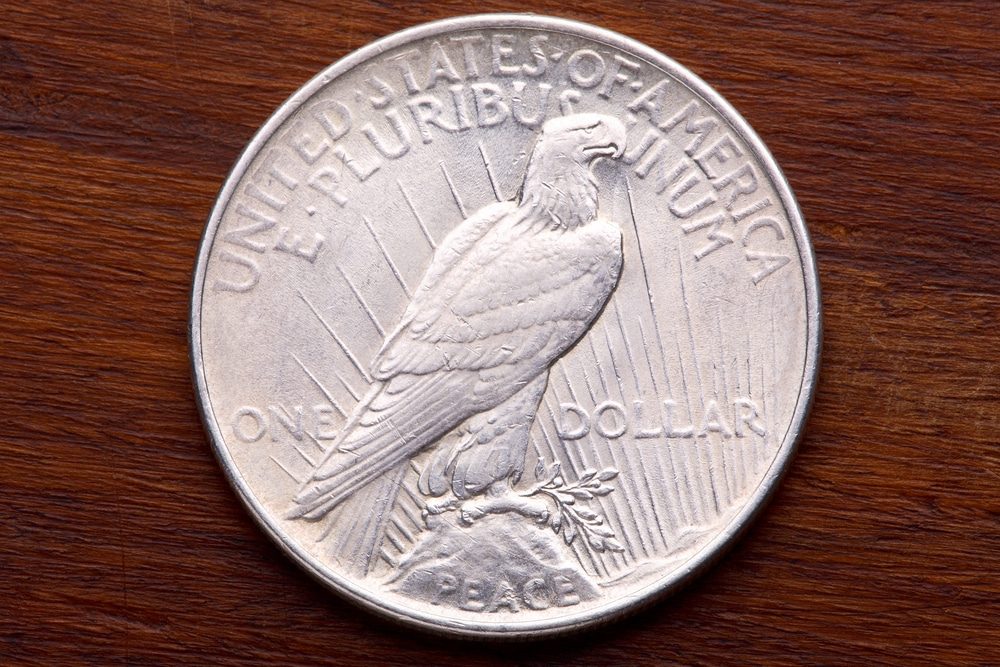
Strip away the finish and you’re holding two designs with long American pedigrees. George T. Morgan, the Mint’s chief engraver at the time, designed both sides of the Morgan dollar, which was struck from 1878 to 1904 and again in 1921. Sculptor Anthony de Francisci designed the Peace dollar, struck from 1921 to 1935 as a postwar coin. Our buyer’s profiles of the Morgan silver dollar and the Peace silver dollar cover the original series, key dates, and why the old coins still anchor so many collections.
The modern versions exist because of the 1921 Silver Dollar Coin Anniversary Act, signed January 5, 2021, as Public Law 116-286. The law called for coins honoring the centennial of the last Morgan and the first Peace dollar, with specifications of 26.73 grams, a 1.500-inch diameter, a reeded edge, and not less than 90 percent silver. The Mint chose to go further and strike them in .999 fine silver, as it explained when the 2021 coins launched. That’s why the new coins carry about 0.859 troy ounce of pure silver apiece, compared with roughly 0.77 ounce in an original 90 percent Morgan. The 2021 releases came with several mint mark and privy variations, and modern Morgans and Peace dollars have been a recurring part of the Mint’s catalog since, with this set adding another variant to the run.
Where this set fits in a silver holding
Honesty matters most here. Together the two coins contain about 1.72 troy ounces of .999 silver. That metal is the floor under the set, and it is a real floor: if silver spot rises, so does the melt value of what is inside the box. You can follow spot on our markets page.
Everything above that floor is collector demand. The Mint sells numismatic products like this one at a price set well above the metal content, as it does across its collector line, and the law that created these coins directs that they be sold at face value plus the costs of design and issuance. A buyer purchasing the set to accumulate silver will get far more ounces per dollar from plain bullion such as the American Silver Eagle. The set can still be a fine purchase; just buy it as a collectible first and a silver holding second, and our rules of gold lay out why the distinction matters when you eventually sell.
Will the set hold its premium on the secondary market? Nobody can know in advance, and anyone who promises otherwise is guessing. A few factors are worth weighing honestly:
- Limit versus demand. A 262,500-set limit is not tiny for a modern Mint product. If the limit is reached quickly, scarcity can support aftermarket interest; if sales linger, the set may trade closer to its metal floor plus a modest premium.
- First-of-a-kind appeal. Debut finishes tend to attract collectors who want the first example of something new. That appeal depends on whether the finish later shows up on other coins or stays rare.
- Taste. Early reader reaction in CoinWeek comments was mixed, with some praising the look and others preferring the classic designs unadorned. A finish people argue about can cut either way.
- Keep it intact. As with most modern Mint collectibles, original packaging and the certificate tend to matter at resale, so keep them together.
If you already collect the modern Morgan and Peace series, the diamond field Morgan and Peace dollars are a natural addition and likely the conversation piece of the run. If you are new to silver and mainly want ounces, start with bullion and come back to the collectibles later. Either way, it helps to see the set in the context of everything else the Mint issued for the 250th, which our guide to the 2026 Semiquincentennial coins pulls together, alongside our look inside the 2026 proof set.
Quick facts
- Contents: one 2026 Morgan dollar and one 2026 Peace dollar, diamond field finish
- Dates and privy: 1776 ~ 2026 dual date, Liberty Bell privy with 250
- Mint: Philadelphia (P mint mark reported)
- Metal: .999 fine silver, about 0.859 troy ounce per coin
- Size: 26.73 grams, 1.500 inches, reeded edge
- Product limit: 262,500 sets
- On sale: November 12, 2026, at noon Eastern from the U.S. Mint
Release details, limits, and timing come from the Mint’s announcement and contemporary coverage, and the Mint occasionally changes them close to launch, so check the Mint’s own product page before you order. For how FMV Gold tracks coin values against their metal content, see how it works.